Category Archives: Food & Recipes

Hot Stuff

I’m finding cooking to be a major antidote to boredom and anxiety during these trying times.  (Unfortunately, so is eating… but that’s a topic for another time.) Recently, our daughter B suggested I write about mustard. Can’t remember what prompted this, but here goes.

Did you know that mustard is one of the world’s oldest condiments? According to my “deep” Internet dive, the Romans used to grind mustard seeds with grape juice (called must) to create a spicy paste known as mustum ardens (“burning must”) in Latin. Travelers brought mustard seeds to Gaul, where they were planted in vineyards alongside the grapes. French monasteries cultivated and sold mustard as early as the ninth century, and the condiment was available in Paris by the 13th century.

autumn-4568733_640

Very simply, mustard is a combination of the ground seeds of the mustard plant and some form of liquid such as water, vinegar, lemon juice, or wine. Different types of each create different varieties: some sweet, some spicy, some eye-wateringly hot. While the level of heat is mostly related to the style of seed—yellow seeds are mild, while brown and black seeds are spicier— it’s the liquid that activates their natural enzymes and determines a mustard’s potency.

These enzymes convert to mustard oil once the seed is broken. The more acidic the liquid, the longer lasting the burn will be; less acidic mustards tend to be quite pungent at first, but quickly lose their punch.

Generally low calorie, especially compared with condiments like mayonnaise, mustard also provides important nutrients. Mustard leaves contain significant amounts of calcium, vitamins A, C, K, and copper, while the seeds are rich in fiber, selenium, magnesium, and manganese.

shelf-4499973_640

What follows is adapted from an article at spoonuniversity.com, which includes recipe suggestions.

YELLOW mustard (aka ballpark mustard) is the most basic. Made from yellow mustard seeds and vinegar, it gets its yellow color from turmeric. It’s one of the mildest types of mustard, popular on hot dogs and other sandwiches.  I think of it as “starter” mustard.

DIJON takes mustard to the next level. White wine is used instead of vinegar, and the seeds are brown rather than yellow.  This results in a complex flavor with more of a bite, perfect for salad dressing, potato salad, and sauces for fish and chicken.

SPICY BROWN mustard is made with coarsely-ground brown mustard seeds that offer more heat than classic yellow or Dijon, along with turmeric and a combination of spices such as allspice, ginger, cinnamon, and nutmeg. Commonly found in delis, the warm flavor goes beautifully with meat.

Too tame? HORSERADISH MUSTARD packs even more heat.

HOT MUSTARD You’ll find this searingly hot mustard in most Chinese restaurants. What makes it so brutally strong is that brown or black mustard seeds are mixed with water. These seeds are naturally more pungent than yellow seeds, due to their alkaline nature. An acidic liquid– like the vinegar used in yellow mustard — would calm that natural heat, while water’s neutral ph lets it go roaring forth.  Your sinuses know what I’m talking about.

WHOLE GRAIN This is more of a manufacturing process than a type of mustard—as the name suggests, the seeds are essentially whole. Type of seeds and mixing liquid can vary, with most brands available in the store featuring brown mustard seeds mixed with white wine.  Expect a flavor similar to that of Dijon with a coarser texture that pairs well with cheese, potato salad, and sandwiches.

STONE GROUND mustard is the middle ground between smooth Dijon and the chewiness of whole grain. Most commonly, brown seeds are ground between two stones in the form of a mortar and pestle. This type of mustard is typically made with vinegar, and has a little more heat than yellow mustard with less spice than brown mustard.

HONEY MUSTARD is both sweet and tangy and works well in salad dressing, especially to soften the taste of bitter greens such as kale. You can whip some up yourself by mixing your mustard of choice with honey in a 1:1 ratio. Use half as much honey if you prefer less sweetness than commercial brands.

Do you have a favorite type? Or a recipe to share?


Good News Monday: Rotten Luck

Garbage: it’s not just for landfills anymore! A company in New York City has created an all-purpose cleaner made from 97% food waste plus 3% sustainably sourced natural fragrance. Lab tests indicate that it’s 99% effective at cleaning tough dirt from multiple surfaces.

Rather than adding water — which accounts for as much as 90% in most household cleaners — all the liquid in this product is directly derived from the recycled food waste.

And instead of a plastic spray bottle that might or might not get recycled, the product comes in a refillable aluminum bottle.

How’s that for cleaning up a mess?

woman standing holding chopping board

Photo by mentatdgt on Pexels.com


Gobble, gobble: US Edition

Happy Thanksgiving, dear US readers!

If you’re wondering what wine to bring or serve with turkey, here are the top suggestions, according to a search of the all-knowing Internet:

  • Chardonnay.
  • Pinot Noir.
  • Viognier.
  • Gamay.
  • Dry Riesling.
  • Zinfandel.
  • Champagne.

Plus, a few hints to avoid overeating today — or at any large holiday meal this season:

  1. Your brain can only crave 3 or 4 things at a time.  So decide what you most want to eat, instead of trying a little bit of everything.  If you go back for seconds, that’s the time to sample other foods — you’ll eat a lot less.
  2. Experts say that a serving is the size of your loosely held fist, not the entire plate.
  3. Eat slowly and stop after 10 minutes to let your brain register whether you’re satisfied. After a five-minute break, you may find that you don’t want much more.
  4. Plan ahead to “save” room for dessert, rather than “making” room for dessert; ie, be sure you’re actually still a bit hungry.

Wishing you a wonderful holiday, however you’re spending it! xx, Alisa

bread food plate light

Photo by Element5 Digital on Pexels.com

Good News Monday: Where’s The Beef?

Did you ever wonder what “sustainably produced beef” actually means? According to the World Wildlife Fund, there’s a big difference between cattle ranching where the intact grassland ecosystem is compatible with grazing — such as the Northern Great Plains in the US — and in parts of the world where forests are converted to pasture.

Costco to the rescue! Collaborating with the WWF, ranchers and others, the Northern Great Plains Sustainable Beef Pilot Project — now, there’s a mouthful — is working towards greater transparency so that consumers will know just what they’re eating and understand its environmental impact.

Dare I say the “steaks” are high?

selective focus photography of beef steak with sauce

Photo by Snapwire on Pexels.com

…But Liquor is Quicker

Anyone else remember the saying, “Candy is dandy but liquor is quicker”? The expression is a quote from American poet Ogden Nash’s 1931 poem, “Reflections on Ice Breaking”.  It also appeared in the 1971 movie, “Willy Wonka & the Chocolate Factory”.

In honor of Halloween, I’m sharing the following.  My commentary below in red.

HOW TO QUIT CANDY AFTER HALLOWEEN

Weaning yourself off the good stuff once and for all.

By: Noah Lehava

There were tons of reasons Halloween was the best holiday as kids. One, you got to walk around all night in a ridiculous outfit, holding big bags that strangers would just throw full-sized candy bars into. Two, you’d have a cache of Starburst and Reese’s to last you weeks (or months, if you had a parent moderator). Three, your metabolism (and energy) and general lack of nutritional knowledge meant the guilt of stuffing your face with one last mini Snickers before bed didn’t exist. But alas, we’re adults now, which means we know that eating piles of candy isn’t actually all that good for us. That’s not to say we’re expecting you to avoid itty-bitty bags of sugary stuff all Halloween week long (that’s a thing, right?). But the struggle to quit sugar post-indulgence is real. Which is why we’ve come up with a few ways to wean yourself off the good stuff (in the palate sense).

GO FOR THE COMBO

This technique is what we like to call step one of the recovery process. When you really just want to pile M&Ms into your mouth until your stomach hurts, instead, eat or drink something healthy, like a green tea and vegetable-loaded salad for lunch, then finish it off with a bite of candy. You’ll be full from the nutrition-packed meal, but have just enough sugar-coated chocolate on your palate to satisfy a craving.

To go one step further, try drinking a combination of 1 part orange juice to 7 parts water.  There’s just enough sweetness to satisfy cravings, and the water fills you up. This is also great to have in the morning — often what we think is hunger is actually thirst, especially after fasting all night while we’re sleeping. You might not even crave those pancakes!

THE SWAP-OUT

We all know that the really bad stuff in candy is the added sugar (and, OK, there’s other stuff in there, but let’s not get too technical). But good sugar, fructose, by way of fruit, is an easy way to crush cravings, plus you’ll be filling up on the extra stuff in fruit like water, fiber, and, you know, actual nutrients.

Sugar is sugar. It’s generally better to avoid it, and satisfy the urge for sweetness with carrots, red or yellow peppers, etc. Experts suggest that it’s best to eat fruit with your meal rather than in-between.  And choose whole fruit, not juice.

SNACK

Not on candy! Waiting too long between meals and the impending hunger that comes with that will have you reaching into the plastic pumpkin every ten minutes. Eating regularly throughout the day keeps your blood sugar level stable—aka no crazy, irrational cravings.

Disagree! True hunger is actually a good thing — it tells you that your body needs sustenance. If you eat a satisfying meal (eg lunch) that includes lean protein, you should not be physically hungry for around 5 hours.  What we think of as mid-morning or mid-afternoon “hunger” is often anxiety, boredom, or another emotion.  Rather than eating, do something to distract yourself, such as taking a short walk. The brain can’t hold on to cravings for very long.

If it’s late afternoon, and you know you won’t be having dinner for a few hours and are starting to feel real hunger, try eating a handful of nuts (slowly) to help avoid temptation. But don’t beat yourself up if you can’t resist an occasional peanut butter cup.

HAPPY HALLOWEEN, dear readers!

light landscape sky sunset

Photo by Pixabay on Pexels.com

Good News Monday: When Bad Food Happens to Good People

I thought this was so clever: a simple way to tell if food has gone off, without having to guess, sniff, or rely on a (frequently unreliable) sell-by date.

Developed by researchers in London, paper-based electrical gas sensors (“PEGS”) can detect spoilage gases like ammonia and trimethylamine in packaged fish and chicken.

Smartphones can read the data, so you simply hold your phone up to the packaging to learn whether a food is safe to eat.

In lab tests, PEGS identified trace amounts of spoilage gases more accurately than existing sensors.  And since they’re much cheaper to manufacture, the hope is that once PEGS are widely used, the savings for retailers might get passed along to the rest of us as lower food costs.

shopping-2613984_640


No More ‘Sniff Tests’: Cheap Biodegradable Sensors Can Tell Smartphones When Food Has Gone Bad

Kitchen Confessions

Live long enough, cook long enough, and you’re bound to make a few mistakes along the way.  Last week I may have surpassed myself.

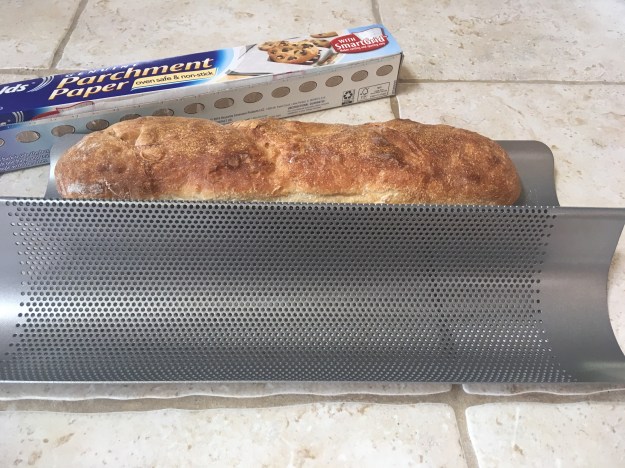
Lately, I’ve been baking bread using a perforated double loaf pan.  They can be hard to clean, so instead of putting the dough directly on the pan I first place a sheet of parchment paper on top.  The paper tends to slide around, so I weigh each side down with something to keep it in place until the dough goes on it.

IMG-1274 (1).JPG

For last week’s French bread, I weight one side with an apple and the other side with a paring knife until I’m ready to put my dough down on the paper-covered pan. I let them rise and bake as usual.

Both loaves of bread look good, although I do notice a groove on the bottom of one loaf when I take them off the paper to cool.

Cue the music: “Dumb, da dumb dumb”….

I remove the paper and discover my paring knife… not in the bread, but under the paper, melted directly onto the loaf pan where it is stuck for all eternity! Of course, my loaf pan/knife combo has to be thrown away and both items replaced ASAP.

I still can’t figure out how this happened.

oops-1444975_640.jpg


Good News Monday: Pretty Delicious

ruby-chocolate.jpg (5184×3456)There’s a new chocolate in town and it’s a natural Millennial pink. I learned about this from blogger Sandra Wood, who also offers up an interesting post on the color most likely to land you a job.  (Hint: It’s not pink.)

But, I digress. According to Wikipedia,

Ruby chocolate is a variety of chocolate introduced in 2017 by the Callebaut cocoa company. It’s been in development since 2004, but was only recently unveiled to the public.

The chocolate is made from the “ruby cocoa bean (possibly, unfermented cocoa beans, which can be naturally reddish pink), with a taste described as “sweet yet sour”, and having “little to none” of the cocoa flavor traditionally associated with other types of chocolate.

In April 2018, Kit Kat announced the release of the ruby chocolate in the UK — have any of you UK readers tried it yet? — and we can expect to see ruby chocolate soon in the US.

Trend? Or a new staple we never knew we needed?

Booze News

In honor of the coming weekend, and on the off chance that alcohol may be involved, here are a few items I found interesting this week.

First up, I’m sharing a hack from KellysDIY blog on improving the taste of cheap vodka.  Haven’t tried this myself but it’s an intriguing idea:

Pour your cheap vodka into a water filter pitcher.  It will remove the impurities that make inexpensive vodka taste, well, cheap.  

mountain ranges covered in snow

Photo by Denis Linine on Pexels.com

Another great tip: Baking soda removes wine stains.

red wine

Photo by rawpixel.com on Pexels.com

Speaking of wine, the industry’s latest annual report cited some millennial trends that will impact not just this age group (currently 23-38) but the rest of us, too, as winemakers take notice. Cheers to healthy wines at a reasonable price!

Millennials:

  1. Tend to prefer craft beers, spirits (e.g., whiskey) and/or cannabis to wine
  2. Less interested in accumulating “stuff”; experiences mean more
  3. Health oriented (wine’s competing with kombucha, for heaven’s sake!), which means a preference for wine that’s organic, sustainable and local
  4. Don’t have a lot of money. They’re still dealing with fallout from the 2008 recession, student loans, and establishing themselves in their careers
  5. Want their drinking experience to be fun (hence the appeal of inventive cocktails and entertaining mixologists), not precious or snobby
  6. Turned off by pretentious tasting rooms (and high prices) they associate with their parents
  7. Inclined to reject “safe” choices like pinot and chardonnay in favor of something unexpected. (Barrel-aged sauvignon blanc, anyone? Oenologists describe this rare specialty as having a creamier texture and more rounded lemony/crème brûlée flavors than flinty Sancerre or herbaceous New Zealand offerings.)

Are you a millennial? Do you agree with these general observations?

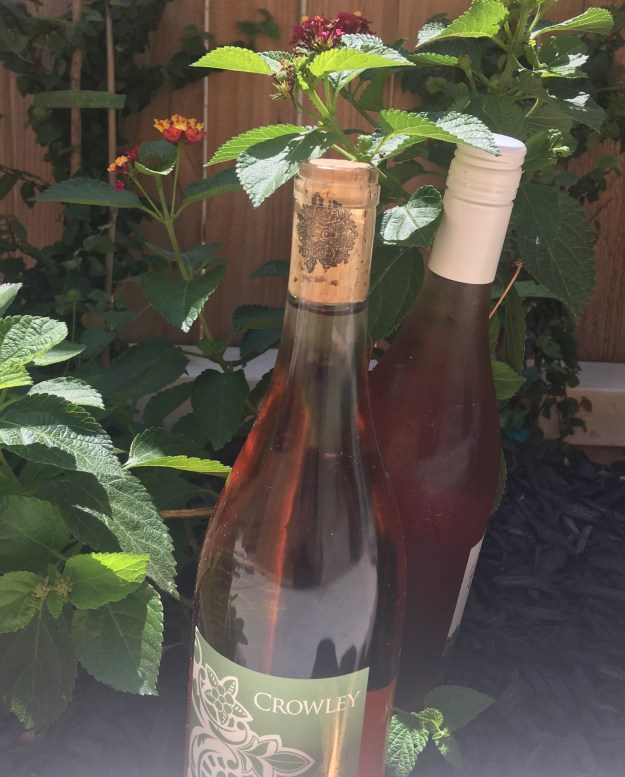
Incidentally, did you know that rosé is the fastest growing wine segment in the US?  If you’re of the generation that grew up on Mateus and have shunned them ever since, one of Oregon’s lovely, fresh, pinot noir rosés will be a revelation.

IMG-1200

(front) Crowley Wines; (back) Coleman Vineyard’s Cherry Cove

And finally, some fun facts:

  • Milkshakes originally contained alcohol.
  • Red wines have higher alcohol content than white wines.
  • Moonshine accounts for around 30% of the world’s alcohol drinking.
  • A bottle of champagne contains 90 PSI of pressure — three times the pressure in your car tire.
  • A gin & tonic will glow under a UV light because tonic contains quinine, which is UV light reactive
  • Fear of an empty glass has a scientific name, Cenosillicaphobia.


Souper Sunday


As I write this, my DH (dear husband) is creating something he calls “Clear Out The Refrigerator” Soup. We’re at the start of a two-day cold snap, which calls for gloves, turtlenecks and something warm, comforting and low-calorie to eat.

Pretty much anything edible can be turned into soup.  In this case, we’ve been stockpiling withered vegetables, accidentally frozen herbs, and most of a large box of chicken broth. It either needs to become soup or compost.

Making soup couldn’t be simpler, even for you non-cooks out there.

  1. Chop up an onion, a couple of garlic cloves, some celery and some carrots. This will be your mirepoix (“meer-pwah”).  Sauté them with a little olive oil in a large pot.
  2. Roughly chop the rest of your ingredients and throw them in. Today’s haul includes carrots, turnips, some kale, some collard greens, mysteriously frozen basil, some dill, red potatoes and a can of garbanzo beans (aka chickpeas) without the liquid. Quantities don’t matter.
  3. Cover with liquid: approximately half chicken or vegetable stock, and half water.
  4. Simmer on low heat for a couple of hours until vegetables start to soften. Add water if it’s getting too thick (more like a stew than a soup).
  5. Season to taste with salt and fresh pepper. Add ground herbs such as oregano and rosemary for more flavor.

Here, DH and I diverge.  He likes the individual tastes of the separate veggies in broth. I prefer using an immersion blender to purée them to a texture resembling pea soup.

Either way, simmer until the flavors blend, re-checking and adjusting your seasoning as needed. Add a hunk of crusty bread, some cheese and a glass of wine. Voilà: dinner!

IMG-1124