Tag Archives: bloggers 50+

Boredom: The Flip Side of Anxiety

An interesting parenting column in today’s New York Times has me thinking about whether boredom is just another name for stress dressed in sweatpants. Although not a parent of small children anymore, I can certainly relate to the excruciating sameness we are all experiencing. It’s also combined with the inability to meet some of our basic human needs such as anticipation, order and control, and touch.

Wherever possible, it’s helpful to search out little ways to feel happier. Could be planning a trip, varying your routine even if only to get takeout from somewhere new, moving some furniture around, calling a friend rather than emailing, etc. But let’s not get all Pollyanna about this — the seemingly-endless pandemic sucks. Read on!

Credit…Moritz Wienert
Jessica Grose

By Jessica Grose April 7, 2021 Updated 2:57 p.m. ET

Before the pandemic, I found comfort in the routine of my life and the rhythms of my family — what Nora Ephron once called the “peanut-butter-and-jellyness” of days with children. I liked the morning thunderdome of getting the children dressed and fed and breaking up some fights along the way, dropping them at school and taking the 20-minute walk to the subway. When I got off the subway, I had an array of coffee shops to choose from, which at the time did not seem exciting, but after a year of pandemic isolation would probably feel like bungee jumping.

At this point my commute is the five feet from my bed to my desk, and I am somehow both tired and agitated when I start work each day. My kids never leave the house, except when we go to the same three parks in our neighborhood. Sometimes when I go running outside, I fantasize about just … not stopping, my eyes thirsty for some new horizon.

In other words, I’m so freaking bored.

I’m not the only parent — or nonparent, to be sure — having trouble with the monotony of this moment. A study conducted early in the pandemic of more than 4,000 French people found that though respondents felt an increase of stress and fear, they mostly experienced a “slowing down of time” that was attributed to boredom and sadness.

“I’ve particularly struggled with boredom this year, in fact it resurfaced so many of the mixed emotions of maternity leave for me, feeling lonely and bored but simultaneously guilty for not treasuring every moment with my daughter,” said Jenny Brewer, the mom of a toddler in London. She said she feels her brain cells “ebbing away,” and like she’s not achieving anything at work. “I am so used to organizing days out and time with friends and family, that when it was taken away I was at an utter loss for how to kill the hours,” she said.

The way Ms. Brewer describes boredom is actually very close to the way boredom researchers — yes, there are boredom researchers — have defined the emotion. “‘Feeling unchallenged’ and perceiving one’s ‘activities as meaningless’ is central to boredom,” according to a study by Wijnand Van Tilburg, an experimental social psychologist at the University of Essex in England.

Or, as Leo Tolstoy put it, boredom is “the desire for desires.”

“The bored person does want to do something quite desperately, but does not want to do anything in particular,” said John D. Eastwood, an associate professor of clinical psychology at York University in Toronto, and co-author of “Out of My Skull: The Psychology of Boredom.” Boredom is distinct from apathy, because if you’re apathetic, you don’t want to do anything at all — but if you’re bored, you’re both restless and lethargic, Dr. Eastwood said.

Even in normal times, boredom is a very common emotion — a study of almost 4,000 American adults found that 63 percent felt bored at least once in a 10-day sampling period. While most cases of boredom are mild, chronic boredom can metastasize into depression, poor health behavior like drug use, or risk-taking behavior, said Dr. Van Tilburg. The causes of boredom are multifaceted, but a lack of control over your situation is a common one. He added, “There’s research that shows when you’re limited in your control over the situation — that intensifies boredom.”

Parents of very small kids may find our pandemic lot particularly stifling because it’s both repetitive and involuntary — we have no choice about keeping up the routines for our little ones, who cannot do things for themselves. Emily Lyn-Sue, a stay-at-home mom of two in Miami, said that while her husband and older son have outlets outside the home with work and school, she feels isolated and bored at home with her 3-year-old. “We speak an entirely different language that no one else understands. We are literally on an island alone, together — he is my Wilson and I am his Tom Hanks,” she said, referring to the relationship Hanks’ character develops with a volleyball while shipwrecked in the movie “Cast Away.”

Knowing that many of us may not be able to have much control over our movements for at least the next few months, how do we try to alleviate our boredom? First, the researchers I spoke to said it’s important to acknowledge there’s no easy fix for our doldrums — so much of what is happening right now is beyond our control, and the vaccines are just beginning to be tested in children under 12, so we may not be able to make big moves just yet.

That said, there are small changes you can make to break the monotony. James Danckert, a professor of psychology at the University of Waterloo in Ontario and the co-author with Dr. Eastwood of “Out of My Skull,” said that because boredom can result from a lack of control over your life, finding even small ways to assert your agency can make you feel more engaged. For me, that means sometimes walking to a restaurant in the neighborhood to pick up lunch rather than making myself the same sad desk salad every workday.

Dr. Danckert also suggested finding some joy in the minutiae of a regular activity; he quoted Andy Warhol, who said, “You need to let the little things that would ordinarily bore you suddenly thrill you.” To be honest, I have struggled with this approach. When I took my younger daughter to a place we call “toy park” — a park filled with discarded and half-broken toys, which she loves — I tried paying close attention to the interactions of the children and the interplay of light from the spring sun breaking through the trees. But boredom won out, and I ended up looking at Twitter.

One bit of advice that resonated more with me came from Dr. Van Tilburg, who emphasized that boredom doesn’t just have to be a negative thing — it can also be a wake-up call encouraging you to find activities that are more meaningful.

I am by nature sort of a hermit, but pandemic isolation has stretched the limits of my introversion. This weekend, we saw relatives I adore for an outdoor Easter egg hunt. Just 90 minutes of warm interaction with these beloved adults made me feel so happy and alive that I was smiling for the rest of the day.

As the weather gets warmer here in the Northeast and more of my peers are inoculated, I am planning more get-togethers, with and without my kids. Whenever I drop back into the doldrums among those discarded toys, I will think about all the walks and dinners and hugs on the horizon.

Good News Monday: Bye-Bye Baldness

And did you know that shorter men are more likely to be prematurely bald? That seems very unfair.

Photo by Andrea Piacquadio on Pexels.com

Cure for baldness may be coming after discovery of a protein that fuels hair growth

by Study Finds

CAMBRIDGE, Mass. — A scientific discovery may make the “comb over” a thing of the past for people losing their hair. Harvard researchers say a cure for baldness is on the horizon after scientists uncovered a protein that fuels hair growth.

The breakthrough could lead to a cream that fuels an unlimited supply of locks for the follicly-challenged. In experiments, mice successfully sprouted three times as many hairs by surgically removing their adrenal glands. The small organs above each kidney release the stress hormone corticosterone, the rodent equivalent of cortisol. This stops the protein GAS6 in its tracks.

Stress reactions such as worry, anger, and anxiety have long been connected to male pattern baldness. Researchers even estimate about a quarter of COVID-19 survivors suffer hair loss due to the shock of infection.

“Stress hormones suppress growth in mice through the regulation of hair follicle stem cells,” says professor of stem cell and regenerative biology and study corresponding author Ya-Chieh Hsu in a statement to SWNS.

The study, appearing in the journal Nature, identifies the process that underpins hair loss for the first time and reveals how to reverse it.

“Chronic, sustained exposure to stressors can profoundly affect tissue homeostasis, although the mechanisms by which these changes occur are largely unknown,” researchers write in their report.

“The stress hormone corticosterone—which is derived from the adrenal gland and is the rodent equivalent of cortisol in humans—regulates hair follicle stem cell (HFSC) quiescence and hair growth in mice.”

Turning back the clock on hair’s lifespan

Study authors explain the hormone regulates dormancy and activity of hair follicle stem cells (HFSCs) in mice. In the absence of systemic corticosterone, the little cavities where each hair grows enter substantially more rounds of the regeneration cycle throughout life.

“When corticosterone levels are elevated, hair follicles stay in an extended rest phase and fail to regenerate,” Prof. Hsu tells SWNS. “Conversely, if corticosterone is depleted, hair follicle stem cells become activated and new hair growth occurs.”

An analysis discovered corticosterone suppresses production of GAS6. In the absence of the hormone, it boosts proliferation of hair follicles.

“Restoring the expression of GAS6 could overcome stress-induced inhibition of hair follicle stem cells – and might encourage regeneration of growth,” Prof Hsu notes. “It might therefore be possible to exploit the ability of HFSCs to promote hair-follicle regeneration by modulating the corticosterone–GAS6 axis.”

Throughout a person’s lifespan, hair cycles through three stages, growth (or “anagen”), degeneration (“catagen”), and rest (“telogen”). During anagen, a follicle continuously pushes out a hair shaft. In catagen, growth stops and the lower portion shrinks, but the hair remains in place. During telogen, it remains dormant.

Under severe stress, many hair follicles enter this phase prematurely and the hair quickly falls out. This lifespan is much shorter in the corticosterone-free mice than controls; less than 20 days compared with two to three months.

Curing hair loss due to stress

Their follicles also engaged in hair growth roughly three times as often. However, researchers restored their normal hair cycle by feeding the subjects corticosterone. Interestingly, when they applied various mild stressors to the controls for nine weeks, corticosterone rose and hair stopped growing. These stressors included tilting their cage, isolation, crowding, damp bedding, rapid lighting changes, and restraining. Injecting GAS6 into their skin reinitiated hair growth with no side-effects.

“These exciting findings establish a foundation for exploring treatments for hair loss caused by chronic stress,” adds Prof. Rui Yi, a dermatalogist at Northwestern University and not involved in the study.

The study also reveals GAS6 increases expression of genes involved in cell division in HFSCs.

“So, the authors might have uncovered a previously unknown mechanism that stimulates HFSC activation directly by promoting cell division,” Prof Yi continues. “In aging skin, most progenitor cells harbor DNA mutations – including harmful ones that are often found in skin cancers – without forming tumors.

“It will be crucial to see whether forced GAS6 expression could inadvertently unleash the growth potential of these quiescent but potentially mutation-containing HFSCs,” Yi concludes. “Modern life for humans is inevitably stressful. But perhaps, one day, it will prove possible to combat the negative impact of chronic stress on our hair, at least – by adding some GAS6.”

The Ingrate

This was a first: a Dear John letter from our landscaper, a vendor with whom we’d had a cordial, mutually respectful eight-year relationship.

To paraphrase: “Dear ___ (yes, a form letter), this has been a challenging year so we’ve decided to cut back on the number of clients we service. Unfortunately, you are among them.”

What he doesn’t bother to mention (because it’s a form letter) is that for the past 14 months we have been paying our monthly contractual fee EVEN THOUGH THEY HAVEN’T DONE ANY WORK. Sorry, am I shouting?? In what universe is it ok to accept over $1000 for services not rendered and then not even have the courtesy to acknowledge our loyalty or pick up the phone to work out a solution?

So much for trying to be supportive of a small business. You know that old adage, “No good deed ever goes unpunished”? ARRGGGHHHH.

Photo by Steve Johnson on Pexels.com

Good News Monday: Something Writers Always Suspected

writing paper
(Credit: Karolina Grabowska from Pexels)

(From Studyfinds.org)

Writing on paper triggers more brain activity than using a tablet or smartphone

by Chris Melore

TOKYO, Japan — As digital devices become an everyday part of society, many probably view a pen and paper as things of the past. Despite the ease of tapping information into a smartphone or tablet, a new study finds you may want to keep those paper notebooks after all. Researchers in Tokyo have discovered that people writing notes by hand display more brain activity than their peers entering data into an electronic device.

A team from the University of Tokyo adds the unique and tactile information that comes from writing things on paper may also help writers remember the information better.

“Actually, paper is more advanced and useful compared to electronic documents because paper contains more one-of-a-kind information for stronger memory recall,” says corresponding author and neuroscientist Professor Kuniyoshi L. Sakai in a university release.

“Our take-home message is to use paper notebooks for information we need to learn or memorize.”

The pen is mightier than the tablet?

It’s a common belief that digital devices help people complete tasks faster. Despite this, the study finds people writing notes by hand actually finished their task 25 percent quicker than tablet users.

Researchers add that paper notebooks also contain more complex spatial information than a digital screen. Physical paper allows the writer to add tangible permanence to their important information. Writers can also use irregular strokes to convey special meaning and uneven shapes — like a folded corner of a page. Study authors say “digital paper” is much more uniform. There is no fixed position when scrolling and the information disappears from view when users close the app.

What happens to the brain when you write on paper?

The study gathered 48 volunteers to read a fictional conversation between two people talking about their future plans. The discussion included 14 different class times, assignment due dates, and scheduled appointments. Researchers also sorted the participants — all between 18 and 29 years-old from university campuses or the NTT Data Institute of Management Consulting — into three groups, according to memory skills, personal preferences of digital or paper methods, gender, and age.

The groups then recorded the fictional schedules using a paper notebook and pen, a calendar app using a tablet and stylus, or an app on a smartphone using the touch-screen keyboard. The participants did not take extra time to memorize the information after completing the task.

After a one-hour break and an “interference task” to distract the volunteers from thinking about their notes, researchers gave participants a test on the conversation. The multiple choice questions also ranged in difficultly from simple to more complex. Simple questions asked “when is the assignment due?” while others included “which is the earlier due date for the assignments?”

During this test, study authors examined brain activity using functional MRI (fMRI) scans. During this procedure, scientists say increased blood flow in specific brain regions is a sign of higher neuronal activity.

The results reveal young adults using paper completed their note-taking in just 11 minutes. Tablet and smartphone users finished in 14 and 16 minutes, respectively. Volunteers using pen and paper also scored higher on the multiple choice test. However, researchers say the participants’ brain activity reveals even greater differences.

Volunteers using paper displayed more brain activity in areas with a connection to language and imaginary visualization. They also show more activity in the hippocampus, a brain region vital to memory and navigation.

Writing on paper may also be better for kids and creativity

Study authors say the fact that writing on paper triggers activity in the hippocampus shows analog methods contain richer spatial details which make hand-written notes easier to remember.

Digital tools have uniform scrolling up and down and standardized arrangement of text and picture size, like on a webpage. But if you remember a physical textbook printed on paper, you can close your eyes and visualize the photo one-third of the way down on the left-side page, as well as the notes you added in the bottom margin,” Sakai explains.

The team notes that it is possible to personalize digital documents, using highlighting, underlining, circling, and drawing arrows. People who prefer a digital pad can even leave virtual sticky notes that mimic analog-style spatial enrichment.

Although the experiment only included young adults, researchers believe the link between paper writing and brain activity will be even stronger in children.

“High school students’ brains are still developing and are so much more sensitive than adult brains,” Sakai adds.

“It is reasonable that one’s creativity will likely become more fruitful if prior knowledge is stored with stronger learning and more precisely retrieved from memory. For art, composing music, or other creative works, I would emphasize the use of paper instead of digital methods.”

The study appears in the journal Frontiers in Behavioral Neuroscience.

The Pandemic Oscars

I see the Oscars are coming up next month, and I’m baffled: Did anyone actually make any movies in 2020? I know I didn’t set foot in a theater all year.

Well, hats off to whichever intrepid souls did any filming. Here’s my list of nominees:

Home Alone: 19

The Loneliness of the Long Distance Runner

Toilet Paper Story

Apocalypse 2020

The Unsocial Network

The Adventures of Han, Solo

The Do-Over

CasaVacia (The Empty House)

Big Night In

12 Billion Angry Men

Sleepless in Seattle, London, Paris, and Barcelona

Raging Bulls***

The Six-Foot Journey

What are yours, dear readers?

Good News Monday: A Cancer Vaccine?

BERLIN (AP) — The scientist who won the race to deliver the first widely used coronavirus vaccine says people can rest assured the shots are safe, and the technology behind it will soon be used to fight another global scourge — cancer.

Ozlem Tureci, who co-founded the German company BioNTech with her husband, was working on a way to harness the body’s immune system to tackle tumors when they learned last year of an unknown virus infecting people in China.

Over breakfast, the couple decided to apply the technology they’d been researching for two decades to the new threat, dubbing the effort “Project Lightspeed.”

Within 11 months, Britain had authorized the use of the mRNA vaccine BioNTech developed with U.S. pharmaceutical giant Pfizer, followed a week later by the United States. Tens of millions of people worldwide have received the shot since December.

“It pays off to make bold decisions and to trust that if you have an extraordinary team, you will be able to solve any problem and obstacle which comes your way in real time,” Tureci told The Associated Press in an interview.

Among the biggest challenges for the small, Mainz-based company that had yet to get a product to market was how to conduct large-scale clinical trials across different regions and how to scale up the manufacturing process to meet global demand.

Along with Pfizer, the company enlisted the help of Fosun Pharma in China “to get assets, capabilities and geographical footprint on board, which we did not have,” Tureci said.

Among the lessons she and her husband, BioNTech chief executive Ugur Sahin, learned along with their colleagues was “how important cooperation and collaboration is internationally.”

Tureci, who was born in Germany to Turkish immigrants, said the company, which has staff members from 60 countries, reached out to medical oversight bodies from the start, to ensure that the new type of vaccine would pass the rigorous scrutiny of regulators.

“The process of getting a medicine or a vaccine approved is one where many questions are asked, many experts are involved and there is external peer review of all the data and scientific discourse,” she said.

Amid a scare in Europe this week over the coronavirus shot made by British-Swedish rival AstraZeneca, Tureci dismissed the idea that any corners were cut by those racing to develop a vaccine.

“There is a very rigid process in place and the process does not stop after a vaccine has been approved,” she said. “It is, in fact, continuing now all around the world, where regulators have used reporting systems to screen and to assess any observations made with our or other vaccines.”

Tureci and her colleagues have all received the BioNTech vaccine themselves, she told the AP. “Yes, we have been vaccinated,” she said.

As BioNTech’s profile has grown during the pandemic, so has its value, providing funds the company can use to pursue its original goal of developing a new tool against cancer.

The vaccines made by BioNTech-Pfizer and U.S. rival Moderna uses messenger RNA, or mRNA, to carry instructions into the human body for making proteins that prime it to attack a specific virus. The same principle can be applied to get the immune system to take on tumors.

“We have several different cancer vaccines based on mRNA,” said Tureci, who is BioNTech’s chief medical officer.

Asked when such a therapy might be available, Tureci said “that’s very difficult to predict in innovative development. But we expect that within only a couple of years, we will also have our vaccines (against) cancer at a place where we can offer them to people.”

For now, Tureci and Sahin are trying to ensure the vaccines governments have ordered are delivered and that the shots respond effectively to any new mutation in the virus.

On Friday, German President Frank-Walter Steinmeier awarded the wife and husband one of the country’s highest decorations, the Order of Merit, during a ceremony attended by Chancellor Angela Merkel, a trained scientist herself.

“You began with a drug to treat cancer in a single individual,” Steinmeier told the couple. “And today we have a vaccine for all of humanity.”

Tureci said ahead of the ceremony that getting the award was “indeed an honor.”

But she insisted developing the vaccine was the work of many.

“It’s about the effort of many: our team at BioNTech, all the partners who were involved, also governments, regulatory authorities, which worked together with a sense of urgency,” Tureci said. “The way we see it, this is an acknowledgement of this effort and also a celebration of science.”

The Sun and I: A Cautionary Tale of Unrequited Love

Ah, dear sun… you were so hot. In my misspent youth, how I burned for your touch. And oh, how I am paying for this as an adult!

Those of you who are blessed with darker complexions will never know the true agony of raw, red, sunburned skin. Or the “cute” freckles that eventually become age spots. Or the ever-present threat of skin cancer lurking below the surface, waiting to pounce years later.

But who thought about this while spending long, sunsoaked days at the beach with my friends during the endless summers of my teens and early twenties?

For decades since, I have been diligent about sunblock, avoiding the sun, and wearing a hat. But I have displeased the sun by my inattention, and now I am being punished. A biopsy here, a patch of squamous carcinoma there (on my wrist a few years ago), and lately a nasty little basal cell uprising on the tip of my nose. On my damn face, for heavens sake — you couldn’t wreak your revenge somewhere else?!?!

Last Monday I trekked to a specialist an hour away for Mohs surgery. The technique was developed in the 1940s by Dr. Frederick Mohs at the University of Wisconsin, and has subsequently been refined.

Unlike other forms of treatment, Mohs is generally reserved for cosmetic areas or types of skin cancer that are at risk of recurring. It permits immediate and complete microscopic examination of affected tissue to make sure all “roots” are removed. And it is said to leave the least noticable scar.

Well.

We arrived at a very nice office and the very nice doctor (both physician and surgeon) immediately told me I looked much younger than my age, so we were off to a good start.

A little numbing, a little scraping, a little cauterizing, and then a long wait to see if he’d gotten everything. Which he hadn’t, so then it was time for Round Two, which did.

I emerged three hours later feeling ok only because the numbing hadn’t worn off yet and my nose was covered with a pressure bandage.

Naturally, I did not know what I looked like, which was a good thing. Although the cancer was fairly superficial and about the size of a pencil eraser, I have a row of stitches all the way up the side of my nose. And OMG do they itch!

The bandage came off two days later and I could assess the full effect. Luckily, I’ve had to keep the area covered with petroleum jelly and regular bandages so nobody has to see it, including me. To add to the loveliness are several areas of bruising, which are now in the process of fading from bright red to purple to yellow.

I’ll see the derm again on Tuesday to get the outer stitches removed, but I have been “assured” that the dissolving stitches will render my nose a little lumpy for months until they dissolve. Not to mention the scar. Woo hoo.

So, dear readers, be warned: If you have fair skin that is prone to burning or freckling, and especially if you are young enough, it is time to end your love affair with the sun for once and for all.

Oh, and meanwhile, ask your dermatologist about nicotinamide and HelioCare, just to improve the odds.

Photo by Mathias P.R. Reding on Pexels.com

What’cha Thinkin’, Dudes?

File this under “Dumb da dumb dumb”…. oops, sorry, my politics are showing.


Almost Half of Republican Men Say They Won’t Get the Coronavirus Vaccine

By Marisa Sarnoff

Mario Tama/Getty Images

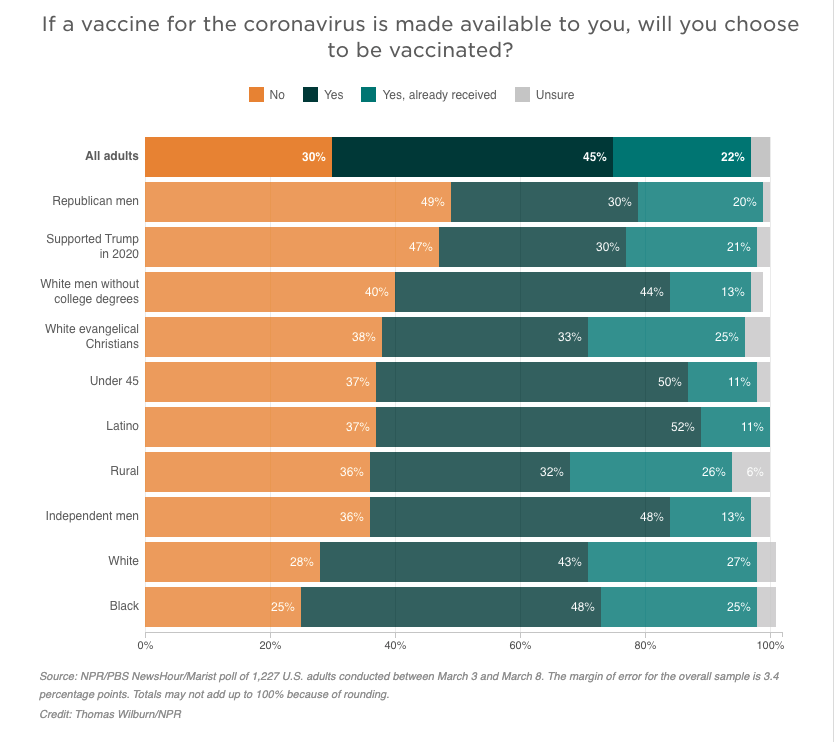
Almost half of Republican men say they will not choose to be vaccinated if given the chance, according to a new NPR/PBS NewsHour/Marist poll.

According to a survey taken March 3 through March 8, when asked whether they would choose to be vaccinated “if a vaccine for the coronavirus is made available to you,” 49% of Republican men said they will not get the vaccine. More than one-third of Republican women (34%) also said they will not get vaccinated, along with 36% of Independent men.

Nearly half of Trump supporters – 47% – said they would not take the vaccine.

While Republican men and Trump supporters are the biggest group that would refuse a vaccine, 37% of Latinos also said they will not get vaccinated; similarly, 37% of people younger than 45 would also not get the shot.

The poll also measured approval of President Joe Biden’s handling of the pandemic, which currently stands at 62% approval, and 30% disapproval. Thirty percent of Republicans and 22% of Trump supporters are among those who approve of Biden’s actions on the pandemic so far.

According to the survey, two-thirds of Americans say have either gotten the vaccine or will get it, and overall, only 30% say they won’t, down from 44% who said they would not get it when asked the same question in September 2020.

While the CDC hasn’t yet determined how many people need to be vaccinated in order to reach herd immunity in the U.S., Dr. Anthony Fauci recently said the number might need to be 75 to 85 percent of the population, up from earlier estimates of 60 to 70 percent, according to a New York Times report.

Good News Monday: Planet of the Apes

Great apes at the San Diego Zoo receive a Covid-19 vaccine for animals

By Stella Chan and Scottie Andrew, CNN

Updated 4:10 PM ET, Fri March 5, 2021Members of the San Diego Zoo's orangutan and bonobo tribes have received a Covid-19 vaccine designated for non-human use, zoo officials said. Members of the San Diego Zoo’s orangutan and bonobo tribes have received a Covid-19 vaccine designated for non-human use, zoo officials said.

(CNN) Several great apes at the San Diego Zoo have been vaccinated against Covid-19 a few weeks after the zoo’s gorillas tested positive for the virus. Members of the zoo’s bonobo and orangutan troops were vaccinated using doses from a supply intended strictly for non-human use, the San Diego Zoo Wildlife Alliance (SDZWA) said in statement to CNN. Veterinarians identified members of the bonobo and orangutan troops most at risk who could be easily vaccinated, the organization said.

San Diego Zoo gorillas make full recovery from Covid-19

Vaccinations began in January and have continued up to this month, and the animals received their second dose after three weeks. “The animals are doing well and we have seen no adverse reactions from the vaccine. The wildlife in our care is closely monitored throughout their lives,” said Darla Davis, a SDZWA spokeswoman.

In January, eight of the San Diego Zoo Safari Park’s gorillas caught the virus, though their symptoms were mild and limited to coughing, congestion and fatigue. The troop has since fully recovered.

What We Eat Now

I’m inspired by Marty, of the witty blog snakesinthegrass2014, to revisit the infamous food pyramid.

Pre-pandemic food pyramid:

Healthy Eating Pyramid

Post-pandemic food pyramid:

As my friend D commented the other day, “Covid-19 stands for the 19 lbs we’ve gained.”