Tag Archives: wordpress

Good News Monday: People Still Read Books

It’s not just about digital devices, TV and movies.  A recent survey of reader habits revealed some interesting stats:

  • Women are major mystery fans (37% citing as their preferred genre)
  • 2% of men admit that romance is a preferred genre
  • 70% of respondents prefer print over e-books
  • Women prefer reading in bed, and 13% of people read while they commute (hopefully not while driving)
  • Men and women were equally likely to read in the tub

beach-1866992_640Another cool thing: international literacy is on the rise. And although books are in short supply in developing nations, most people have access to cellphones, which broadens opportunities to read. In a UNESCO survey of more than 4,000 in Ethiopia, Kenya, Nigeria, India, Pakistan, Ghana and Zimbabwe, 62% of respondents reported that they were reading more — by using their phone.


Good News Monday: Oryx and Eagles and Bears, Oh My!

Happy Labor Day, US friends!

bear-2574086_640

Today’s heartening item is that several animal populations are finally on the upswing, including

  • Bald Eagle
  • Arabian Oryx
  • Gray Wolf
  • Northern Elephant Seal
  • Brown Bear
  • Giant Panda
  • Humpback Whale

Unfortunately, no politicians have been added to the endangered species list.


A Love Letter to a Younger Me

Recently, my friend N sent me a collection of letters I’d written to her the summer we were 14. Talk about cringe-worthy!

IMG-0164

Note: Bob the postman played along; our correspondence continued all summer!

One thing I learned was that my writing style hasn’t evolved much since my teens. That was a bit scary. Also, that I was completely boy-crazy, which did not come as a shock.

These were my major interests:

  • Trying to sort out what appealed to boys and which girls they liked.
  • The Mets baseball team (I had no memory of being such a fan) and the Beatles, especially George. (I was obsessed.)
  • Sailing and tennis lessons. I never got very good at either, but apparently had fun: “Sailing is terrific, but I almost capsized last lesson! It was a panic – I turned too far & we almost turned over. Boy! Was my sailing instructor MAD!”
  • Trying to ascertain whether a 16 year old could possibly be interested in a 14 year old. (Spoiler: We did get together the next summer.)
  • Bad boys in general: “Last year, K got stoned once on the golf course with O, & also got picked up (with O) for trying to steal a car!!!!” I had a major crush on K, who was gorgeous. (I’ve always been a sucker for a pretty face. But a guy who got stoned at 13? That was a surprise.)
  • Obsessing over whether I should say Happy Birthday to K: “Will he think I went to a lot of trouble to find out when it is? Or should I forget it? (We’ve known each other for 13 years.) I really don’t know. He might think I’m chasing him. And I’m not positive that’s his birthday. If it isn’t, he’ll think I like him (which I do, but he shouldn’t know, exactly.) If I don’t, he may think I’m stuck-up, or a snob. If I do, he might think I’m chasing him. What to do?????”
  • I wasn’t a complete airhead. I read a lot (in one letter, I recommend Huxley’s Brave New World) and played chamber music (cello) and chess. And I loved my summer science classes, especially when K and I were paired for dissection and swapped different fish parts on purpose to create two new species. OK, maybe that was less about science and more about the cute boy, but still….
  • Money went a lot further in the 60’s. I was paid $2.50 for 4 hours of babysitting three little kids.
  • I was a staunch Democrat: “J is such a jerk. He swears like anything. p.s. He’s for Goldwater!!!” (I was outraged.)
  • Boy-girl parties were a washout. Most of the boys wouldn’t dance.

As I was laughing, I developed a deep affection for this young teenager:

  • I was enthusiastic.
  • I was a good sport.
  • I was a loyal friend.
  • I had a sense of humor.
  • I loved to write.

So,

Dear 14-year-old Me:

You are a great kid. Some boys will like you. Some won’t. It will all work out; you have nothing to worry about. Develop your talents, try lots of new things, keep making friends, and enjoy the next few decades.

Oh, and you will always be obsessive; try to channel it constructively!

Love,

Older, Wiser, Adult Me

lips-145758_640


Good News Monday: Climate Change

We’ve still got a long way to go, but trees are adapting to offset carbon emissions.  They’ve begun to use water more efficiently, which allows them to grow in size and thereby remove more CO2 from the air.

Keep reducing your own carbon footprint, though.  Trees can’t do it all by themselves!


Dementia or Alzheimer’s?

mental-health-3285627_640

A few days ago DH and I watched the lovely and touching movie, The Leisure Seeker, which reminded me to share an interesting article.

My parents’ generation used to refer to this health issue as “losing your marbles”, which sounds more charmingly benign than the sad reality of cognitive decline. Whether you’re concerned for yourself, an aging relative, or a friend, I hope you’ll find it informative.

(SHARED FROM AARP)

Dementia vs. Alzheimer’s: Which Is It? How to understand the difference — and why it matters

by Kathleen Fifield, AARP, June 25, 2018 

The terms “dementia” and “Alzheimer’s” have been around for more than a century, which means people have likely been mixing them up for that long, too. But knowing the difference is important. While Alzheimer’s disease is the most common form of dementia (accounting for an estimated 60 to 80 percent of cases), there are several other types. The second most common form, vascular dementia, has a very different cause — namely, high blood pressure. Other types of dementia include alcohol-related dementia, Parkinson’s dementia and frontotemporal dementia; each has different causes as well. In addition, certain medical conditions can cause serious memory problems that resemble dementia.

A correct diagnosis means the right medicines, remedies and support. For example, knowing that you have Alzheimer’s instead of another type of dementia might lead to a prescription for a cognition-enhancing drug instead of an antidepressant. Finally, you may be eligible to participate in a clinical trial for Alzheimer’s if you’ve been specifically diagnosed with the disease.

What It Is

Dementia 

In the simplest terms, dementia is a nonreversible decline in mental function.

It is a catchall phrase that encompasses several disorders that cause chronic memory loss, personality changes or impaired reasoning, Alzheimer’s disease being just one of them, says Dan G. Blazer, M.D., a professor of psychiatry at Duke University Medical Center.

To be called dementia, the disorder must be severe enough to interfere with your daily life, says Constantine George Lyketsos, M.D., director of the Johns Hopkins Memory and Alzheimer’s Treatment Center in Baltimore.

Alzheimer’s

It is a specific disease that slowly and irreversibly destroys memory and thinking skills.

Eventually, Alzheimer’s disease takes away the ability to carry out even the simplest tasks.

A cure for Alzheimer’s remains elusive, although researchers have identified biological evidence of the disease: amyloid plaques and tangles in the brain. You can see them microscopically, or more recently, using a PET scan that employs a newly discovered tracer that binds to the proteins. You can also detect the presence of these proteins in cerebral spinal fluid, but that method isn’t used often in the U.S.

How It’s Diagnosed

Dementia

A doctor must find that you have two or three cognitive areas in decline.

These areas include disorientation, disorganization, language impairment and memory loss. To make that diagnosis, a doctor or neurologist typically administers several mental-skill challenges.

In the Hopkins verbal learning test, for example, you try to memorize then recall a list of 12 words — and a few similar words may be thrown in to challenge you. Another test — also used to evaluate driving skills — has you draw lines to connect a series of numbers and letters in a complicated sequence.

Alzheimer’s 

There’s no definitive test; doctors mostly rely on observation and ruling out other possibilities.

For decades, diagnosing Alzheimer’s disease has been a guessing game based on looking at a person’s symptoms. A firm diagnosis was not possible until an autopsy was performed.

But that so-called guessing game, which is still used today in diagnosing the disease, is accurate between 85 and 90 percent of the time, Lyketsos says. The new PET scan can get you to 95 percent accuracy, but it’s usually recommended only as a way to identify Alzheimer’s in patients who have atypical symptoms.

(Images from Pixabay.com)

Sourdough Made Simple

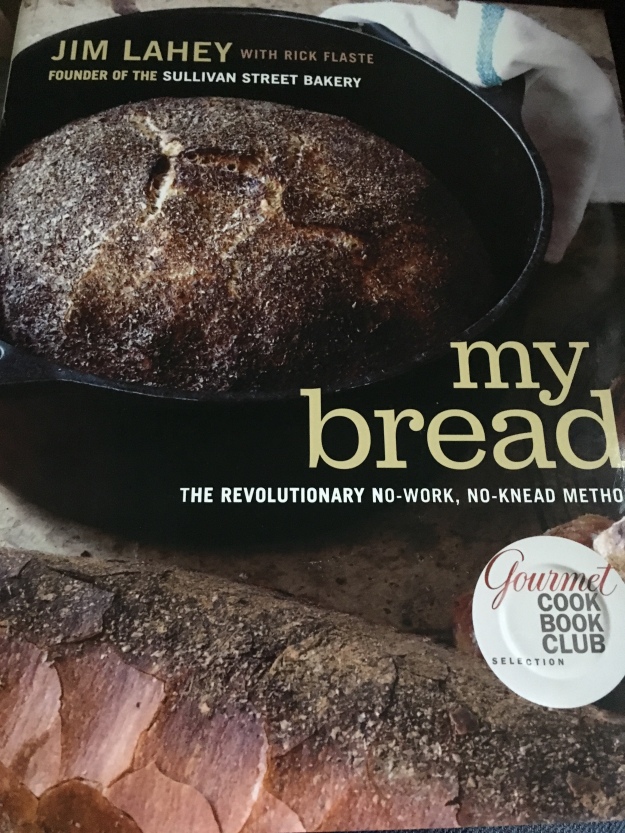
Sourdough has a reputation for being a bit tricky, so a lot of people find it intimidating. Thanks to my friend P, a fellow baking geek, I’ve been introduced to the Lahey method, which makes it super-easy to bake bread at home. I love this book!
IMG-0127.jpg

I’ve been experimenting with Lahey’s method for several weeks and my adapted recipe for sourdough is even simpler. It looks like a lot of steps but bear with me.

The genius part: Instead of folding/kneading your dough every few hours, you let your dough ferment overnight (18 hrs), do a second rise for 2 hrs and bake. No more being stuck in your house all day during the rising process!

STEP 1

All sourdough begins with a starter — natural yeast with a brinier flavor than the commercial yeast you find at the supermarket. Plan on 3-4 days before it’s ready to use. All you need is flour, water, air and time.

Mix equal parts water and flour in a wide mouthed container, cover it loosely so air can get to it, leave it out on your counter and wait. THAT’S IT. Really!

Once your starter is bubbly and active, try to make your dough within a few hours, before it loses potency. Thereafter, if you’re not baking regularly, dump out about 50-75% once a week, stir in equal parts water and flour, and start the process over.

IMG-0038.JPG

Starter is ready to use!

I encourage everyone to invest a few bucks in a kitchen scale and measure by weight rather than volume because 1) it’s easier and 2) it will guarantee consistent results. Remember, different flours have different densities so one cup of A may be slightly more or less than one cup of B.

Put your empty container on the scale, and set it to zero. Add 50g-75g whole wheat flour, 50g-75g bread (strong) flour, and 100g-150g cool water, resetting to zero after each addition. Don’t worry if you’re off by a gram or two as long as your ratio of total flour to water is roughly 1:1.

STEP 2

You’ve been patient and you now have over 100g of starter. Let’s get going.

Put a large bowl on the scale, zero it out, and add:

  • 600g flour (I like 475g bread flour +125g whole wheat or another grain)
  • 16g salt
  • ¼ teaspoon of active dry yeast (the kind you get at the grocery store)
  • 450g water
  • 107g active starter*
  • Optional: Add a generous handful of chia seeds and a tablespoon of caraway seeds, as I’ve done here.

*If this amount uses up most of your starter, replenish by adding  50g flour plus 50g water, mix well and set it aside to reactivate for a couple of days.

STEP 3
IMG-0110

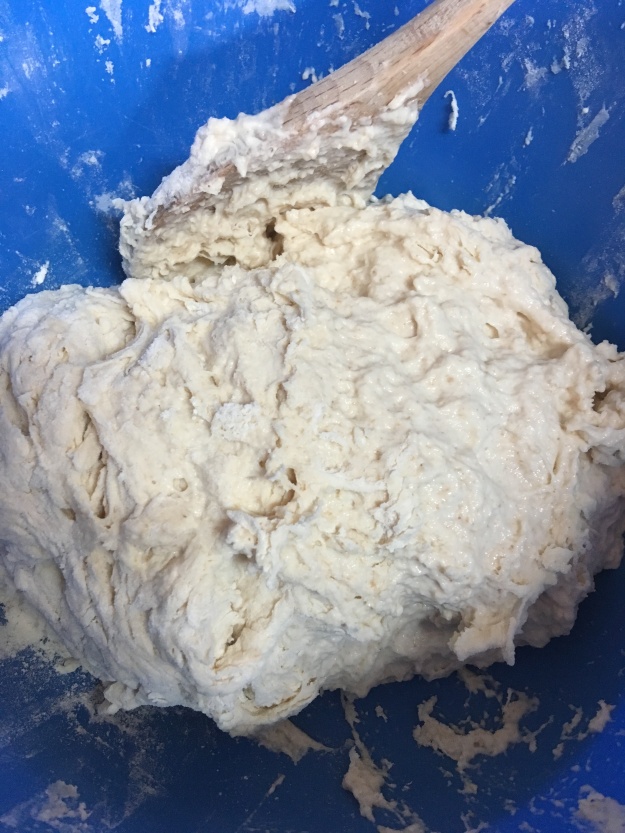
Once you have a well mixed dough (it will be sticky; DO NOT be tempted to add more flour), loosely cover the bowl with plastic wrap and leave it out at room temperature overnight for 18 hours. If you do this at, say, 4 PM, your dough will be ready for the next step at 10 AM the next day.

STEP 4

18 hours later, your dough will be bubbly and will come away from the bowl in long strands – this is the developed gluten. It will be loose and sticky; don’t add more flour!

IMG-0121

IMG-0114

Those strands are the gluten

Dump it onto a lightly floured counter, and form the dough into a ball by tucking the edges under – using either a dough scraper or your (lightly floured) hands.

IMG-0116

The dark bits are the chia and caraway seeds.

STEP 5

The traditional method is to bake your dough in a pre-heated cast iron pot.  This is an easy alternative.

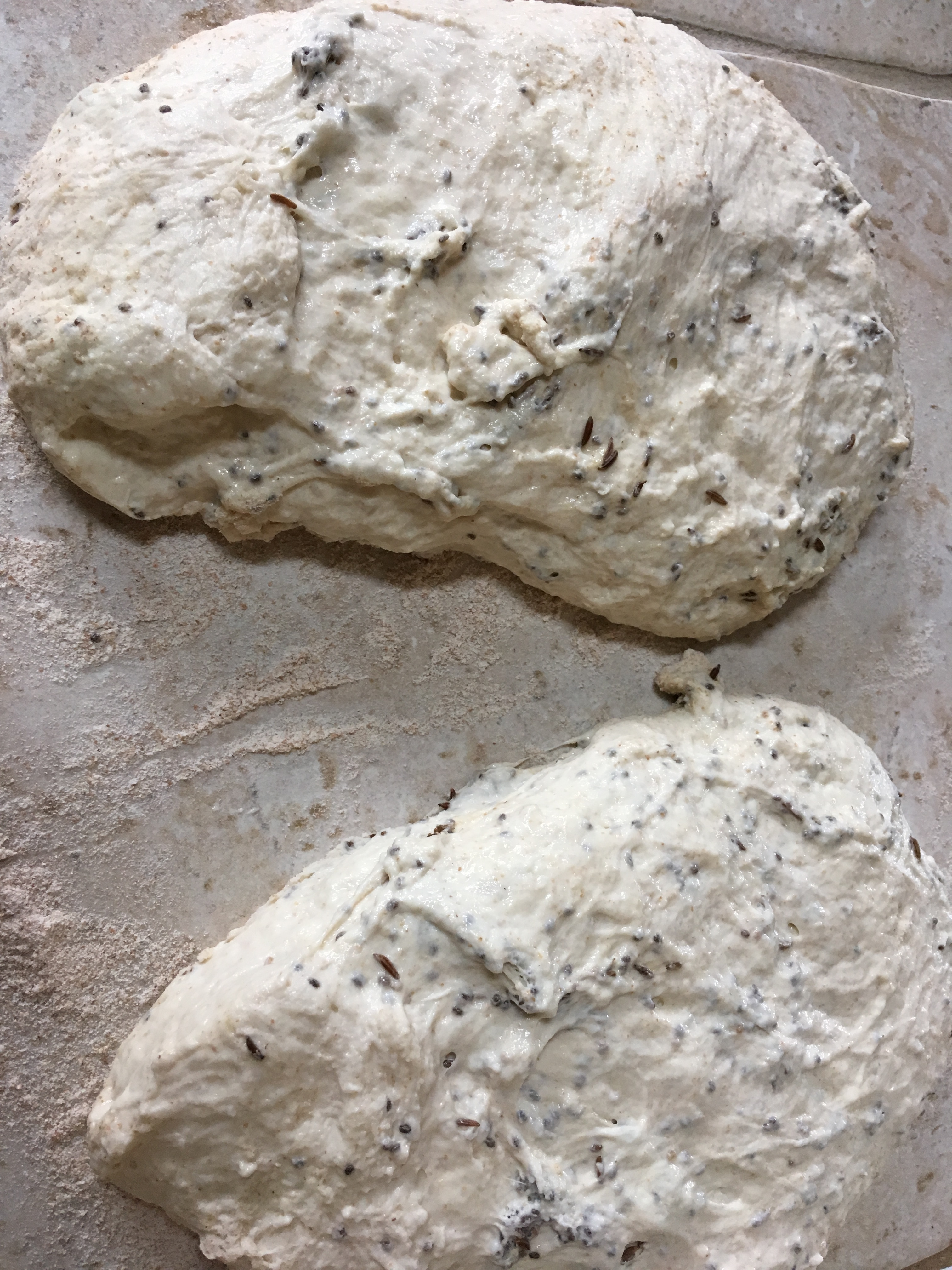
Divide dough into two balls. Shape each ball into a log and put them in a perforated baguette pan. For a free form shape, place your logs (or ovals) onto a baking sheet that’s been generously dusted with cornmeal. Leave plenty of room between them.
IMG-0115.JPG

IMG-0118

Lightly dust the tops with flour. Cover the pan or baking sheet with a linen or cotton dishtowel (avoid terry cloth) or plastic wrap, and let the dough rise again for 2 hours.  After 1.5 hours have elapsed, preheat your oven to 500 degrees F.

STEP 6

After another half hour (the full two hours), your dough will have puffed up nicely. Spritz your hot oven with water, put the bread into the oven and lower the heat to 475 degrees F.

You can spritz again after 2-3 minutes to keep the steam going and create a crispier crust. You can also score the dough at this point to let steam escape during baking but it’s not crucial.

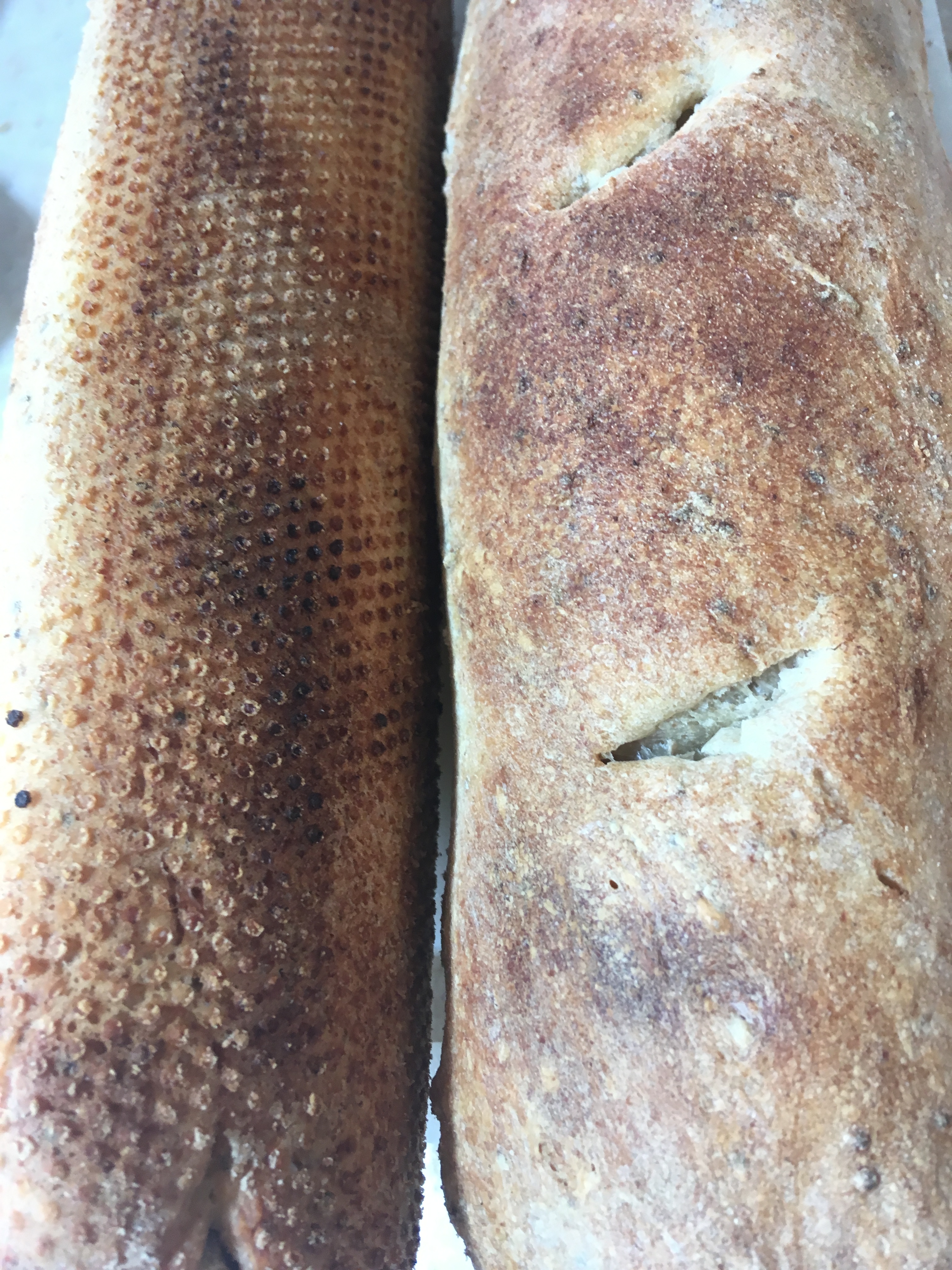
Bake for about 25 minutes and check your bread – it should be a rich golden color. Depending on your oven this may take another 5+ minutes.
IMG-0123.JPG

Left: the bottom, showing bumps from the perforated pan.

To ensure your bread is baked through, check it with a kitchen thermometer – the internal temperature of the bread should be 205-210 degrees F.

IMG-0126.jpg

Nice and craggy with an open crumb

Cool. Slice. Eat.


Early Promise

I couldn’t attend my high school reunion last week, but thanks to generous friends who have shared memories, photos and excerpts from our literary magazine, it was almost like being there.

I especially enjoyed this witty story. Hope you do, too.

preview

preview-1

preview-2

Blue Streak

Earlier this week, I took a break from my favorite summer activities of wine tasting, beach walks and bread baking to pick blueberries at nearby Gibson Farms. I can’t say I’m the most efficient at this, as I subscribe to the notion of “pick one, eat two”, but both my friend P and I wound up with a solid haul: 9 pounds for her; 7 for me. (Not unlike giving birth, we joked.)

The first acres on this family farm were planted in the 40’s, with more added in the 80’s. The moist, mild climate of the central coast gives the berries their distinctive sweetness, and draws large crowds during the two-week “U-pick“ season.

Berkeley blueberries are Gibson’s current crop. Considered the most popular home garden variety of blueberry, Berkeleys grow well in mild climates. Their medium to large size fruit has great flavor and firmness, as well as a long shelf life, should you happen to not devour the entire crop in one sitting.

Blueberry Berkeley, Vaccinium corymbosum, High Bush Blueberry

You probably know that blueberries are healthy — at least until they turn into a pie!
A few facts:
  • Blueberries contain a plant compound called anthocyanin. This gives blueberries both their blue color (cyan) and many of their health benefits.
  • Blueberries can improve bone strength, skin health, blood pressure, diabetes management, cancer prevention, and mental health.
  • Their fiber, potassium, folate, vitamin B6, and phytonutrient content support heart health. (Fiber helps to reduce the total amount of cholesterol in the blood and decrease the risk of heart disease.)
  • One cup of blueberries provides 24% of a person’s recommended daily allowance of vitamin C.
  • People who use blood thinners, such as warfarin, should speak to their doctor before increasing their intake of blueberries, as the high vitamin K content can affect blood clotting.

blueberries-690072_640

Now, other than merely eating great handfuls, what else can you do? Plenty! — from smoothies to pancakes to salsa to desserts.
Besides the aforementioned pie, I made up a batch of muffins using this King Arthur flour basic muffin recipe and adding 2 cups of blueberries to the dry ingredients before combining with the wet ones. This trick keeps the berries from sinking to the bottom.
IMG-0063.jpg
The muffins would be even tastier with the addition of a streusel topping, but I thought it prudent to skip the additional butter and sugar.
If you are feeling indulgent, though, check out this wonderful Ina Garten recipe from my friend Terry’s blog. Terry will never steer you wrong when it comes to deliciousness!
Enjoy the rest of your week!


Random Good Things About Friday the 13th

It’s safer

According to the Dutch Center for Insurance Statistics, Friday the 13th is actually statistically safer than other Fridays — there are fewer accidents and reports of fire and theft on these days. Is that only true in the Netherlands, though?

The first dinosaur eggs were found

Roy Chapman Andrews discovered the first dinosaur eggs at a dig in Mongolia, on July 13, 1923, a huge breakthrough in paleontology and a generally cool thing.

Gender discrimination became illegal in government

Although Title VII prevented private employers from discrimination based on race, color, religion, national origin and sex, it wasn’t until Executive Order 11375 that gender discrimination became illegal for the federal government and federal contractors. President Johnson signed the order — officially titled Amending Executive Order No. 11246, Relating to Equal Employment Opportunity — on October 13, 1967.

Now we need a law prohibiting stupidity in government.

Water was found on the Moon

On November 13, 2009, NASA announced that they had found “significant” water on the Moon. How much? Approximately a dozen two-gallon bucketfuls. But still….

The first female flight instructor got her license

On October 13, 1939, Evelyn Pinckert Kilgore became the first female flight instructor. She then flew non-combat missions during World War II, and owned and operated her own private airport after the war.

Benjamin Franklin wrote one of his most famous quotes

“[B]ut in the world nothing can be said to be certain except death and taxes.”

In a letter to Jean-Baptiste Leroy, a fellow inventor, on Friday, November 13, 1789, Benjamin Franklin wrote that the US Constitution had been completed: “Our new Constitution is now established, and has an appearance that promises permanency; but in the world nothing can be said to be certain except death and taxes.”

Heavy metal became a new music genre

Black Sabbath released their debut album on Friday, February 13th 1970.

Every Friday the 13th has been the beginning of a weekend

Duh! Have a good one!

billiard-ball-1432839_640

Addicted to Books

Our current move has involved putting approximately 1000 boxes of books weighing approximately 1,000,000 lbs into storage: Art. History. Art History. Theatre. Theatre History. Obscure Writings on Theatre History… you get the idea.

Which prompts me to wonder if my Dear Husband and others like him should form a chapter of Book Buyers Anonymous.

books-1655783_640

In fairness, DH’s library is much better organized!

DH navigates a bookstore or library the way I peruse the designer floor at Neiman Marcus or almost any bakery: eyes glazed, slack-jawed and bent double so as to read the title/label. It’s nearly impossible to leave empty-handed.

Like chocolate and expensive perfume, scent is part of the experience: dusty, musty old books exude an irresistible pull, as does the cottony, slightly acrid crispness of a new volume.

I used to share DH’s addiction but, much as I love to read, I don’t collect books the way I collect, say, shoes and bags. Once done, I almost never return for a second round of the same story. The library would be a perfect solution, except that I prefer the pristine quality of a new book to one that’s been handled by someone else. Hence, regular purchases of paperbacks, which can easily be recycled to friends, family or Goodwill.

But as a kid the library was my safe haven, especially during the summers we spent on Cape Cod, when I had endless hours to curl up with a book.

My childhood library was founded in 1875 and moved to its present stone building in 1913. It felt both vast and cozy. Also deeply welcoming, despite the looming presence of librarians who’d shush you if you happened to be giggling with a friend.

I loved the dark, dusty stacks, the wooden files of Dewey Decimal System reference cards (named for the proprietary library classification system first published in the United States by Melvil Dewey in 1876), and most of all the sense of anticipation that you’d find something wonderful to bring home.

Dickens. Austen. Nancy Drew – I was voracious and indiscriminate. And I still have anxiety if I have fewer than 3 books at the ready. Kindles have their place but I want to hold my book. (Sounds like a Beatles song, no?)

Anyway. For the time being DH’s beloved boxes are safe and snug, though I have recurring nightmares of the second floor of our soon-to-be-built new home caving in under the weight of all those invaluable tomes.

Maybe I should go bake something.