For weeks, I’d been dreading this: several days in Austin to clear out our remaining belongings — we’d sold the house in late March –, sell two cars, close our safe deposit box, and then drive 3-4 days back to Oregon.
Luckily, we were able to accomplish said tasks quickly, ship the boxes instead of loading them into our Titanic-sized, impossible-to-park rental car, and fly back instead. As I’ve often remarked, there is almost no problem that can’t be solved by throwing money at it. (Though, to digress, this apparently hasn’t worked for Bill and Melinda Gates.)
This allowed us time to visit with family and friends and reflect on some of the unexpected pleasures of dining out during a pandemic.
Pandemic Travel 2.0
Waitstaff no longer hover over your table, telling you their life story (“Hi, I’m Bruce and I’ll be your server tonight, although I’m really an actor and I’ve written this cool sci-fi script…”).
Table spacing makes for a much quieter experience. You might even be able to hear your own conversation.
Maybe it’s an illusion, but everything just seems cleaner.
Silverware arrives wrapped in a napkin, rather than having been sitting out on the table.
Many restaurants have streamlined their menus, so the choices are better thought-out and fresher.
People are too far away to eavesdrop.
As for air travel,
Fewer travelers = speedier security. They sure want you to keep moving.
Nobody seems to worry about liquids anymore.
Better filtration = less chance of catching a cold or flu, never mind COVID.
Even anti-maskers have to wear one.
A discreet cough or two (into your mask of course) and no one will attempt to ask what you’re reading or whether you live at your destination.
Fewer travelers = less luggage. For the first time in recent memory, our checked bags were already at the carousel by the time we arrived at baggage claim.
Woo hoo — home sweet (temporary) home in one day, not four. So what if we’ll have to load 17 boxes into our car and lug them to a new (also temporary) storage unit; the kids can sort out our crap when we cross the rainbow bridge!
BRAGA, Portugal — It’s no secret that shot of caffeine from a morning coffee can give many people a quick boost. Now, a new study finds going for that second and third cup may be good for your brain. Researchers in Portugal say people who regularly drink coffee are not only more alert, but see more activity in their brains as well.
According to the European Food Safety Authority, moderate coffee consumption is typically three to five cups per day. In the new study, researchers from the University of Minho reveal consuming this much caffeine each day can make coffee drinkers more focused while also displaying greater memory and learning abilities.
Scientists examining MRI scans discovered differences in the makeup of the brains between regular coffee drinkers and those who don’t consume the beverage at all. Coffee drinkers had a more “efficient” brain, with quicker connectivity in the cerebellum, the right precuneus, and the right insular.
Even one cup of coffee can keep you sharp
These patterns show regularly drinking coffee may give people better motor control. Participants consuming caffeine were also less likely to let their minds wander. Study authors add the effects of this brain boost can be immediate. Results show non-coffee drinkers could start seeing benefits for a short time after a single cup of java.
Researchers studied the connectivity and structure of the brain in 31 regular coffee drinkers and 24 non-coffee drinkers while at rest. The team also examined these individuals while they performed a mental task soon after consuming a cup.
“This is the first time that the effect that drinking coffee regularly has on our brain network is studied with this level of detail,” says Professor Nuno Sousa in a university release. “We were able to observe the effect of coffee on the structure and functional connectivity of our brain, as well as the differences between those who drink coffee regularly and those who do not drink coffee in real time.”
“The findings help to understand improving the effects of caffeine, highlighting improved motor control, increased levels of attention and alertness, and benefits in learning and memory,” Prof. Sousa’s team concludes.
Previous studies find the world drinks about three billioncups of coffee each day. Along with brain health, the morning drink of choice for many also has links to increased fat-burning and better heart health.
Does the slightest cough, muscle ache, or sore throat beget frenzied thoughts of fatal disease? Do you panic that you can’t get an immediate doctor’s appointment?
According to the following study, reliable help is as close as your computer.
Going to ‘Dr. Google’ to look up your symptoms actually leads to accurate diagnoses!
BOSTON, Mass. —The moment something doesn’t look or feel right, many people won’t run to their doctor, they’ll turn to Google. Although an internet search may not sound like good medical advice, a new study finds it can actually help. Researchers say patients who use “Dr. Google” to find out what’s wrong with them will likely get the right diagnosis.
According to the report, googling symptoms improves peoples’ ability to diagnose their illness without adding additional stress. Researchers from Brigham and Women’s Hospital and Harvard Medical School admit that “cyberchondria” has made the value of internet medical searches controversial.
This increased anxiety brought on by continuously looking up every ailment online has even pushed some medical professionals to urge patients not to look their symptoms up online before seeing them. Researchers add anxiety can lead people to think they’re on death’s door when in fact they are perfectly healthy.
Despite Dr. Google’s poor reputation, study authors conclude using the internet to check your symptoms may not be such a bad idea after all.
“I have patients all the time, where the only reason they come into my office is because they Googled something and the Internet said they have cancer,” study author Dr. David Levine says in a media release. “I wondered, ‘Is this all patients? How much cyberchondria is the Internet creating?”
Can everyday people give out sound medical advice?
Researchers asked 5,000 participants to read a short “case vignette,” describing a number of symptoms and imagine someone close to them was experiencing them. The participants then had to make two diagnoses, before and after looking up the symptoms online.
Cases ranged from mild to severe, but described common illnesses, such as viruses, heart attacks, and strokes. Study authors also asked the group to choose between letting the health condition get better on its own or calling 911. After making their choice, participants reported how anxious they felt.
Results reveal participants were “slightly better” at correctly diagnosing their cases after carrying out an internet search. The process also did not add to their levels of anxiety.
“Our work suggests that it is likely OK to tell our patients to ‘Google it,’” Dr. Levine says. “This starts to form the evidence base that there’s not a lot of harm in that, and, in fact, there may be some good.”
Are robot doctors next?
The team admits it’s not clear whether people would behave the same way if one of their loved ones was truly ill. Moreover, the results won’t represent the reactions of all people who use the internet for health-related searches. Next, study authors are planning on testing whether artificial intelligence could use the Internet to correctly diagnose patients.
“This next study takes a generalized AI algorithm, trained on all of the open-source text of the Internet such as Reddit and Twitter, and then uses that to respond when prompted,” Dr. Levine concludes. “Can AI supplement how people use the Internet? Can it supplement how doctors use the Internet? That’s what we’re interested in investigating.”
BERLIN (AP) — The scientist who won the race to deliver the first widely used coronavirus vaccine says people can rest assured the shots are safe, and the technology behind it will soon be used to fight another global scourge — cancer.
Ozlem Tureci, who co-founded the German company BioNTech with her husband, was working on a way to harness the body’s immune system to tackle tumors when they learned last year of an unknown virus infecting people in China.
Over breakfast, the couple decided to apply the technology they’d been researching for two decades to the new threat, dubbing the effort “Project Lightspeed.”
Within 11 months, Britain had authorized the use of the mRNA vaccine BioNTech developed with U.S. pharmaceutical giant Pfizer, followed a week later by the United States. Tens of millions of people worldwide have received the shot since December.
“It pays off to make bold decisions and to trust that if you have an extraordinary team, you will be able to solve any problem and obstacle which comes your way in real time,” Tureci told The Associated Press in an interview.
Among the biggest challenges for the small, Mainz-based company that had yet to get a product to market was how to conduct large-scale clinical trials across different regions and how to scale up the manufacturing process to meet global demand.
Along with Pfizer, the company enlisted the help of Fosun Pharma in China “to get assets, capabilities and geographical footprint on board, which we did not have,” Tureci said.
Among the lessons she and her husband, BioNTech chief executive Ugur Sahin, learned along with their colleagues was “how important cooperation and collaboration is internationally.”
Tureci, who was born in Germany to Turkish immigrants, said the company, which has staff members from 60 countries, reached out to medical oversight bodies from the start, to ensure that the new type of vaccine would pass the rigorous scrutiny of regulators.
“The process of getting a medicine or a vaccine approved is one where many questions are asked, many experts are involved and there is external peer review of all the data and scientific discourse,” she said.
Amid a scare in Europe this week over the coronavirus shot made by British-Swedish rival AstraZeneca, Tureci dismissed the idea that any corners were cut by those racing to develop a vaccine.
“There is a very rigid process in place and the process does not stop after a vaccine has been approved,” she said. “It is, in fact, continuing now all around the world, where regulators have used reporting systems to screen and to assess any observations made with our or other vaccines.”
Tureci and her colleagues have all received the BioNTech vaccine themselves, she told the AP. “Yes, we have been vaccinated,” she said.
As BioNTech’s profile has grown during the pandemic, so has its value, providing funds the company can use to pursue its original goal of developing a new tool against cancer.
The vaccines made by BioNTech-Pfizer and U.S. rival Moderna uses messenger RNA, or mRNA, to carry instructions into the human body for making proteins that prime it to attack a specific virus. The same principle can be applied to get the immune system to take on tumors.
“We have several different cancer vaccines based on mRNA,” said Tureci, who is BioNTech’s chief medical officer.
Asked when such a therapy might be available, Tureci said “that’s very difficult to predict in innovative development. But we expect that within only a couple of years, we will also have our vaccines (against) cancer at a place where we can offer them to people.”
For now, Tureci and Sahin are trying to ensure the vaccines governments have ordered are delivered and that the shots respond effectively to any new mutation in the virus.
On Friday, German President Frank-Walter Steinmeier awarded the wife and husband one of the country’s highest decorations, the Order of Merit, during a ceremony attended by Chancellor Angela Merkel, a trained scientist herself.
“You began with a drug to treat cancer in a single individual,” Steinmeier told the couple. “And today we have a vaccine for all of humanity.”
Tureci said ahead of the ceremony that getting the award was “indeed an honor.”
But she insisted developing the vaccine was the work of many.
“It’s about the effort of many: our team at BioNTech, all the partners who were involved, also governments, regulatory authorities, which worked together with a sense of urgency,” Tureci said. “The way we see it, this is an acknowledgement of this effort and also a celebration of science.”
Ah, dear sun… you were so hot. In my misspent youth, how I burned for your touch. And oh, how I am paying for this as an adult!
Those of you who are blessed with darker complexions will never know the true agony of raw, red, sunburned skin. Or the “cute” freckles that eventually become age spots. Or the ever-present threat of skin cancer lurking below the surface, waiting to pounce years later.
But who thought about this while spending long, sunsoaked days at the beach with my friends during the endless summers of my teens and early twenties?
For decades since, I have been diligent about sunblock, avoiding the sun, and wearing a hat. But I have displeased the sun by my inattention, and now I am being punished. A biopsy here, a patch of squamous carcinoma there (on my wrist a few years ago), and lately a nasty little basal cell uprising on the tip of my nose. On my damn face, for heavens sake — you couldn’t wreak your revenge somewhere else?!?!
Last Monday I trekked to a specialist an hour away for Mohs surgery. The technique was developed in the 1940s by Dr. Frederick Mohs at the University of Wisconsin, and has subsequently been refined.
Unlike other forms of treatment, Mohs is generally reserved for cosmetic areas or types of skin cancer that are at risk of recurring. It permits immediate and complete microscopic examination of affected tissue to make sure all “roots” are removed. And it is said to leave the least noticable scar.
Well.
We arrived at a very nice office and the very nice doctor (both physician and surgeon) immediately told me I looked much younger than my age, so we were off to a good start.
A little numbing, a little scraping, a little cauterizing, and then a long wait to see if he’d gotten everything. Which he hadn’t, so then it was time for Round Two, which did.
I emerged three hours later feeling ok only because the numbing hadn’t worn off yet and my nose was covered with a pressure bandage.
Naturally, I did not know what I looked like, which was a good thing. Although the cancer was fairly superficial and about the size of a pencil eraser, I have a row of stitches all the way up the side of my nose. And OMG do they itch!
The bandage came off two days later and I could assess the full effect. Luckily, I’ve had to keep the area covered with petroleum jelly and regular bandages so nobody has to see it, including me. To add to the loveliness are several areas of bruising, which are now in the process of fading from bright red to purple to yellow.
I’ll see the derm again on Tuesday to get the outer stitches removed, but I have been “assured” that the dissolving stitches will render my nose a little lumpy for months until they dissolve. Not to mention the scar. Woo hoo.
So, dear readers, be warned: If you have fair skin that is prone to burning or freckling, and especially if you are young enough, it is time to end your love affair with the sun for once and for all.
Oh, and meanwhile, ask your dermatologist about nicotinamide and HelioCare, just to improve the odds.
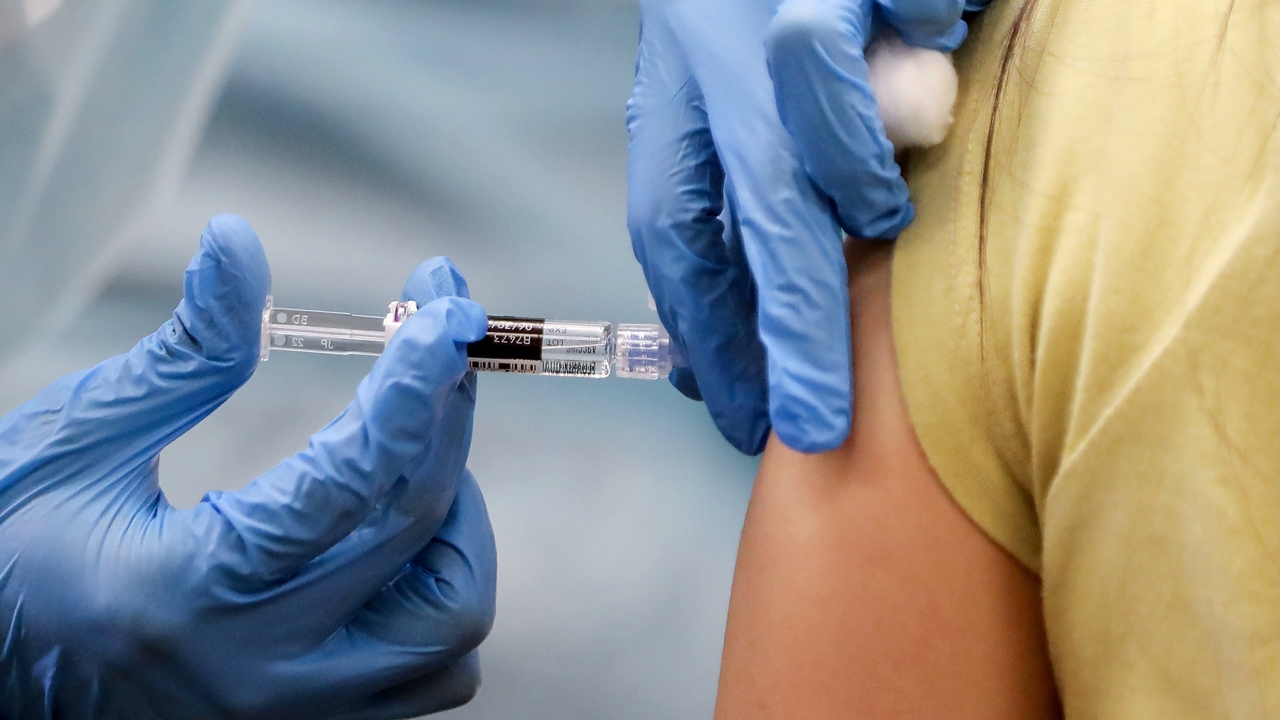
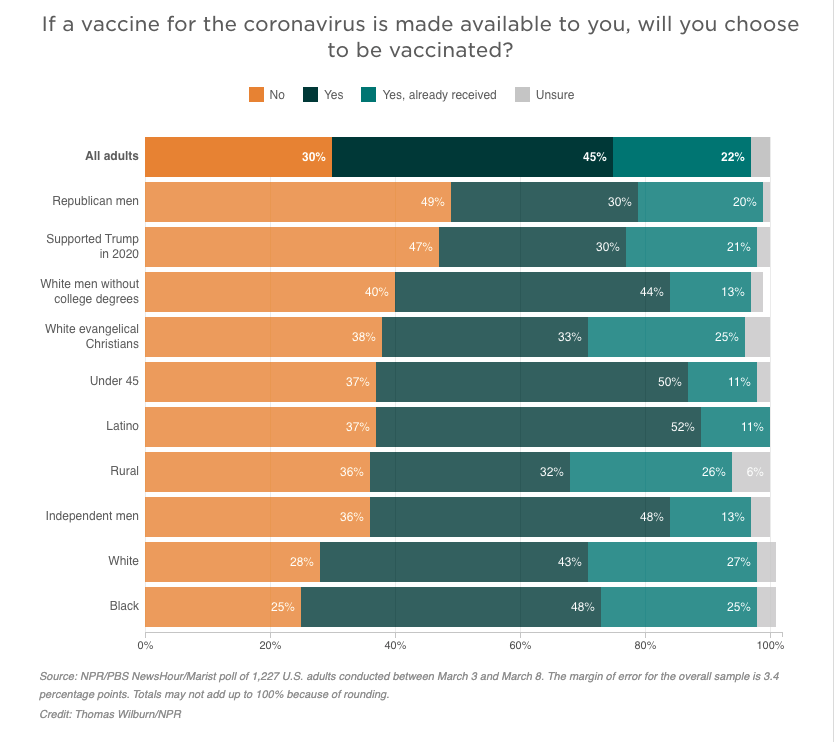
Almost half of Republican men say they will not choose to be vaccinated if given the chance, according to a new NPR/PBS NewsHour/Marist poll.
According to a survey taken March 3 through March 8, when asked whether they would choose to be vaccinated “if a vaccine for the coronavirus is made available to you,” 49% of Republican men said they will not get the vaccine. More than one-third of Republican women (34%) also said they will not get vaccinated, along with 36% of Independent men.
Nearly half of Trump supporters – 47% – said they would not take the vaccine.
While Republican men and Trump supporters are the biggest group that would refuse a vaccine, 37% of Latinos also said they will not get vaccinated; similarly, 37% of people younger than 45 would also not get the shot.
The poll also measured approval of President Joe Biden’s handling of the pandemic, which currently stands at 62% approval, and 30% disapproval. Thirty percent of Republicans and 22% of Trump supporters are among those who approve of Biden’s actions on the pandemic so far.
According to the survey, two-thirds of Americans say have either gotten the vaccine or will get it, and overall, only 30% say they won’t, down from 44% who said they would not get it when asked the same question in September 2020.
While the CDC hasn’t yet determined how many people need to be vaccinated in order to reach herd immunity in the U.S., Dr. Anthony Fauci recently said the number might need to be 75 to 85 percent of the population, up from earlier estimates of 60 to 70 percent, according to a New York Times report.
Great apes at the San Diego Zoo receive a Covid-19 vaccine for animals
By Stella Chan and Scottie Andrew, CNN
Updated 4:10 PM ET, Fri March 5, 2021Members of the San Diego Zoo’s orangutan and bonobo tribes have received a Covid-19 vaccine designated for non-human use, zoo officials said.
(CNN) Several great apes at the San Diego Zoo have been vaccinated against Covid-19 a few weeks after the zoo’s gorillas tested positive for the virus. Members of the zoo’s bonobo and orangutan troops were vaccinated using doses from a supply intended strictly for non-human use, the San Diego Zoo Wildlife Alliance (SDZWA) said in statement to CNN. Veterinarians identified members of the bonobo and orangutan troops most at risk who could be easily vaccinated, the organization said.
Vaccinations began in January and have continued up to this month, and the animals received their second dose after three weeks. “The animals are doing well and we have seen no adverse reactions from the vaccine. The wildlife in our care is closely monitored throughout their lives,” said Darla Davis, a SDZWA spokeswoman.
In January, eight of the San Diego Zoo Safari Park’s gorillas caught the virus, though their symptoms were mild and limited to coughing, congestion and fatigue. The troop has since fully recovered.
For years, the recommendations have been vague and confusing. (What actually constitutes a “serving”?) But this clarifies the “what”, if not the “how much”.
Sadly, potatoes and corn don’t make the list. However, I remain convinced that the pleasure inherent in eating french fries (“chips” to you in the UK) absolutely prolongs life.
This just in: Wearing a mask — any mask — reduces the risk of infection with the coronavirus, but wearing a more tightly fitted surgical mask, or layering a cloth mask atop a surgical mask, can vastly increase protections to the wearer and others, the Centers for Disease Control and Prevention reported on Wednesday.
New research by the agency shows that transmission of the virus can be reduced by up to 96.5 percent if both an infected individual and an uninfected individual wear tightly fitted surgical masks or a cloth-and-surgical-mask combination.



 Members of the San Diego Zoo’s orangutan and bonobo tribes have received a Covid-19 vaccine designated for non-human use, zoo officials said.


 olderfatterhappierdotcom