Category Archives: Food & Recipes

Lechyd Da!

First stop of the day: Cilgerran Castle, a 13th-century ruined castle located in Cilgerran, Pembrokeshire, Wales, near Cardigan. According to Wikipedia, the first castle on the site was thought to be built by Gerald of Windsor around 1110–1115, and it changed hands several times over the following century between English and Welsh forces.

No one’s here today so we roam at leisure, wondering if there are any ghosts.

Croeso! Welcome to Aberystwyth!IMG-0529

Before we explore, we check in to our hotel.

IMG-0527

The Conrah Hotel (originally named Ffosrhydgaled, aka “ditch”!) is a beautiful Edwardian mansion, constructed circa 1850 on the site of a farmstead, stables, outhouses and watermill.

IMG-0548

Following a devastating fire in 1911, it is reported that the owner, a Mr. Davies, spent considerable time arguing with his insurance company over where the new house should be built. Davies wished to demolish what was left of the house and re-erect the property in a more elevated position to improve his view, whereas the insurance company refused to allow this due to the increased cost of re-siting the property. Needless to say, the insurers won and the property was rebuilt on the same site.

IMG-0549

I’d kill for this stained glass.

It remained a private home until 1967, when new owners Constance and Ronald Alfred Hughes converted it to a hotel. The couple had made their money locally, manufacturing ‘Conrah’ vases, table settings and similar items from pressed metals (“Co” for Constance + Ronald’s initials RAH), hence the name change.

Gardens and public assembly rooms first attracted wealthy travelers, and in 1800 a new bathhouse provided “respectable visitors” the opportunity to bathe in heated seawater.  Within a few years, bathing machines offered the chance to venture into the sea itself, and guesthouses sprang up to cater to an increasing number of tourists.
IMG-0539

This shop could be owned by one of my husband’s many Welsh relatives of the same name.

The pier was built in 1865 and by the early 1900’s Aberystwyth boasted a large pavilion, railway, theatres, cinemas and concert halls.  By the 1950’s, it was well established as a seaside holiday destination.
IMG-0533
Dinner tonight is with DH’s cousins, who are warm and welcoming. The husband is an ardent Welsh nationalist, so we keep the Brexit discussion short. (Luckily, we don’t have a dog in this fight.)
We learn that a popular toast is “Lechyd da” (Le-chid-ya), which is easier for me to remember than “lloniannau”, or “cheers”.  The pronunciation is close to the Hebrew toast “L’chaim” (“to life”), which supports a theory that the lost tribes of Israel wound up in Wales.
The following morning, we head off to Bath.  I love this bridge — very Hermès, non?!
IMG-0552 (1)Arriving in Bath, our 17th century hotel (Paradise House) looks unimpressive from the outside, and parking in its tiny driveway is precarious, but it’s quite lovely inside. We’re treated to a delicious tea while the room is readied. Would definitely stay here again!
IMG-0558
The town center is an easy walk from the Paradise.  Bath is known for its natural hot springs and 18th-century Georgian architecture. Many of the buildings feature local honey-gold stone, including Bath Abbey, famed for its large stained-glass windows, fan-vaulting, and tower.
IMG-0562
The museum at the site of the original Roman-era Baths includes The Great Bath, statues (a later addition) and a temple.
IMG-0561
There’s a lot to see but we have only one day, so we concentrate on the Baths, a long walk to get a sense of the town, and the Jane Austen museum.

The Baths are well worth the trip, with wonderful depictions of Roman life “back in the day” and many artifacts.

IMG-0564


The Austen museum, however, is kind of a bust — costumed guides tell you about her family history (Austen didn’t spend a lot of time in Bath, as it turns out) but this is best visited by the true enthusiast.

Our stroll takes us to the Royal Crescent, very glamorous.

IMG-0593

And I loved this wonderful old-timey chemist’s shop.

IMG-0591 (1).JPGWe wrap up the day with an excellent meal at Clayton’s Kitchen. Linguine with crab is fresh and delicious.

Tomorrow it’s back to Devon, where we’ll make a major decision….

Mid-October, 2018.

On to Wales, Land of Few Vowels

Scenes from Week Two of our monthlong saga. We’re still in Devon…

IMG-0421 (2)But on the agenda: a visit to DH’s cousins in Aberystwyth (with an indulgent hotel stay en route), and a stopover in Bath on the return trip.

IMG-0445

Friendly cows welcome us to Molleston.

Early in the week, we explore Lynmouth’s picturesque harbor, more villages, and Exmoor National Park.

IMG-0423

IMG-0419.JPGWe stop in Ilfracombe, notable for its controversial Damien Hirst “Verity” statue which depicts both her pregnant exterior and interior. Erected in 2012, the statue looms over the harbor and is on loan to the town for 20 years. Many residents are counting the days until it’s removed. Are you a fan?

Verity Statue: photo0.jpg

Our drive back to Peppercombe takes us through more villages — one where a thatched roof is being repaired.

And of course we see mehhhnnnny sheep!

IMG-0413

(They never fail to amuse.)

Mid-week, it’s off to Wales. You know you’ve arrived when highway signs are in both English and Welsh and towns have romantic-sounding names such as  Dyffryn Arth and Llansantffraed.

Useful phrases: ARAF (Slow), CYFLEUSTERAU CYHOEDDUS (public conveniences) and CERDDWYR EDRYCHWCH I R CHWITH (pedestrians look right).

The first night, we stay at The Grove-Narberth, which is nothing short of fabulous. Beautiful setting and a wonderful restaurant.

IMG-0505.JPGNaturally, they grow their own herbs and veggies.

Dinner is delish, beginning with amuse-bouches in the bar while we wait for our table.

Desserts are pretty, too.

We stagger to our charming room, complete with fireplace, and nod off. Oh, it is SO nice to be in a hotel!

Early-mid October, 2018.

Good News Monday: Monotony Helps People Lose Weight.

Well, maybe.  The general idea is that eating the same thing every day emphasizes food as nutrition, not entertainment.  When meals are less exciting, we’re less likely to overeat.

The caveat: mix it up to avoid both nutritional deficiencies and bingeing when the boredom gets to be too much.

Here’s an interesting POV on the subject: https://www.healthline.com/health/eating-the-same-thing-pros-and-cons


Good News Monday: An Easy Way to Reduce Bloating

We all know that sodium (salt) causes water retention: think how bloated we feel after overindulging in soda, chips, or peanuts — even if we didn’t devour the entire bag. (Who, me?!)

But did you know that increasing potassium intake can help? I didn’t. Potassium has a diuretic effect that counteracts sodium. And it’s abundant in foods such as spinach, watercress, broccoli, bananas, papaya and strawberries.

p.s., If you’re making a fruit smoothie with those bananas or strawberries, use 2% Greek yogurt instead of a fat-free version. The extra fat slows the absorption of sugar, which helps keep it from being stored as body fat.


Turkey Day Tips

Happy Thanksgiving, dear American readers! Here are two random holiday tips:

When tempted to shop Black Friday or Cyber Monday, there are two categories one should avoid, as prices will be lower at other times.

  • Jewelry: Prices often increase around holidays and even discounts will be minimal; best times will be early January and then again after Valentine’s Day.
  • Coats: Prices will be lower at the end of the season.  Of course, if there’s something you need AND want, it may be sold out if you wait too long.

When faced with a huge holiday meal, don’t end up more stuffed than the turkey. (This applies to any large meal, especially when family’s involved!)

  • Your brain can only crave 3 or 4 foods at a time.  So before you load up your plate, circle the buffet or table and decide which are the items you most want to eat and only take your favorites.
  • Don’t gobble, gobble! Eat s-l-o-w-l-y and take a 5+ minute break after you’ve eaten. This will give your stomach time to tell your brain whether you’re still hungry.
  • If actually hungry, or you simply want to be polite, go back for round two but only take small tastes of any remaining foods you didn’t sample.
  • Love sweets? Plan ahead to leave room for dessert and don’t fill up on everything else.

Wishing you a wonderful holiday — I’m thankful to be connected to all of you!

Good News Monday? Eggs-actly!

I have high-ish cholesterol (controlled by medication); as a result, I tend to avoid eating eggs. But a little research has revealed that they’re more good than bad for our health.

While it’s true that chicken eggs are high in cholesterol, their effect on blood cholesterol is minimal when compared with the effect of trans fats and saturated fats; i.e., skip the bacon/ham/sausage/frying in butter part. Instead, opt for poached eggs or make your omelet with one egg white + one whole egg and cook it in olive oil.

According to experts, most healthy people can eat up to seven eggs a week with no increase in their risk of heart disease, and some scientists don’t see a problem with eating as many as three a day. (The main problem would probably be how boring that would be!)

Eggs consistently raise HDL (“healthy”) cholesterol. For 70% of people, there is no increase in total or LDL (“lousy”) cholesterol, though some people may experience a mild increase in a benign subtype of LDL.

As a good source of inexpensive, low-calorie, high quality protein, eggs are hard to beat (pun intended). More than half their protein is found in the egg white, along with vitamin B2 and lower amounts of fat than the yolk.

Along with beneficial fat, they also contain biotin and vitamin B12 (great for skin, hair and nails), plus vitamin A and lutein, which support eye health. Some stats:

  • Vitamin A: 6% of the RDA.
  • Folate: 5% of the RDA.
  • Vitamin B5: 7% of the RDA.
  • Vitamin B12: 9% of the RDA.
  • Vitamin B2: 15% of the RDA.
  • Phosphorus: 9% of the RDA.
  • Selenium: 22% of the RDA.
  • Eggs also contain decent amounts of vitamin D, vitamin E, vitamin K, vitamin B6, calcium, and minerals such as iron, copper and zinc (which supports a healthy immune system).
  • Virtually all egg yolks contain omega-3 fats. And of course, egg whites contain no cholesterol.

I’m pretty sure there are health benefits associated with an accompanying mimosa, too, aren’t you?!

beverage breakfast drink orange juice

Photo by JÉSHOOTS on Pexels.com

Going Nuts for Mokonuts’ Cookies

My friend T turned me on to this Paris bakery via a New York Times recipe, which Dorie Greenspan adapted from their unusual rye-cranberry-chocolate chunk cookie.

I made these yesterday and agree with the raves. T wrote about them this morning in her entertaining blog and I couldn’t wait to share the recipe with you. My only caveat is that the directions say that the dough makes 15 cookies, which seemed enormous. So I made 18 (roughly 2.5″ diameter) instead, and next time might go even smaller, perhaps 20 cookies, as they are quite hearty and filling. Enjoy, and let me know if you try them!

IMG-0274

Don’t Ask If You Don’t Want Me To Tell You

We recently ate at a pleasant Italian restaurant; a day or so later, having been contacted by OpenTable to post a review, I wrote something short and positive.

At least I thought it was positive: 4/5 stars for food/ambiance/value and 5/5 for service, which was terrific. After all, this wasn’t an undiscovered Michelin gem, just a perfectly nice little restaurant with an undistinguished décor and limited menu. I’ve eaten out enough to know what “outstanding” means – from Tour D’Argent in Paris in its heyday to our local pub, which has consistently excellent grub. And, hey, I’ve got the extra pounds to prove it!

Almost immediately, I received a very defensive reply from the chef-owner, wanting to know why I’d given him a “bad” review. (My comments about the “lovely little restaurant with delicious house-made pasta” apparently hadn’t been sufficient praise.) So this led to a series of back-and-forth e-mails in which I explained that one reason for my rating was that the bread was disappointing. As regular readers will know, I take my carbs seriously: flabby, squishy white bread is not ok – though I expressed this as, “I prefer a firmer crust and texture”, attempting to be diplomatic.

The point is, I wasn’t trying to be mean or snarky – but if you ask for feedback, you should expect feedback, not a gold star for trying. (This being the problem of an entire generation getting trophies merely for showing up.)

Which led me to think about other situations in which it might be unwise to ask questions if you don’t want to hear the answers. A classic is, “Where is our relationship going?” Now, if a woman is asking a man, chances are that if he were about to propose, she would know it. If he’s asking her where they stand, well, sorry dude but she’s not that into you, as they say.

I don’t know if gay etiquette is any different, but humans being humans I’ll go out on a limb here and say that, in any relationship, if you don’t know where you stand you can assume it’s on shaky ground.

It’s the same at work. A good manager will praise what’s going well and offer constructive criticism to make you better. Be honest: If you were 100% perfect you’d probably be the CEO, or have retired by age 40 to your yacht in the South Pacific.

In other words, be careful what you ask for.

mistake-1966448_640


Good News Monday: Chocolate Is Good For You

chocolate-183543_640

This might be the best news ever!  Caveat: it needs to be the super-dark stuff, not super-sugary junk.  And we shouldn’t be eating TONS of it. Still…

7 Proven Health Benefits of Dark Chocolate

  • Highly nutritious, containing lots of fiber and minerals
  • Powerful source of antioxidants
  • May improve blood flow and lower blood pressure
  • Cholesterol benefits: raises HDL and protects LDL from oxidation
  • May reduce heart disease
  • May protect your skin from the sun
  • Could improve brain function

Click the link for the full article.


Sourdough Made Simple

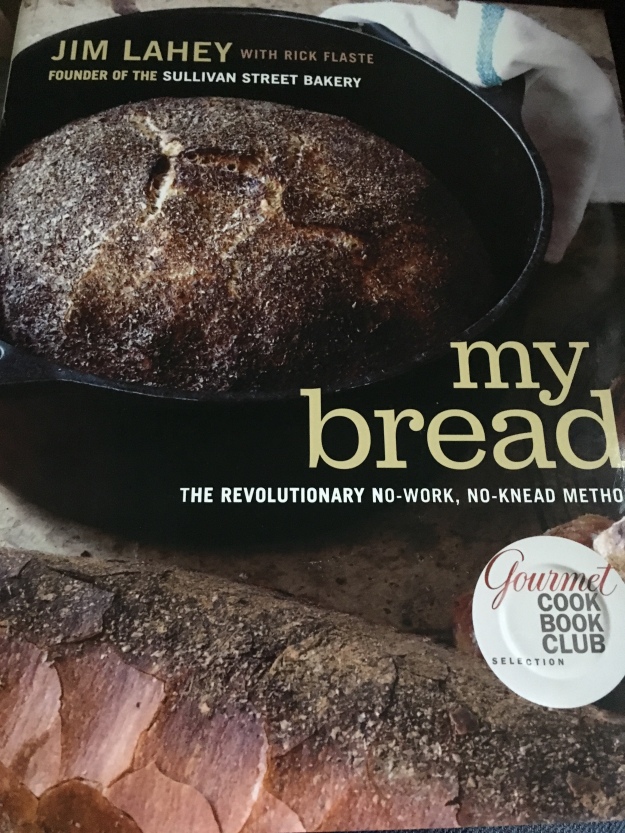
Sourdough has a reputation for being a bit tricky, so a lot of people find it intimidating. Thanks to my friend P, a fellow baking geek, I’ve been introduced to the Lahey method, which makes it super-easy to bake bread at home. I love this book!

IMG-0127.jpg

I’ve been experimenting with Lahey’s method for several weeks and my adapted recipe for sourdough is even simpler. It looks like a lot of steps but bear with me.

The genius part: Instead of folding/kneading your dough every few hours, you let your dough ferment overnight (18 hrs), do a second rise for 2 hrs and bake. No more being stuck in your house all day during the rising process!

STEP 1

All sourdough begins with a starter — natural yeast with a brinier flavor than the commercial yeast you find at the supermarket. Plan on 3-4 days before it’s ready to use. All you need is flour, water, air and time.

Mix equal parts water and flour in a wide mouthed container, cover it loosely so air can get to it, leave it out on your counter and wait. THAT’S IT. Really!

Once your starter is bubbly and active, try to make your dough within a few hours, before it loses potency. Thereafter, if you’re not baking regularly, dump out about 50-75% once a week, stir in equal parts water and flour, and start the process over.

IMG-0038.JPG

Starter is ready to use!

I encourage everyone to invest a few bucks in a kitchen scale and measure by weight rather than volume because 1) it’s easier and 2) it will guarantee consistent results. Remember, different flours have different densities so one cup of A may be slightly more or less than one cup of B.

Put your empty container on the scale, and set it to zero. Add 50g-75g whole wheat flour, 50g-75g bread (strong) flour, and 100g-150g cool water, resetting to zero after each addition. Don’t worry if you’re off by a gram or two as long as your ratio of total flour to water is roughly 1:1.

STEP 2

You’ve been patient and you now have over 100g of starter. Let’s get going.

Put a large bowl on the scale, zero it out, and add:

  • 600g flour (I like 475g bread flour +125g whole wheat or another grain)
  • 16g salt
  • ¼ teaspoon of active dry yeast (the kind you get at the grocery store)
  • 450g water
  • 107g active starter*
  • Optional: Add a generous handful of chia seeds and a tablespoon of caraway seeds, as I’ve done here.

*If this amount uses up most of your starter, replenish by adding  50g flour plus 50g water, mix well and set it aside to reactivate for a couple of days.

STEP 3

IMG-0110

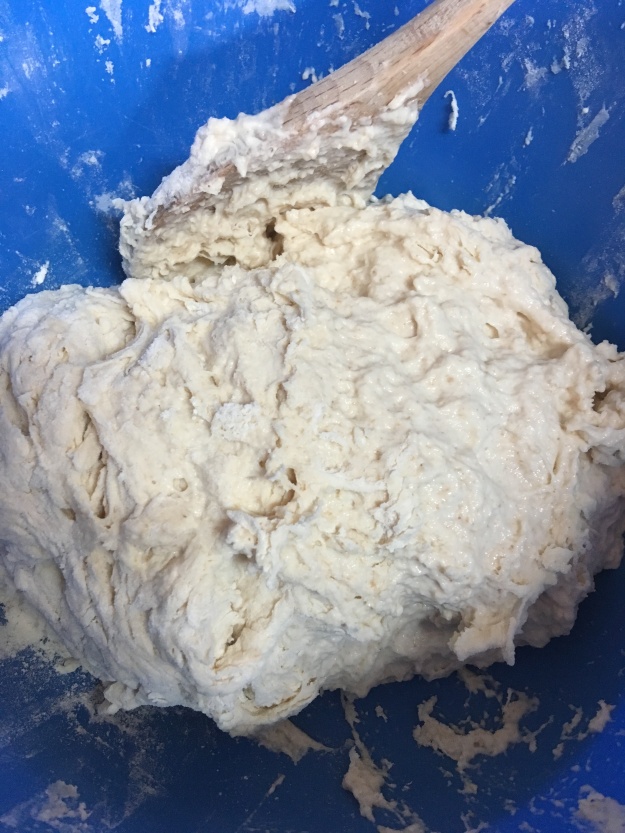
Once you have a well mixed dough (it will be sticky; DO NOT be tempted to add more flour), loosely cover the bowl with plastic wrap and leave it out at room temperature overnight for 18 hours. If you do this at, say, 4 PM, your dough will be ready for the next step at 10 AM the next day.

STEP 4

18 hours later, your dough will be bubbly and will come away from the bowl in long strands – this is the developed gluten. It will be loose and sticky; don’t add more flour!

IMG-0121

IMG-0114

Those strands are the gluten

Dump it onto a lightly floured counter, and form the dough into a ball by tucking the edges under – using either a dough scraper or your (lightly floured) hands.

IMG-0116

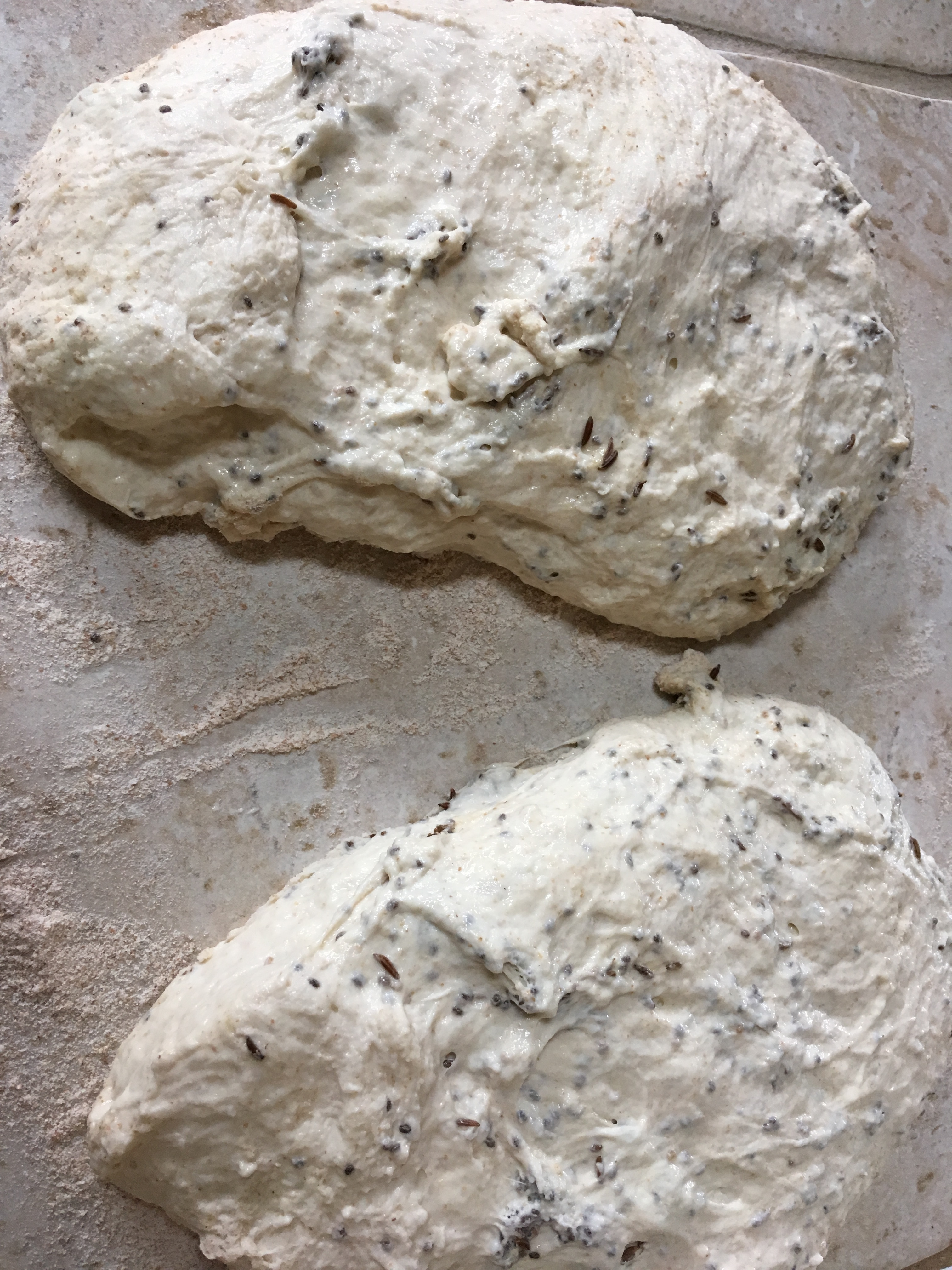
The dark bits are the chia and caraway seeds.

STEP 5

The traditional method is to bake your dough in a pre-heated cast iron pot.  This is an easy alternative.

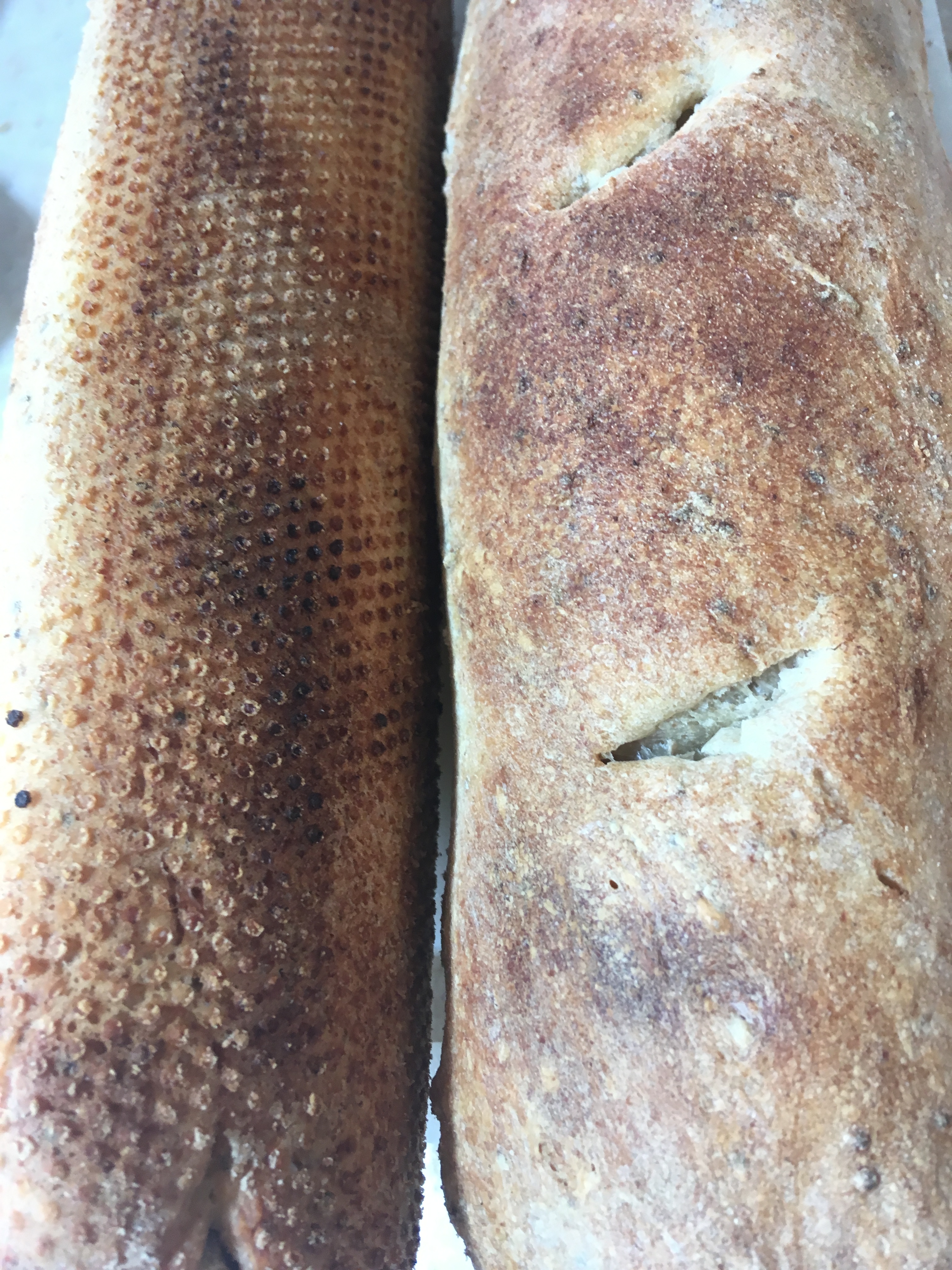
Divide dough into two balls. Shape each ball into a log and put them in a perforated baguette pan. For a free form shape, place your logs (or ovals) onto a baking sheet that’s been generously dusted with cornmeal. Leave plenty of room between them.

IMG-0115.JPG

IMG-0118

Lightly dust the tops with flour. Cover the pan or baking sheet with a linen or cotton dishtowel (avoid terry cloth) or plastic wrap, and let the dough rise again for 2 hours.  After 1.5 hours have elapsed, preheat your oven to 500 degrees F.

STEP 6

After another half hour (the full two hours), your dough will have puffed up nicely. Spritz your hot oven with water, put the bread into the oven and lower the heat to 475 degrees F.

You can spritz again after 2-3 minutes to keep the steam going and create a crispier crust. You can also score the dough at this point to let steam escape during baking but it’s not crucial.

Bake for about 25 minutes and check your bread – it should be a rich golden color. Depending on your oven this may take another 5+ minutes.

IMG-0123.JPG

Left: the bottom, showing bumps from the perforated pan.

To ensure your bread is baked through, check it with a kitchen thermometer – the internal temperature of the bread should be 205-210 degrees F.

IMG-0126.jpg

Nice and craggy with an open crumb

Cool. Slice. Eat.