This just in: Wearing a mask — any mask — reduces the risk of infection with the coronavirus, but wearing a more tightly fitted surgical mask, or layering a cloth mask atop a surgical mask, can vastly increase protections to the wearer and others, the Centers for Disease Control and Prevention reported on Wednesday.
New research by the agency shows that transmission of the virus can be reduced by up to 96.5 percent if both an infected individual and an uninfected individual wear tightly fitted surgical masks or a cloth-and-surgical-mask combination.
The title of this article intrigued me, as I wondered if there are universally annoying sounds such as “nails on a chalkboard” (does anyone still have chalkboards? Does this reference mean anything to a younger generation?) — or if it is more subjective.
My list would have to include:
A screaming child, especially in a public place or an airplane
The sound of someone chewing loudly, esp. if there’s gum involved
A dental drill
The screech of a train pulling into the station
Donald Trump’s voice (hopefully, we will not hear it much longer)
Nervous clicking, tapping, etc. of long, fake nails. Even without the chalkboard.
The common denominators being Loud/Repetitive/Incessant/Harsh.
The author posits that the pandemic has made things worse, as being cooped up for weeks/months on end is bound to lower our collective tolerance. Odds are, your neighbor banging pots and pans might be (slightly) more tolerable if you weren’t forced to hear it day in, day out.
Happy Hump Day! This info is very encouraging. Maybe we’re close to turning the corner on this vicious pandemic. How sad it didn’t happen much, much earlier. And if Congress defangs that crazy Marjorie Taylor Greene, it will be an all-around excellent week. Cheers!
[From New York Times] “For once, we have some good news to talk about: the prospect of another vaccine coming online in the U.S., and a long-awaited indication that at least one vaccine reduces transmission, not just the severity of Covid-19.
Let’s start with the remarkable turnaround of the experimental vaccine from Novavax, a Maryland-based company that has never before brought a vaccine to market.
Last fall, Novavax postponed U.S. clinical trials because of manufacturing delays, jeopardizing the company’s $1.6 billion federal contract and leaving some to wonder whether they should write off the company’s shot entirely. In December, Novavax watched from the sidelines as the Pfizer-BioNTech and Moderna vaccines were approved.
But things have changed. Novavax announced last week that its vaccine produced robust protection in a large British trial and that it worked — although far less well — in a smaller study in South Africa. The company has also been able to quickly recruit volunteers for its U.S. trials because the two authorized vaccines have been difficult to get, and many see the Novavax trial as their best chance to get vaccinated.
So the company now stands a chance of having trial results this spring, with possible government authorization as early as April. If everything goes well, and that is a big if, Novavax could deliver enough additional doses to vaccinate 55 million Americans by the end of June. That would be on top of the 400 million doses that Moderna and Pfizer are contracted to supply the U.S. by the middle of the year — enough for 200 million people.
It gets better: Novavax has been laying the international groundwork for the eventual production of two billion doses per year — and its vaccine, unlike Moderna and Pfizer’s, can be stored and shipped at normal refrigeration temperatures.
As for protection against transmission, AstraZeneca recently released a report that offered an answer to one of the pandemic’s big questions: Will vaccines prevent people from giving the virus to others?
Researchers from the University of Oxford and AstraZeneca have found that not only did their vaccine protect people from serious illness and death but also had the potential to reduce transmission. Swabs taken from trial participants showed a 67 percent reduction in virus being detected among those vaccinated, though scientists warned that the data was preliminary and that masking remained necessary for all.
The AstraZeneca-Oxford vaccine is in U.S. trials, and the company has a deal to supply 300 million doses, enough for another 150 million people.”
To summarize some encouraging vaccine news in today’s New York Times:
All five vaccines with public results have eliminated Covid-19 deaths. They have also drastically reduced hospitalizations. “They’re all good trial results,” reports Caitlin Rivers, an epidemiologist at Johns Hopkins University. “It’s great news.”
Don’t focus on the relatively minor differences among the vaccine results. The available data is very encouraging — including the vaccines’ effect on the virus’s variants.
Coronaviruses have been circulating for decades if not centuries, and they’re often mild. The common cold can be a coronavirus. The world isn’t going to eliminate coronaviruses — or this particular one— anytime soon.
We don’t need to eliminate Covid-19 for life to return to normal. We need to downgrade it from a deadly pandemic to a normal virus.
All five vaccines — from Pfizer, Moderna, AstraZeneca, Novavax and Johnson & Johnson — look extremely good. Of the roughly 75,000 people who have received one of the five in a research trial, not a single person has died from Covid, and only a few people appear to have been hospitalized. None have remained hospitalized 28 days after receiving a shot.
For perspective, in 75,000 American adults, Covid has killed roughly 150 and sent several hundred more to the hospital. The vaccines reduce those numbers to zero and nearly zero, based on the research trials. A typical U.S. flu season kills between five and 15 out of every 75,000 adults and hospitalizes more than 100.
When you read that the Johnson & Johnson vaccine was 66 percent effective or that the Novavax vaccine was 89 percent effective, those numbers are referring to the prevention of all illness. Researchers count mild symptoms as a failure.
What about the highly contagious new virus variants that have emerged in Britain, Brazil and South Africa? There is no evidence yet that it increases deaths among vaccinated people. Two of the five vaccines — from Johnson & Johnson and Novavax — have reported some results from South Africa, and none of the people there who received a vaccine died of Covid.
The vaccines still provide considerable protection against the variant, though less than against the original version. Some protection appears to be enough to turn this coronavirus into a fairly normal disease in the vast majority of cases.
Any of the five vaccines can save your life. If you have to choose between getting the Johnson & Johnson vaccine now or waiting three weeks to get the Moderna or Pfizer vaccine, the experts say: Get what you can, as soon as you can. Don’t risk three more weeks of exposure.
The ability to pee while standing up is one that is distinctly masculine. But just because a man can pee standing up, does that mean he should? The ability to urinate while standing up is a definite plus on wilderness hikes and out in the backwoods. But is it something that should be used in the world of low toilet seats, expensive hardwood floors, and marble restrooms? Is it better for a man’s health to urinate while in the seated position? Here are six reasons why men should consider peeing sitting down.
6. It Prevents the Spread of Illness
While urine is sterile, those splashes and puddles that accumulate on the toilet seat and floor make for sticky areas where germs can collect. When your doctor collects your urine for a urine test, the pee is sent to a lab, placed in a petri dish, and kept at body temperature to see if any bacteria grows. Since no one wants to walk into a life-sized petri dish, sitting down will keep your pee in the toilet where it belongs.
5. It May Prevent Lower Urinary Tract Symptoms
The National Institutes of Health reports that sitting down while peeing can decrease lower urinary tract symptoms (LUTS) in men who are prone to frequent symptoms. Symptoms of LUTS are an increased frequency of urination, inability to completely empty the bladder, and an urgent need to urinate. Sitting down allows the bladder to more completely empty and prevents leftover urine from developing a bacterial infection.Related: 12 Signs You May Have a Kidney Infection
4. It Prevents Unsightly Puddles
One of the best reasons to pee sitting down is simply for the aesthetic effect. You don’t have to be a germaphobe or a neat freak to prefer using a restroom that is devoid of unsightly splashes and splatter. Bathrooms are used for more than just peeing. You might enjoy a soak in the tub, relaxing in a steamy shower, and trimming your beard at the sink. These activities aren’t so pleasant when surrounded by yellowing drips and drizzles. Peeing while sitting down ensures you don’t have to keep seeing your pee on subsequent trips to the bathroom.
3. It May Improve Prostate Health
As men age, the prostate gland can become enlarged. When this happens, added pressure on the bladder can lead to incomplete emptying of the bladder. Sitting down allows for more complete relaxation of the pelvic muscles and more complete emptying of the bladder. Peeing sitting down can help prevent some of the painful symptoms of an enlarged prostate such as bladder stones and urinary tract infections.Related: 8 Prostate Cancer Myths Debunked
2. It Protects Your Floors
The uric acid in pee can leave behind stains and odor in your tile, wooden, and ceramic floors. A landlord in Germany actually sued one of his tenants for urine damage to his marble floors. To keep your floors pristine and to avoid odors from urine damage, take a seat while emptying your bladder.
1. It Makes Your Spouse Happier
Leaving the cap off the toothpaste, hogging the blankets, and not replacing the toilet paper roll are all common disagreements among couples. Add leaving unsightly pee splatter near the toilet to that list. Sitting down to pee is one way to keep your spouse happy—especially if she is the one cleaning the bathroom. Sitting down to pee is one simple way to keep your bathroom cleaner and your wife happier. Maybe then she’ll be more willing to share the blankets.
Encouraging news from today’s New York Times (Sorry, the formatting is a little wonky):
Why the vaccine news is better than you may think.
By David Leonhardt
Preparing the Pfizer vaccine in Phoenix.Adriana Zehbrauskas for The New York Times
‘We’re underselling the vaccine’ Early in the pandemic, many health experts — in the U.S. and around the world — decided that the public could not be trusted to hear the truth about masks. Instead, the experts spread a misleading message, discouraging the use of masks.
Their motivation was mostly good. It sprung from a concern that people would rush to buy high-grade medical masks, leaving too few for doctors and nurses. The experts were also unsure how much ordinary masks would help.
But the message was still a mistake.
It confused people. (If masks weren’t effective, why did doctors and nurses need them?) It delayed the widespread use of masks (even though there was good reason to believe they could help). And it damaged the credibility of public health experts.
“When people feel as though they may not be getting the full truth from the authorities, snake-oil sellers and price gougers have an easier time,” the sociologist Zeynep Tufekci wrote early last year.
Now a version of the mask story is repeating itself — this time involving the vaccines. Once again, the experts don’t seem to trust the public to hear the full truth.
This issue is important and complex enough that I’m going to make today’s newsletter a bit longer than usual. If you still have questions, don’t hesitate to email me at themorning@nytimes.com.
‘Ridiculously encouraging’ Right now, public discussion of the vaccines is full of warnings about their limitations: They’re not 100 percent effective. Even vaccinated people may be able to spread the virus. And people shouldn’t change their behavior once they get their shots.
These warnings have a basis in truth, just as it’s true that masks are imperfect. But the sum total of the warnings is misleading, as I heard from multiple doctors and epidemiologists last week.
“It’s driving me a little bit crazy,” Dr. Ashish Jha, dean of the Brown School of Public Health, told me.
“We’re underselling the vaccine,” Dr. Aaron Richterman, an infectious-disease specialist at the University of Pennsylvania, said.
“It’s going to save your life — that’s where the emphasis has to be right now,” Dr. Peter Hotez of the Baylor College of Medicine said.
The Moderna and Pfizer vaccines are “essentially 100 percent effective against serious disease,” Dr. Paul Offit, the director of the Vaccine Education Center at Children’s Hospital of Philadelphia, said. “It’s ridiculously encouraging.”
The details Here’s my best attempt at summarizing what we know:
The Moderna and Pfizer vaccines — the only two approved in the U.S. — are among the best vaccines ever created, with effectiveness rates of about 95 percent after two doses. That’s on par with the vaccines for chickenpox and measles. And a vaccine doesn’t even need to be so effective to reduce cases sharply and crush a pandemic.
If anything, the 95 percent number understates the effectiveness, because it counts anyone who came down with a mild case of Covid-19 as a failure. But turning Covid into a typical flu — as the vaccines evidently did for most of the remaining 5 percent — is actually a success. Of the 32,000 people who received the Moderna or Pfizer vaccine in a research trial, do you want to guess how many contracted a severe Covid case? One.
Although no rigorous study has yet analyzed whether vaccinated people can spread the virus, it would be surprising if they did. “If there is an example of a vaccine in widespread clinical use that has this selective effect — prevents disease but not infection — I can’t think of one!” Dr. Paul Sax of Harvard has written in The New England Journal of Medicine. (And, no, exclamation points are not common in medical journals.)
On Twitter, Dr. Monica Gandhi of the University of California, San Francisco, argued: “Please be assured that YOU ARE SAFE after vaccine from what matters — disease and spreading.”
The risks for vaccinated people are still not zero, because almost nothing in the real world is zero risk. A tiny percentage of people may have allergic reactions. And I’ll be eager to see what the studies on post-vaccination spread eventually show. But the evidence so far suggests that the vaccines are akin to a cure
Offit told me we should be greeting them with the same enthusiasm that greeted the polio vaccine: “It should be this rallying cry.”
The costs of negativity Why are many experts conveying a more negative message?
Again, their motivations are mostly good. As academic researchers, they are instinctively cautious, prone to emphasizing any uncertainty. Many may also be nervous that vaccinated people will stop wearing masks and social distancing, which in turn could cause unvaccinated people to stop as well. If that happens, deaths would soar even higher.
But the best way to persuade people to behave safely usually involves telling them the truth. “Not being completely open because you want to achieve some sort of behavioral public health goal — people will see through that eventually,” Richterman said. The current approach also feeds anti-vaccine skepticism and conspiracy theories.
After asking Richterman and others what a better public message might sound like, I was left thinking about something like this:
We should immediately be more aggressive about mask-wearing and social distancing because of the new virus variants. We should vaccinate people as rapidly as possible — which will require approving other Covid vaccines when the data justifies it.
People who have received both of their vaccine shots, and have waited until they take effect, will be able to do things that unvaccinated people cannot — like having meals together and hugging their grandchildren. But until the pandemic is defeated, all Americans should wear masks in public, help unvaccinated people stay safe and contribute to a shared national project of saving every possible life.
Here’s a bow-WOW from the world of science: Dogs’ acute sense of smell may mean they can sniff out people carrying the virus — say, before they get on an airplane.
[from StudyFinds.org]
Dogs trained to detect people infected with COVID-19 – by sniffing their armpits
MAISONS-ALFORT, France — While a vaccine for the coronavirus will help stop the pandemic’s spread, finding everyone who may be carrying the virus is still an issue. Luckily, man’s best friend is now on the case. Researchers in France are helping to specially train dogs to detect people infected with COVID-19 — by sniffing their armpits.
A new study that has seen pilot programs spring up around the world has discovered that dogs can sniff out coronavirus in the sweat of humans. Thanks to their famously acute sense of smell, dogs have been rooting out drugs, explosives, and even successfully pick up diseases like cancer for years.
A team of French scientists have now shown man’s best friend can also help save lives during the pandemic by spotting the virus. (Image credit: National Veterinary School of Alfort)
The French scientists are now showing how our furry friends can also help save lives during the pandemic by spotting virus clues. An early experiment suggested canines could be between 75 and 100 percent effective at detecting the disease with their noses.
Dogs paw-trolling airports for COVID?
The technique has already been piloted in several countries including the UEA, Lebanon, Finland, Australia, and elsewhere. Travelers may already have seen the specially trained dogs at some airports, but researchers are still trying to prove without a doubt that dogs can pick up the scent before the method is fully adopted.
The team behind the study hope their findings will mean dogs could help with COVID aid in parts of the world without the infrastructure for expensive mass testing programs. The loveable animals could be used anywhere however, with the hope that invasive nasal swabs could be replaced by a simple sweat sample taken from under the armpit for a dog to sniff.
Mass testing alternative?
Professor Dominique Grandjean, from the National Veterinary School of Alfort in France, says the dogs could check a large number of people in a short period of time.
“The results are good and I’m happy, really happy,” Grandjean says in a statement, per SWNS. “It is a success technically and scientifically and it’s surprising because we didn’t know what we were going to have as results.”
During the study, which started in March, the researchers recruited six dogs previously trained to sniff out bombs, colon cancer, or were used in search and rescue missions and re-trained to detect COVID-19. (Image credit: National Veterinary School of Alfort)
“We have been validated by the World Health Organization and they have given us a bit of money which is good. “Probably the country which is the most advanced now is the UAE, where they have dogs in three international airports. They are deploying some mobile units to go to the villages and to the people that might be more exposed to the virus,” the professor explains.
“For us here the idea was, of course, the airports but I can imagine a small city having a couple of dogs and just saying to the population ‘you can be tested whenever you want.’ You just come and put a swab under your armpit and give that to the dog and he will tell you yes or no. The dogs would be able to do that very quickly on a large number of people.”
Ending the pandemic one sniff at a time
Grandjean adds that dogs could also be used where people are reluctant to have uncomfortable nasal swab tests. During the study, which started in March, the researchers recruited six dogs previously trained to sniff out bombs, colon cancer, or used in search-and-rescue missions and re-trained to detect COVID-19.
They then collected sweat samples from 177 people (95 with COVID-19 and 82 without) and then placed the samples inside cones for the dogs to sniff. In trials, the dogs successfully picked out the infected sweat when examining a line-up of mock and negative samples.
Although the published study is just a “proof of concept” and cannot be taken as absolute proof, Prof. Grandjean and his team have now carried out further studies to validate their results and have more planned in 2021. They have also issued a “practical guide” to other academics to help others in their research and are building up a set of “international training standards” for dogs.
“We have been working with lots of countries. I think we have 20 countries working for us. It’s amazing, really amazing,” Prof. Grandjean concludes.
The study was published in the online journal PLOS ONE.
SWNS writer William Janes contributed to this report.
What a week! I would normally shy away from discussing anything political on this blog, but it’s been such a wild time that I feel compelled to dive in and mix a few metaphors.
7 million more of us saw the writing on the (bathroom obscenities) wall and anticipated a certain amount of resistance to the election results. But I do have some sympathy for those blindsided Kool-Aid drinkers who couldn’t see that their beloved was in the throes of a Hitler-in-the-bunker last stand.
Think about it. Four years is a long time to be in an intense relationship with a crazy person. There’s been a collective Stockholm Syndrome amongst these supporters who only get information from their crush and don’t want the grownups to explain that all is not as it seems. Both the highs and lows are so intense that “normal” is seen as boring. And woe betide anyone who dares say that the emperor has no clothes (ok, that’s a horrifying visual). He HAS clothes. They’re GREAT clothes. They’re the BEST clothes anyone ever had.
Well, sadly, the wannabe coup-coo dictator can’t even break up with his fan club on Twitter, like other cowards do. And unless he’s planning to write a whole lot of personal “It’s not you, it’s me” Dear Don letters, they’ll have to learn about it on the real news, i.e. the non-conspiracy, actually-validated-with-facts sort of news.
Meanwhile, expect sales of tissues and Rocky Road ice cream to go through the roof.
Need help following your New Year’s resolution to eat healthier food? Move to the UK, where apparently they will do this for you! (You might take this with a grain of salt, except it’s also on the watch list.)
On Monday, the U.K.’s Department of Health and Social Care announced a pack of new regulations that will be implemented in April 2022 to restrict junk food promotions.
In 2018, London implemented a ban of junk food advertising that was written so broadly that it forbid promotion of all sorts of normal foods (like butter, olive oil, and canned fruit) not because those items were unhealthy but because they had sugar, salt, or fat levels beyond government-approved thresholds.
The U.K. now plans a nationwide ban on television advertisements for what it calls “junk food” before 9 p.m. And that’s not the only new regulation. Also on the list:
Retailers will not be permitted to offer “buy one, get one free” promotions (or similar offers) for foods the government deems unhealthy.
Retails will not be permitted to display these unhealthy foods for promotioal purposes near checkout counters, near the front of the store, or on the ends of aisles.
Retailers will not be permitted to promote unhealthy foods on the entry or landing pages of their websites.
Free refills of sugary drinks will be banned at restaurants.
“We know families want to be presented with healthier choices,” said Public Health Minister Jo Churchill. “This is why we are restricting promotions and introducing a range of measures to make sure the healthy choice is the easy choice.” They’re going to make it the “easy choice” by deliberately bringing about economic harm to any competing choices!
The government claims that the British people have an obesity problem—more than 63 percent of adults and a third of elementary school children are overweight. Because the United Kingdom has socialized medicine through the National Health Service (NHS), this means the healthcare costs associated with obesity, which are estimated to be 6 billion pounds annually ($8 billion), are everybody’s problem.
The U.K. government can’t seem to acknowledge or accept the idea that people are voluntarily and willingly making bad choices. This Nanny State mentality means that the government must lay the blame on those who sell or advertise unhealthy food.
“Promotions often appear to help shoppers save money,” the agency explained in its press release. “However, data shows that these deals actually increase purchases of promoted products by almost 20%. They encourage people to buy more than they need or intended to buy in the first place.”
But people always need food. If you buy more food than you “need or intended to buy in the first place” you can usually save it for the future. That is what sales, promotions, and other low-pricing deals accomplish. They allow people to stock up and store food. That’s particularly important when governments everywhere are trying to discourage people from gathering in public places due to the pandemic.
Speaking of COVID-19, even though the U.K.’s food nannyism has been building for years, British officials can’t help but try to use the coronavirus as a justification for their actions: “The COVID-19 pandemic has brought to the fore the impact that obesity can have on people’s health and health outcomes.”
Snowdon notes that a ban on buy-one-get-one-free promotions could cost the average family more than 600 pounds (more than $800) a year by the government’s own estimate. That means that British officials are trying to deliberately force up the cost of unhealthy foods because they think this will force people to choose healthier alternatives.
What will U.K. health authorities do when their latest tactics fail to make people eat better? A cynic might assume they’re already planning out even more new rules that are doomed to fail.
Experimental brain implants in monkeys offer hope for restoring vision
Scientists have said they are one step closer to restoring the sight of blind people using brain implants.
[Adapted from an article by Amy Woodyatt, CNN]
Monkey business? After a series of successful experiments, scientists are a step closer to restoring the sight of blind people using brain implants.
Researchers at the Netherlands Institute for Neuroscience developed implants containing 1,024 electrodes — conductors that carry electrical currents into and out of the brain — and implanted them in the visual cortex, the part of the brain that processes visual information, in two macaque monkeys. By sending electrical signals to the monkeys’ brains, researchers created “phosphenes” — dots of light that could be “seen” or perceived by the brain, and then used to create the illusion of shapes and objects.
Lead researcher Pieter Roelfsema told CNN that the team wanted to show it was possible to induce “vision of objects” through direct electrical stimulation of the brain, explaining that the visual cortex has “a sort of visual map of space.””You can work with it like a matrix board along the highway. If you stimulate or light up multiple boards, you can see patterns,” he said.The monkeys performed a series of tasks, and, using their artificial vision, were able to recognize shapes and “percepts” including lines, moving dots and letters, according to findings recently published in the journal Science.
Wider implications for restoring sight
The team believes that such technology could one day be used to simulate sight in blind people who have been able to see at some point in their lives.












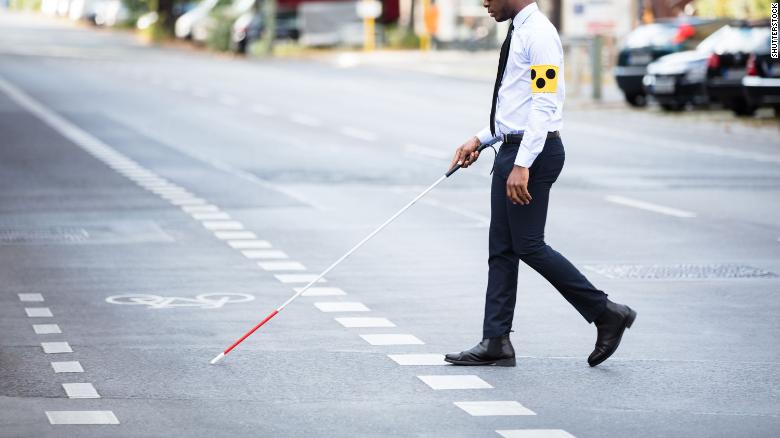 Scientists have said they are one step closer to restoring the sight of blind people using brain implants.
 olderfatterhappierdotcom