Category Archives: Observations

Wouldn’t It Be Nice

There are personal shoppers and people who can do your taxes, clean your house, even stand on line for you. Which made me wonder…

ask-3070333_640

Wouldn’t it be great if someone else could:

• Pee for you when you’re in the middle of something or it’s the middle of the night?

• Catch the flu for you?

• Remove your makeup when you’re about to collapse from exhaustion?

• Sit in bumper-to-bumper traffic for you?

• Take your mammogram/pap smear/proctology exam instead?

• Do your colonoscopy prep and then have tubes shoved up THEIR rectums?

Just sayin’….

Can This Recipe Be Saved?

Hi everyone, it’s hack time again. First up: cooking.

This weekend, DH and I struggled to fix a chicken dish that was weirdly sweet. After adding multiple ingredients, it was eventually quite good. But it got me researching solutions to some common kitchen problems you might encounter, too.

soup-greens-869075_640

KITCHEN HACK: Adjusting a Recipe

Too Salty

  • If you can rinse off the overly salty ingredient (such as the brine on your olives), that’s an easy place to start.
  • Add a raw potato (you don’t have to cut or peel it) to a liquid dish such as soup or curry. Potatoes will soak up some of the extra salt as they cook and add starch that will further dilute the saltiness.
  • Rice or a small amount of flour are other options.

Too Spicy

  • As with saltiness, adding starch is a quick fix for an overly spicy soup or curry.

Too Sweet

This is a common result when using carrots, red peppers or other vegetables with hidden sugars.

  • Add a squeeze of lemon, lime, or a spoonful of apple cider vinegar.
  • Balance the sweet taste with more seasoning to make the dish spicier.
  • Add a fat such as olive oil or avocado.
  • Try adding tangy yogurt if it’s appropriate for your dish.
  • Add more liquid to dilute it.
  • Avoid adding salt, as it will bring out all flavors, including sweetness.

Too Sour

The best way to counter too much sourness is to add sweet, salty or savory flavors. Think of the way a salt rim balances the sweetness of a margarita, or how adding carrots rounds out the taste of a marinara sauce.

Too Bitter

Leafy greens such as kale, collard, and mustard greens can be overpoweringly bitter. Other ingredients with a bitter edge include coffee, espresso, cocoa and herbs and spices such as parsley, paprika and cayenne (red) pepper.

Bitter is the opposite of acidic or sour so adding vinegar, citrus juice or yogurt can help balance the dish.

  • Squeeze some lemon over sautéed greens.
  • In Mexican cooking, lime helps balance red spices such as chile powder which can taste bitter.
  • Add a dash of grated nutmeg. The nutty taste helps balance other flavors.

HOUSEHOLD HACK: Splinters


wood-1693434_640

Don’t you hate those suckers?! I’ve collected a few tips for your next run-in with old furniture, fences or floorboards. It almost makes me wish I had a splinter so I could try them out. Almost.

  • Baking soda technique
  1. Mix a teaspoon of baking soda or baking powder with a few drops of water until it forms a paste.
  2. Apply the paste to the splinter.
  3. Wait 10-20 minutes until the skin swells a little and the splinter pops out of the skin.
  • Use a piece of duct tape or a drop of Elmer’s Glue to remove the splinter.
  • Soak. Pour some white vinegar into a small bowl. Soak the affected area for 15 to 20 minutes. Once the splinter has risen sufficiently out of the skin’s surface, it should be easy to remove with tweezers.

IMG-0045

FOLLOW-UP: Sicily

IMG-3159 (1)

My friend O suggested a post on my Do’s and Don’ts for next time. If you’re planning a trip to Sicily, here are a few post-vacation thoughts.

What I’d do again

  • Reserve Blacklane upon arrival at an unfamiliar destination. It will cost more than a taxi but the price is established and paid by credit card in advance. Benefits: 1) You won’t be driven all over the place to run up the meter. 2) You won’t have to change money at exorbitant airport rates. 3) Drivers are safe and you can request one who speaks your language. 4) The cars are cleaner and nicer than cabs.
  • Rent apartments instead of staying in hotels. Cooking (and grocery shopping) is fun and cheaper than always eating out.
  • If you plan to drive into the country, consider an apartment rental outside of the city so you can easily get in and out of town.
  • Buy tickets online in advance for popular museums and attractions.
  • Bring a good map and pocket Italian language guide.

What I’d do differently

  • Don’t plan on using Taormina as a base from which to travel to other areas unless you book a tour from town. It’s well located but too hard to navigate in and out.
  • One day is sufficient unless you really like to shop.
  • I’d spend more time in Palermo (better shopping, too).
  • I’d rent a place for a week about an hour’s drive from Siracusa and Noto. I’d rent another place for the second week an hour’s drive from Ragusa and the coast.

FOLLOW UP: Biscuits

IMG-0034

I’m still experimenting, but so far Alton Brown’s recipe checks all the boxes.

Curious about the meaning of the word “hack”? Originating as a computer term, it “… refers to any trick, shortcut, skill, or novelty method that increases productivity and efficiency….”

The Apocalypse on $10,000 a Day

A couple of nights ago, we watched the 2012 movie Seeking a Friend for the End of the World. The premise: an asteroid is hurtling towards Earth and will wipe out everyone in 3 weeks.

planet-519937_640

What would you do? Here’s my exit strategy.

Liquidate savings, leaving just a little in case the forecast is, you know, wrong.

Fly (first class of course) to a remote tropical island with a 5-star resort. Pack tons of books, many bottles of limited edition Islay whiskey, and sunscreen. (My end-of-life scenario doesn’t include suffering from painful sunburn.)

Check into our suite, having reserved all the rooms on the floor so as not to endure  fighting couples or screaming children.

Every day:

  • Walk on the beach. No sense meeting my Maker with flabby thighs.
  • Have a 3-hour massage, with one hour spent on neck and shoulders.
  • Drink steadily but only to maintain pleasant buzz, not hangover.
  • Have dessert at lunch and dinner. Who’s judging?
  • Have sex. OK, maybe not EVERY day.

Binge-watch all 19 seasons of Midsomer Murders. Mysteries are soothing because  bad guys always get caught. Unlike life.

Be friendly but don’t waste a minute with anyone who is boring or mean.

Consume plenty of fresh papaya, mango and strawberries. End-of-days plan should  not include constipation.

See glorious sunsets.

Gorge on cheese and chocolate. Cholesterol be damned.

Snuggle up with my sweetie every night. Drift off remembering every nice thing that’s ever happened to me.

There are worse ways to go.

Photo source: Pixabay

No Good Deed Goes Unpunished

Have you ever regretted volunteering for something? That’s the position in which I find myself this week.

As a member of the homeowners’ association board, way too much of my time is currently spent trying to navigate the petty disputes that constantly crop up between neighbors.

While I’m sympathetic to the concerns being raised on both sides of the latest kerfuffle (and deeply grateful to my fellow board members who share this thankless job), I am bone-tired of trying to be mom/cop/shrink/legal interpreter to a bunch of adults acting like whiny children – especially since I’m only actually qualified in the first category. Arrgh.

In between e-mail barrages, phone calls and meetings, I’m putting the stress to more productive use by pounding some dough.

rolling-pin-1680702_640

My weapon of choice!

Current baking challenge: the definitive buttermilk biscuit. Two recipes down so far, each pretty good but in need of adjustment.

Plus, more decisions to make: Cookie sheet or cast iron skillet? Butter, shortening or a combo? Baking soda as well as baking powder? Rolling pin or flatten by hand?

At least they don’t talk back.

IMG-0032.JPG

If anyone has a recipe they love, please share! xxxx

“Anti”-Aging

Allure magazine has recently reported that they’ll no longer use the term “anti-aging”. It’s about time.

Since we’ve only got two options — getting older or checking out — there’s not much point in fighting the inevitable. Instead, let’s embrace some of the positives and enjoy being our best selves.

IMG-0025 (1)

Antiques are so much more interesting than newbies!

The List

1. YOUR DOUBLE CHIN DISAPPEARS. With the passing years, fat pads under our chins usually get smaller as our faces become less round. (Bonus: more visible cheekbones!) So if you’re considering a fat removal procedure in your 20’s or 30’s, you should probably wait.

2. YOU’RE HAPPIER. According to a study in the Journal of Clinical Psychology, happiness steadily increases from your 20’s to your 90’s as anxiety, depression and stress levels tend to go down.

3. YOU CAN WAVE GOODBYE TO THE BAGS UNDER YOUR EYES. When we’re younger, these are often fatty deposits. In older women, they’re more likely caused by fluid retention, which decreases as we go about our day.

4. SEX IMPROVES. Caveat: The study they cite in the magazine contrasts higher levels of satisfaction for women in their 40’s and 50’s vs. women in their early 20’s. Older women know their bodies better, are more likely to ask for what they want, and may be more spontaneous. (Note: no mention of post-menopausal issues, though.)

5. YOUR SKIN IS GLOWIER. Again, they’re talking 30’s-50’s, when moisture levels are highest and problems such as acne tend to resolve themselves. Moisture levels drop as hormones and hydration decrease, so 60+ skin often needs extra help.

6. YOU’LL SAVE ON WAXING. As testosterone dips in your 40’s, body hair starts to be lighter and thinner. Post-menopause, skin becomes thinner and waxing may be more irritating than a gentler process such as sugaring. Or, fuhgeddaboudit.

7. YOU’RE MORE OPEN-MINDED. A University of Michigan study found that women in their 50’s were more empathetic than those who were younger. Mature people may have strong opinions but we’re also more likely to understand other points of view.

For more thoughts on aging, plus a delicious cocktail recipe, click here.


Party Line

I’ve been noticing a growing trend: hosts and hostesses who weren’t taught the golden rule of party giving – namely, that your role is to make sure that all your guests have a great time. (If you have a good time, too, that’s icing on the birthday cake!)

At several parties we attended this past year, the hosts stayed in the kitchen or one part of the house, chatting with only a few people. They didn’t circulate with an eye out for anyone who might be standing alone. Nor did they make introductions (e.g., “Have you met So-and-So? He’s a pilot and since you love to travel, you should get to know each other”), thereby giving the conversation a starting point.

Is this generational? Geographical? Situational… perhaps a carryover from going to office parties where you already know everyone?

There’s a parallel trend at dinner parties: guests who either show up empty-handed or fail to write a “bread and butter” thank you note (or e-mail or text). Contrast that with friends who came over the other night bringing two bottles of wine, homemade dessert, and flowers. These are people you’ll definitely invite again!

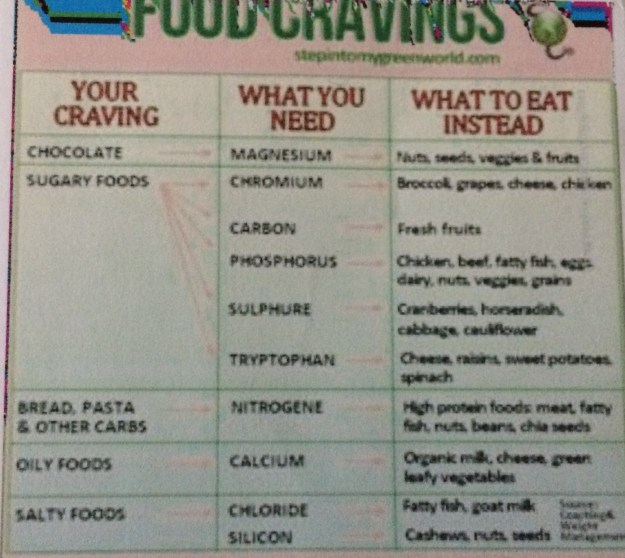
Meanwhile, since you probably have some parties and eating in your future from now through New Year’s, I found the following food cravings chart very interesting. I have no idea whether the science behind it is sound, but if it helps, who cares, right?

Remember that nuts and cheese are high in calories, so substitute in moderation.

FullSizeRender (6)

Happy holidays!

A Little Holiday Humor

(Sent from a friend.)

THERE WERE 3 GOOD ARGUMENTS THAT

Jesus was Black:

  1. He called everyone “brother”.
  2. He liked Gospel.
  3. He didn’t get a fair trial.

But then there were 3 equally good arguments that Jesus was Jewish:

  1. He went into his Father’s business.
  2. He lived at home until he was 33.
  3. He was sure his mother was a virgin, and his mother was sure He was God.

But then there were 3 equally good arguments that Jesus was Italian:

  1. He talked with his hands.
  2. He had wine with his meals.
  3. He used olive oil.

But then there were 3 equally good arguments that Jesus was a Californian:

  1. He never cut his hair.
  2. He walked around barefoot all the time.
  3. He started a new religion.

But then there were 3 equally good arguments that Jesus was a Native American:

  1. He was at peace with nature.
  2. He ate a lot of fish.
  3. He talked about the Great Spirit.

But then there were 3 equally good arguments that Jesus was Irish:

  1. He never got married.
  2. He was always telling stories.
  3. He loved green pastures.

But the most compelling evidence of all proves that Jesus was a WOMAN:

  1. He fed a crowd at a moment’s notice when there was virtually no food.
  2. He kept trying to get a message across to a bunch of men who just didn’t get it.
  3. And even when He was dead, He had to get up because there was still work to do.


#Me Too?

The world is abuzz with new revelations about sexual harassment, workplace predators and all-around bad behavior.

This leads me to think about a couple of incidents from my past.  Viewed through today’s lens, they’d probably warrant a call to HR.  But — and this is not to excuse these men — the world WAS different when I was young.

tiger-2940963_640

Incident #1

A suburban-dwelling supervisor stopped by my desk one evening to let me know he was going to “apartment sit” a friend’s place in the city for a few days and encouraged me to meet him there for drinks “and”. Said supervisor was married, decades older, and my direct boss.  Accepting might fast-track a promotion and certainly lead to plum assignments; refusal could turn a cordial relationship into enmity.

Unlike, say, Harvey Weinstein, there was no physical intimidation.  But the message was clear: if you want to advance, here’s one way to do it.

Incident #2

I had a tiny office and a very large, very tall boss.  One day, he came in, closed the door, and proceeded to back me up against the wall while attempting to kiss me. Physical and scary, as this man had total power over me — not just in that moment but going forward if I handled things badly.

Did I tell anyone? No. Because what good would it have done? Men had no hesitation coming on to women at work; it was almost expected and it happened a LOT. So with both bosses I tried to offer a reply that would protect their egos while I rejected them –thereby preserving our working relationship.

With boss #1, I flattered him by reminding him that I was a lot younger and said that if we became involved I’d risk falling for him, which would be a very bad idea.

He bought it.

With boss #2, I flattered him by telling him how much I liked working for him (he was brilliant) and I may have lied and said I had a boyfriend.

Was this brave? Of course not.  Just simple gut instinct that if I didn’t make a big fuss, they’d stop.  It didn’t occur to me that they might victimize someone else or that this could be a pattern; I only wanted them to leave me alone.

My questions are these:  Does every proposition by a person in authority qualify as sexual harassment? And has it become too easy to assign blame without also considering ways in which the other party might respond?

I get that a powerful person like Weinstein can intimidate the hell out of a young woman whose career might never get off the ground if she doesn’t “go along”.  But showing up at the guy’s hotel room might send the wrong signal.  And if he answers that door in his bathrobe, why in hell does she go in? Is she that naive? Or is she a participant in a quid pro quo?

I don’t mean to diminish the seriousness of sexual harassment. Men who think “grabbing pussy” is a compliment, or feel entitled to treat women as objects, are disgusting. On the other hand, I wonder whether we’ve gone too far in the other direction, labeling every advance or teasing remark as harassment, which minimizes those that are.

Perhaps we should learn how to diffuse a tense situation before it gets out of control. Plus karate, in case that doesn’t work.

What are your thoughts?

UPDATE, 1/11/18: Interesting perspective from Catherine Deneuve, et. al., saying that the pendulum has swung too far in the other direction (if you’ll forgive the anatomy reference):  https://www.nytimes.com/2018/01/09/movies/catherine-deneuve-and-others-denounce-the-metoo-movement.html?smprod=nytcore-ipad&smid=nytcore-ipad-share

In an open letter published in Le Monde, the actress and dozens of other Frenchwomen criticized the movement for punishing undeserving men.

cranium-2028555_640

Chance Encounters of the Meaningful Kind

What’s the best part of travel for you? The food? The culture? Hearing another language? To all these, I’d add, “Having unexpected conversations with strangers.”

I’ve got nothing against museums, monuments, scenery, restaurants, etc. – they all enrich the experience. But to get to another level, you’ve gotta get personal.

Some of my most vivid memories of last winter’s trip to Paris were random and often awkward chats that, despite my halting French and their equally limited English, somehow managed to connect us on a more profound level. In one shop, the attempts to find my correct size led to observations about women in general – how we often think we’re larger than we are, or want an outside observer to reassure us that we look attractive. (Yes, even Parisians can be insecure!)

And at a little place near the hotel specializing in tableware and jewelry, the owner engaged us in a discussion of art, politics (both US and French) and the current state of global anxiety so many of us share, as well as recommendations for which current exhibitions to skip and which to put at the top of our list. What could have been an ordinary, five-minute transaction became an enjoyable half hour conversation.

Our trip to Sicily raised the need to communicate to a whole new level, since almost no one we encountered spoke English and my Italian is basic at best. Yet, we blundered through and in doing so had some delightful moments.

There was the cashier at the grocery store who began to recognize us and teased us about buying yet another bottle of a favorite wine. And the woman selling fish at the local market who insisted that my husband eat a raw shrimp right on the spot so he’d believe her when she told us how fresh they were.

Back in Milan on Wednesday, our last night in Italy, we met two very chic women – a mother “of a certain age” (i.e., close to my own) and her adult daughter – who were also staying at our hotel. We’d shared a car with them earlier in the day when the hotel had taken us to a destination in town and then met by chance in the bar. After the mother greeted us, we invited them to join us and we started talking.

In this case, language wasn’t the challenge; the daughter alone speaks seven languages. (We Americans have much to learn from other countries: for most of us, studying another language in high school is the extent of our globalization and we expect the world to speak English when/if we leave our borders.)

But what I found fascinating was the ease with which our conversation skipped among a number of topics, some light and others quite serious, in a way that rarely happens on a first encounter.

In the space of an hour, we learned about their heritage, their life in Jordan, their fashion business (buying for their boutique brings them to Milan four times a year; how lucky is that?), and some of their family history, including seeing photos of the lovely younger daughter and father, both deceased.

We discussed politics, karma, spa vacations, the importance of intuition, Turkish hostilities towards Armenians and Jews, Bruce/Caitlin Jenner and the Kardashians, favorite fashion designers, which cities are “simpatico”, where to get good pizza in Milan, US universities, modern marriage, and more.

In short, we began to know them in a substantive way, and if we hadn’t been leaving early the next morning we would have enjoyed talking further.

I don’t know if we’ll continue to be in contact, but that’s unimportant. What matters to me is the generosity with which these two women shared stories about their lives, and the depth it added to our trip. Rather than being passive observers in another country, I felt that we were among friends.

And that’s a huge part of why I love to travel.

xo, Alisa


How To Be A Happier Couple

We’re off to Italy tomorrow — (see #1 below). Since I won’t be posting while we’re traveling I wanted to share the following thought-provoking article with all of you.

(Shared from WhoWhatWear):

According to the app Happify, the most blissed-out couples have been married for under five years and have no children. If you’re among that demographic, congrats! If you’re not, or if you foresee yourself crossing over into a long-term partnership or having a family at one point, fret not, as there’s still good news—happiness in relationships, just like individual happiness, is something you can work to achieve. Here, eight research-backed methods for becoming one of those happy couples of whom everyone is jealous (and not just on Instagram, but in actual life).

1. BE ADVENTUROUS

According to the New York Times, “New experiences activate the brain’s reward system, flooding it with dopamine and norepinephrine. These are the same brain circuits that are ignited in early romantic love, a time of exhilaration and obsessive thoughts about a new partner.” So while butterflies inevitably fade, studies show you can inject new energy into your relationship by regularly trying new things with your partner. Try date night activities that are outside of your comfort zone, rather than spending another night in watching Netflix or simply walking over to your favorite neighborhood restaurant. It’s fine to continue with these beloved activities (after all, fall TV!), but if you want to keep the flame alive, it’s advisable to mix things up every once in a while.

2. MAKE AFFIRMATIONS A DAILY OCCURRENCE

According to research conducted by Terri Orbuch, a psychologist and author of the book Finding Love Again: 6 Simple Steps to a New and Happy Relationship, one of the biggest learnings from her divorced clients was that they wished they had been more affectionate toward their spouse, or that their spouse had been more affectionate to them. Dr. Orbuch recommends performing one small act of kindness for your partner each day, be it a verbal affirmation (something focused on a positive attribute they possess or a positive feeling you have about them) or a physical action (like folding their clothes, giving them a hug). Taking specific note of the small things your significant other says and does to make you feel loved is important, too, as negative interactions are more naturally notable to our brains than are positive ones.

3. TALK ABOUT THINGS OTHER THAN MONEY, WORK ETC.

Dr. Orbuch’s research also revealed that the happiest couples made time to talk about things you might talk to your boyfriend about in the early stages of dating—dreams, values and goals. She recommends you commit to spending 10 minutes per day discussing with your significant other something that does not concern your job or other practical life demands. Ask your partner questions about their past (“What’s your favorite memory from childhood?”) and encourage them to share their bolder visions for the future (“What would you do tomorrow if money was no object?”).

4. FIGHT MORE BUT BETTER

Communication is key in relationships, and because you are two separate people, with separate world views, perspectives and goals, chances are that communication sometimes manifests as an argument. If you’re fighting small fights, often, this can be healthy, as it means neither partner is letting resentments build up. That said, the key to a “good” fight is to really listen to your partner’s point of view from a non-defensive place, and to try to look at the situation not just from their perspective, but from a non-partial, third party perspective. Also, it’s important to remember that you likely suffer from a closeness-communication bias, which means that you think you’re communicating your perspective to the people with whom you’re most intimate better than you actually are.

5. MAKE UP MORE

Apparently, being intimate one time per week is enough to increase happiness levels for couples, according to one study, and that going from one time per month to one time per week creates a happiness boost equivalent to that of a $50,000 raise. Though the same study also shows that intimacy more frequent than one time per week does not improve happiness levels, we don’t really believe that you can over-do it on this one.

6. LAUGH A LOT

Couples who laugh together, stay together, according to one study. Apparently, remembering times in which you shared a giggle in the past helps increase happiness within a relationship, as well.

7. MAKE OTHER PEOPLE A PRIORITY

This one has a few caveats. In news that’s sad for discarded single friends everywhere, it turns out that couples who hang out with other couples feel closer to one anotheras a result. More sad news, for divorced people, is that hanging out with friends who have split makes couples 75% more likely to divorce.

Generally speaking, though, it’s assumed to be healthy for any relationship for couples to spend time apart, with friends and family who are outside of the relationship bubble. This way, you’re not putting all of your expectations and needs onto one person—author Bella DePaulo articulates the dangers of doing exactly that here.

On another note, couples who prioritized others in the sense of parading their relationship for them online are not happier than couples who keep it a little more low-key. Read more about this fascinating phenomenon here.

8. DRINK TOGETHER… or don’t

Consuming a similar amount of alcohol as your partner increases the odds of success in a relationship; however, if you and your significant other do not have similar boozing habits, there could be trouble down the line.