Tag Archives: politics

Musings Du Jour

I’ve neglected this blog for too long, as there’s been a lot going on: Health issues with my husband, leading to many medical appointments, endless phone calls, and the usual snafus with insurance.

Happily, we are about to travel: just a week in France on a Viking river cruise, barely in Paris so I hope to skip Olympics madness. Very much looking forward to 8 days when I will not have to cook, clean, or deal with bills.

And, although this blog is not supposed to address politics, thank you Joe for finally stepping aside. Kamala isn’t perfect — not too thrilled with her position on Israel — but anything/anyone is better than that dangerous criminal orange cheeseball so I am cautiously optimistic about the future.

The following piece caught my eye and I think is a good explanation of the ways that otherwise good people are being led astray by so-called progressive rhetoric.

A non-Jew’s Perspective on Antisemitism and ‘Anti-Zionism’

Here are my 15 things to consider about antisemitism and “anti-Zionism.”

An essay by Pat Johnson of Pat’s Substack.

Share

There is an elephant in the room and we need to address it.

It is the relationship between antisemitism and “anti-Zionism.”

I am not Jewish. So, on the one hand, should I be the one defining the problem and offering solutions? On the other hand, why is it always left to Jewish people to make this case?

It is time for allies to stand up.

Here are my 15 things to consider about antisemitism and “anti-Zionism.”

1. Stop saying, ‘Anti-Zionism is not antisemitism.’

This is a deeply problematic statement. The idea that Jewish people and their allies scream “Antisemitism!” when confronted with “anti-Zionism” is a deflection and a projection.

The statement “anti-Zionism is not antisemitism” is used to avoid confronting the possible (in fact, undeniable) presence of antisemitism in the anti-Zionist movement.

They accuse Jews and their allies of deflecting real concerns about Israel by crying antisemitism. It is they, though, who deflect real concerns about antisemitism by cry-bullying about Zionists “silencing” them.

2. Start acting like anti-racists. Stop acting like racists.

We might expect this behavior from Right-wing extremists, who deny the presence of racism and dismiss invitations to self-examination. But it is (mostly) not coming from those people.

This atrocious deflection is coming overwhelmingly from “progressive,” self-declared anti-racism activists who, when faced with the remotest suggestion that they might be exhibiting any form of prejudice, always respond respectfully and engage in introspection.

Except when it comes to Jews and antisemitism.

Instead, not only will they not engage in self-reflection in this sole instance, they double down and accuse Jewish people of manipulating their experiences with prejudice to “silence” criticism of Israel.

In other words, they invoke antisemitic ideas of Jewish deviousness to avoid addressing their own antisemitism. This is obviously among the most unprogressive responses imaginable.

3. Be clear on nomenclature.

Anti-Zionism is not “criticism of Israel.” Anti-Zionism is the idea that Jewish people do not have the right to self-determination. It is a call for the eradication of the State of Israel.

The (very different) statement “criticism of Israel is not antisemitic” is probably fair (though it depends on the language and imagery we use and on our motivations). But anti-Zionism means something very specific.

And if Jewish people are the only people whose right to self-determination we oppose — indeed, if the only country in the world we seek to eradicate is the Jewish one  — well, excuse me for concluding the blatantly obvious.

4. Understand your biases.

We might conclude that we do not “hate” Jews, therefore we are not “antisemitic.” The terminology is problematic, I admit that. The prefix “anti-” suggests active antipathy. That exists, but it is probably not the most significant factor here.

We are not suggesting that people hate Jews, therefore they hate Israel. That’s not how this works. What is happening is that we hear allegations against Israel that dovetail with prejudices about Jews that have been handed down to us through generations of Western civilization and we are predisposed to believe them.

The most obvious example is the idea that Israelis steal Arab land. The fact is that Israel has given away proportionately more land in peacetime than any country in human history. Israel abandoned the Sinai Peninsula — giving up 75 percent of its landmass and its only hope for oil self-sufficiency — in the faint hope of a cold peace within Egypt.

Israel unilaterally disengaged from Gaza in 2005. Israel offered the Palestinian Authority control over the West Bank through the Oslo Accords peace process — and then-Palestinian leader Yasser Arafat overthrew the negotiating table and launched the Second Intifada.

Despite all the evidence, much of the world still adheres to a false narrative that Israelis (that is, Jews) take what is not theirs.

How does this happen?

Inherent prejudices and confirmation bias. We encounter allegations that Israel is taking stuff from Arabs and we hear echoes of our grandparents’ warnings about “those people” and their greed.

There are scores of examples like these, in which accusations against Israel dovetail with received prejudices about Jews — and the soils tilled by generations of anti-Jewish bias allow anti-Israel allegations (some with a seed of truth, some completely fabricated) to flourish.

5. You are criticizing Israel. Your words are heard by Jews.

The defense that most “pro-Palestinian” activists make today is that they are not criticizing Jews, just Israel. This is profoundly naive and disingenuous.

Here’s why: There are about 15 million Jews in the world. About half live in Israel. It is simply not sustainable to think that decent, empathetic people could condemn in the most violent, hateful terms possible the one Jewish country in the world, home to half the world’s Jewish people, with no emotional impact whatsoever on the other half of the Jewish people.

Outcome matters more than intent. You may heap hatred on Israel but Israelis do not hear it. The Jews who live in the Diaspora do. And they know what antisemitism-fueled discourse looks like, even if you do not.

6. Understand the Jews’ connections to Israel.

Regardless of the sheer numerical importance of Israel, almost every Jewish person in the world has a deep personal, familial, spiritual, religious, historical and/or cultural connection to the land of Israel.

Any expression whatsoever that diminishes or dismisses that connection — and such expressions are ubiquitous in the “pro-Palestinian” movement — is an absolute abrogation of the core identity of almost every Jew in the world.

Is that antisemitism?

Really, who cares what we call it.

7. Act in good faith.

The Holocaust is a huge issue (and a huge problem) in this dialogue. If your reaction to even bringing up this history is to roll your eyes, sigh or in any other way dismiss this as absolutely central, you lack the empathy and good faith to be engaged in this discussion.

8. Know your history.

The relationship between the Holocaust, Israel, and Zionism is complex. I cannot possibly do it justice in this brief space.

But the least you need to know is this: The Holocaust happened because of the Nazis, yes.

However, it was allowed to occur, in the scope that it did, killing more than one-third of the Jewish people in the world, because every other country outside of Germany was complicit.

At the Evian Conference of 1938, the entire “civilized world” voted as one to reject sanctuary to the imperiled Jews of Europe. Democratic countries, led by the United States, but enthusiastically endorsed by Canada, Australia, and every free European country, refused to take any Jewish refugees.

The Holocaust happened because the entire world turned their back on the Jews. The existence of Israel is the Jewish People’s answer not only to the Holocaust, but to the Evian Conference. It is the recognition that Jews can count on nobody but themselves at the most existential moment. If you don’t get that, you get nothing.

9. Know the centrality of Israel.

Because of this, the appealing, naive, preposterous idea of a “one-state solution” (which is, to be extremely generous, the least genocidal interpretation of the phrase “From the river to the sea”) denies the core reason Israel exists: So that, no matter what, there will always be one country in the world whose immigration policy welcomes endangered Jews.

10. Recognize the right to Jewish self-determination.

All of these (entirely legitimate) arguments for Israel’s right to exist are (or, at least, should be) irrelevant. The Jewish People have a right to national self-determination. If you think that the Palestinian people have a right to national self-determination, but Jewish people do not, you need to take a deep look into yourself and your biases.

11. Don’t (mis)define Jews.

If, however, you buy into the argument that Jewish people do not deserve self-determination because they are a “religion” rather than a “race,” you lack the knowledge to be engaged in this discussion.

Judaism is a religion. But Jewishness is something broader, with Judaism at its core. Jews are a people, an ethnocultural group, a nation. Yes, Jewishness is different than how most other identities are constituted.

But the fact that you do not understand the nuances of what makes a Jew a Jew, or who the Jewish People are, does not justify abrogating their right to national self-determination. Why should Jewish people suffer for your ignorance?

12. Understand that Jews are deeply invested in Israel.

Another Holocaust related point: as the magnitude of the Shoah slowly dawned on Jewish (and non-Jewish) people, in the years after 1945, it would have been completely understandable for the surviving Jews in the world to have plummeted into an unprecedented collective depression, to have given up all hope of redemption or belief in the humanity of their fellow beings.

Instead, in ways that dumbfound me as a non-Jew and a student of history, the Jewish People engaged in what is one of history’s most profoundly inspiring and redeeming experiments in rebirth and renewal.

Whether they chose to move to Israel or not, whether they signed up as foreign volunteers to defend Israel when it was attacked by its combined neighbors at the moment of its birth, whether they sold the family silver and sent the money the new state, whatever they did, almost every single Jew in the world took hope and invested their emotional, spiritual and financial resources into building the Jewish state.

That personal and familial connection remains — even among Jews who have never set foot in Israel.

This is what you spit on when you spit on Israel.

13. Israel is a testament to the past and a guarantee of the future.

Political Zionism was invented in the 19th century, but after the Holocaust, it became an almost-universal Jewish value, and the closest thing that could exist to an antidote to the Holocaust. Nothing — nothing — could undo what the Nazis did (with the complicity of the entire world).

But the universal Jewish commitment to creating, building and sustaining the Jewish state is viewed by almost all Jews as both a tragically belated testament to the memory of those murdered (if Israel had existed 10 years earlier, six million might not have died) but also a promise to the future, the greatest fulfillment of the crucial words: “Never again!”

14. Israel does not guarantee Jewish survival. But it is the best bet.

This raises two additional questions: Does the existence of Israel guarantee the security of the Jewish people?

October 7th said, clearly not, and that was only a reiteration of decades of genocidal attacks against the Jewish people in Israel by state actors and terrorist organizations.

It is, nevertheless, the surest guarantee that Jews will never again lack a coordinated defense against those who seek their destruction.

15. Don’t be cavalier about genocide.

The other question this raises may be (we know this from far-too-common statements): Isn’t it a bit paranoid to think that Jews could face another Holocaust? Is this not evidence of a particularly Jewish “persecution complex”?

If this idea so much as enters your mind as a legitimate argument, you lack both knowledge of the world and empathy for the Jewish experience.

Plenty of voices have called, and continue to call, for the annihilation of the entire Jewish People — voices not only in the darkest recesses of the Internet, but from leading religious, political and social figures around the world, including the government of Iran, which is nearing the capability to eradicate at least half the Jewish people in the world with nuclear weapons.

Even if there were no chance of a future genocide — there is, and your dismissal of the possibility is one of the reasons for your Jewish neighbors’ anxieties right now — the fears among Jewish people of a repetition of that unimaginable history is absolutely legitimate.

How could it not be?

Their grandparents thought they were integrated, welcome citizens in their “civilized” societies. Now the world is dogpiling in ways that have resonance for anyone with knowledge of that history.

It is impossible in this short space to thoroughly itemize the connections that Jewish people worldwide have with the people, land, and state of Israel and that, by extension, help explain why the words you may intend as “only directed toward Israel” have impacts on Jews that many perceive as antisemitic. 

But that complexity, if nothing else, should encourage any person of goodwill to exercise some degree of humility and empathy when approaching this subject.

Photo by James Wheeler on Pexels.com

Holiday Hopefulness

As you know, I try to avoid political topics on this blog. But the following (warning: it’s long!) has enough stories of heroism and coexistence to warrant sharing. These stories of everyday people are fascinating, illuminating, and encouraging. I hope you’ll read it all the way to the end.

There Are More Than Two Sides To This War

By Thomas L. Friedman

Opinion Columnist, reporting from Rahat, Israel, Nov. 22, 2023

I confess that as a longtime observer of the Arab-Israeli conflict, I aggressively avoid both the “From the river to the sea” activists on the pro-Palestinian left and the similarly partisan zealots on the “Greater Israel” Zionist right — not just because I find their exclusivist visions for the future abhorrent but also because the reporter in me finds them so blind to the complexities of the present.

They aren’t thinking about the Jewish mother in Jerusalem who told me in one breath how she just got a gun license to protect her kids from Hamas, and in the next about how much she trusted her kids’ Palestinian Arab teacher, who rushed her children to the school bomb shelter during a recent Hamas air raid. They aren’t thinking about Alaa Amara, the Israeli Arab shop owner from Taibe, who donated 50 bicycles to Jewish kids who survived the Hamas attack on their border communities on Oct. 7, only to see his shop torched, apparently by hard-line nationalist Israeli Arab youth, a few days later, only to see a crowdfunding campaign in Hebrew and English raise more than $200,000 to help him rebuild that same shop just a few days after that.

Over the last half-century, I have seen Palestinians and Israelis do terrible things to one another. But this episode that began with the barbaric Hamas attack on Israelis, including women, little kids and soldiers in communities alongside Gaza, and the Israeli retaliation against Hamas fighters embedded in Gaza that has also killed, wounded and displaced so many thousands of Palestinian civilians — from newborns to the elderly — is surely the worst since the 1947 U.N. partition days.

But those on all sides who read this column know that I am not one for keeping score. My focus is always on how to get out of this eye-for-an-eye, tooth-for-a-tooth horror show before everyone is left blind and toothless.

To that end, I devoted a lot of time on my trip to Israel and the West Bank this month observing and probing the actual day-to-day interactions among Israeli Arabs and Jews. These are always complex, sometimes surprising, occasionally depressing — and, more often than you might expect, uplifting  experiences. Because they reveal enough seeds of coexistence scattered around that one can still dream the impossible dream — that we might one day have a two-state solution for Israelis and Palestinians living between the Mediterranean Sea and the Jordan River.

So, this Thanksgiving week, I ask you to spare a few moments with me to reflect on some of these people, including some of the extraordinary acts of rescue that they committed on Oct. 7. They will give you more faith in humanity than the headlines around this story would ever suggest.

To put it another way, a friend once described my worldview as a cross between Thomas Hobbes and Walter Mondale. For several days on my trip, I let out my inner Mondale to chase some rays of hope shooting through the darkness.

It began soon after I arrived in Tel Aviv, when I sat down with perhaps the most courageous Israeli political leader today, Mansour Abbas. Abbas is a Palestinian Arab citizen of Israel who happens to be a devout Muslim and a member of Israel’s parliament, where he leads the important United Arab List party. Abbas’s voice is even more vital now because he did not respond to the Hamas terrorism with silence. Abbas understands that while it’s right to be outraged at the pain Israel is inflicting on Gaza’s civilians, reserving all of your outrage for Gaza’s pain creates suspicion among Jews in Israel and worldwide, who notice when not a word is uttered about the Hamas atrocities that triggered this war.

The first thing Abbas said to me about the Hamas onslaught was this: “No one can accept what happened on that day. And we cannot condemn it and say ‘but’ — that word ‘but’ has become immoral.” (Recent polls show overwhelming Israeli Arab condemnation of the Hamas attack.)

Abbas sees the complexities lived by that Israeli Jewish mother in Jerusalem who never lost trust in her kids’ Palestinian Arab teacher, and by that Israeli Arab bicycle shop owner who spontaneously reached out a hand to ease the pain of Jewish children he’d never met. At the same time, though, Abbas spoke about the searing pain Israeli Palestinian Arabs and Bedouins feel at seeing their relatives pummeled and killed in Gaza.

“One of the hardest things today is to be an Israeli Arab,” Abbas said to me. “The Arab Israeli feels the pain twice — once as an Arab and once as an Israeli.”

That’s the thing about this neighborhood: If you only look at one group or the other under a microscope, you want to cry — the brutal massacre of Jews, the harsh treatment of Palestinians by Jewish supremacist settlers. The list is endless. But if you look at their stories through a kaleidoscope, observing the complexity of their interactions, you can see hope. If you want to report accurately about Israelis and Palestinians, always bring a kaleidoscope.

Which brings me to the stories of the Israeli Bedouin Arabs and Oct. 7.

Avrum Burg

About a week into my trip, I got a call from my friend Avrum Burg, the former speaker of the Israeli Knesset, whose grandfather was the chief rabbi of Hebron in 1929. He told me that he and his pal Talab el-Sana — an Israeli Bedouin Arab who served with him in the Knesset, and who provided a key vote that gave Yitzhak Rabin the majority that enabled him to make the Oslo peace deal — wanted to take me to meet some “righteous Bedouins.” These were Arabic-speaking but Hebrew-fluent Muslim-Bedouin citizens of Israel, who had played heroic roles in saving Jews from Hamas’s attack.

Bedouins in Israel are a nomadic community who largely reside in Israel’s Negev Desert and are part of the Israeli Arab minority — 21 percent of the country — spread across cities and towns. There are some 320,000 Bedouins in Israel, with about 200,000 living in government-recognized communities and about 120,000 in makeshift, unrecognized shantytowns. Many Bedouins have served in the Israeli Army, often as trackers, because of their deep knowledge of the area’s geography from generations of roaming desert terrain.

Well, it turns out that some Israeli Bedouins who lived near or worked in the border communities ravaged by Hamas helped to rescue Israeli Jews there. Some Bedouins got abducted by Hamas along with Jews, while others were murdered by Hamas because the terrorist group treated anyone who lived or worked in Israeli kibbutzim and spoke Hebrew as “Jews” — deserving to be killed.

And after Oct. 7, some of those Bedouins who saved Israeli Jews found themselves being treated to hostile glances and quiet slurs by other Israeli Jews, who automatically assumed they were Hamas sympathizers.

And all along, both Jewish and Bedouin victims of Hamas were treated together in Israeli hospitals, where nearly half of all the new incoming doctors are now Israeli Arabs or Druze, as are some 24 percent of the nurses and roughly 50 percent of the pharmacists.

Yup, an Israeli Bedouin Arab can save an Israeli Jew on the Gaza border in the morning, be discriminated against by Jews on the streets of Beersheba in the afternoon and boast that his daughter — a doctor, trained at an Israeli medical school — stayed on her feet all night taking care of Jewish and Arab patients at Hadassah Hospital.

It’s complicated.

El-Sana and Burg took me to two Bedouin villages to meet young men who saved Jews. Joining us was Ran Wolf, an Israeli urban planner who specializes in building shared spaces — innovation centers, cultural centers and markets — to be used by both Israeli Jews and Palestinian Arabs. We stopped at Ran’s home in Tel Aviv on the way to get some water, where he told me this story:

After the Hamas rockets started falling on Tel Aviv on Oct. 7, he called his regular contractor, Emad, an Israeli Arab from Jaffa, to say that the doors on the bomb shelter in his basement couldn’t be closed. “The problem was happening in a lot of shelters, and after Oct. 7 everyone wanted to get theirs fixed,” said Wolf. Indeed, when his neighbors got wind that a repairman was on the block, they asked him to fix theirs, too.

“Emad is a good friend, and he refused to take any money for two days of work,” said Wolf. Keep in mind, he added, that Emad lives in Jaffa, south of Tel Aviv. In the 1948 war, Emad’s father stayed in Jaffa and his uncle fled to Khan Younis in the southern Gaza Strip. “So he was raised in Israel — but half his family is now in Gaza,” Wolf said. “He himself got a Hamas missile 200 yards from his home in Jaffa” the other day, he added.

Get out your kaleidoscope: Today you have Jaffa Palestinian refugees living under a Hamas government in Gaza who are firing rockets at Jaffa Palestinians who are Israeli citizens, one of whom repaired the rocket shelters of his Jewish friends in Tel Aviv — for free.

Ran Wolf

When we arrived in Rahat, the largest Bedouin town in Israel in the Negev Desert, el-Sana, sitting in the back seat of the car, managed to one-up that story.

He explained that some of the first Israeli victims of the Hamas rocket attacks on Oct. 7 were actually Bedouins, many of whom live in unrecognized villages in the Negev that are not listed on any digital maps. (The Israeli government has not kept up with their population growth, as it has for most Jewish towns.)

Those villages do not have municipal bomb shelters or warning sirens to protect their people when Hamas rockets start landing, but — and you cannot make this up — el-Sana explained that the way Israel’s Iron Dome antimissile system works is that when Hamas launches a rocket it automatically plots the trajectory to determine if that rocket from Gaza will land on a settled space in Israel, and kill people, or on an empty field or in the sea. If it is an empty space on a map or in the sea, Iron Dome won’t waste one of its expensive rockets shooting down a cheap Hamas rocket.

Six Bedouins were killed by a Hamas rocket that landed on their village of Al Bat — including two brothers, ages 11 and 12 — because that Bedouin town is not on any official Israeli map loaded into the Iron Dome database, el-Sana explained.

Meanwhile, eight other Bedouins who worked in Jewish communities near Gaza were murdered by Hamas and at least seven more Bedouins, all Israeli citizens, are believed to have been kidnapped and taken to Gaza.

And yet days later some of these same Bedouins did not hesitate to help rescue Israeli Jews, along with their cousins.

El-Sana had set up an interview for me in Al Zayada village, an unrecognized Bedouin settlement in the Negev, at the unrecognized home of Youssef Ziadna, 47, a Bedouin driver who had been recognized for rescuing Jews on Oct. 7. Ziadna, a bus driver, explained that on Friday, Oct. 6, he was hired to drive a group of Jewish kids to an outdoor trance music festival called the Supernova Sukkot Gathering, celebrating the Jewish holiday of Sukkot, adjacent to Kibbutz Re’im, which is adjacent to the Gaza border.

“After I dropped them off, we agreed that on Saturday I would come back and take them home at 6 p.m.,” he told me. But early on Saturday morning, “I got a call from one of them, Amit,” telling him to come immediately, he said. “They were being attacked and there was gunfire everywhere.”

As he rushed to the scene and got near the kibbutz, Ziadna said, “I saw a barrage of rockets and many cars coming toward me — escaping — blinking their lights for me to turn around. Some people who stopped and jumped out of their cars said there were terrorists in Be’eri, so ‘run away.’ I got out of my car and hid on the side of the road and every time I raised my head I got shot at. But I committed to pick these people up, and it was a kilometer away.”

Ziadna said that when the shooting subsided for a bit, he managed to get back in his vehicle and use his cellphone to link up with Amit and his friends — and anyone else he could cram into his minibus. Instead of driving back on the road, where “I knew they’d kill us,” he said, “I drove through the fields.”Image

Talab el-Sana

As a Bedouin, Ziadna had intimate knowledge of the terrain that proved lifesaving. He was able to cut a route through fields and avoid the main thoroughfare near where Hamas terrorists were ambushing escapees from the music festival. Many other escaping cars then also jumped off the road and followed Ziadna’s minibus through the fields, he said. He told The Times of Israel, which profiled him, that he crammed some 30 people into his vehicle, even though it was licensed for only 14 passengers.

A few days later, he said he got a call from a phone number he did not recognize but that he believed was from Gaza, and a voice said in Arabic: “Are you Youssef Ziadna? You saved the lives of Jews? We’re going to kill you.”

He reported the call to the Israeli police. It’s just one reason, he said, that he still needs daily phone calls with a psychologist to try to overcome his trauma from Oct. 7.

Another family member at our gathering, Daham Ziadna, 35, said a total of four of their family members were abducted by Hamas; one was killed for sure, and three others are still missing. Two of them were last seen lying on the ground in a TikTok video released by Hamas, with two gun-toting Hamas fighters standing over them. For Hamas, said Daham, “everyone who lives in Israel is a Jew.”

Daham told me that a few days ago he had gone to the local bank to withdraw some money from the A.T.M., and two Israeli Jews passed him on the sidewalk. “One had a Russian accent. As they walked past me, the Russian guy said, ‘Here’s another Arab.’ I said to him: ‘These “Arabs” you are talking about on the morning of Oct. 7 were on the border of Gaza fighting for the Israeli state — regardless of Jews or Arabs — and the ones who destroy the country are people like you who incite poison.’”

Israeli Arabs live between a rock and a hard place, he added: “Many Jews look at us as if we are all Hamas, and the Hamas people look at us as if we are all Jews.”

A few miles away, in Rahat, el-Sana introduced me to the al-Qrinawi family, who had their own remarkable tale to tell. Their family spokesman, Ismail, led me through the drama, flanked by his male cousins and a giant platter of rice, chicken and chickpeas.

On the morning of Oct. 7, as word spread of the Hamas attack, they discovered through their family’s WhatsApp group that three of their cousins who worked in the dining room at Kibbutz Be’eri had apparently been abducted. Around 10 a.m., one family member got a call from the phone of an Israeli woman named Aya Medan that was strange. It turned out she had met up with one of their missing cousins, Hisham, and they were hiding together from the Hamas terrorists in the same thorny bush near Be’eri. Hisham used her cellphone to call his Bedouin clan for help. Their other two cousins had fled in another direction.

Their uncle, the family patriarch, ordered four of his nephews to get in the family Land Cruiser and go rescue them, since the area was normally about 30 minutes away — but not that day. They grabbed two handguns and sped off.

“When we got close, we found that all the roads were closed,” Ismail told me. “So we went through the woods and through a deep wadi in order to go around. Our car almost flipped over in the wadi.”

First, “we bumped into people running away from the party,” he said. “We gave them our phones to call their parents and made sure that they got into other cars that were driven by Israelis. We managed to rescue 30 or 40 people at the party. But all the time, I am talking to Aya, trying to locate her and Hisham.”

It was taking forever. After two and a half hours of dodging gunfire and Hamas rockets, Ismail said, they managed to find Aya and Hisham hiding in bushes very close to Kibbutz Be’eri. The two had sent a cellphone picture of the area where they were hiding so they could be more easily located. Minutes later, Aya recalled for The Times of Israel, Hisham tugged at her, saying, “Aya, they’re here, they’re actually here.”

The cousins opened the car doors, Aya and Hisham scrambled inside and the Bedouins again used their off-road skills to get them to safety. Sort of.

The most terrifying moment of the day, Ismail told me, was when they got back onto a main road. They got stopped at a makeshift Israeli Army checkpoint, with jittery Israeli soldiers who could not identify friend or foe from afar. “The Israeli soldiers surrounded our car and every one of them was pointing a gun at us. I shouted: ‘We’re Israeli citizens! Don’t shoot!’”

Aya told The Times of Israel that she was asked by an Israeli soldier whether she was being kidnapped. She said, “No, I’m from Be’eri, and they came from Rahat to get us out of there.”

Bedouins saving Israeli Jews from Hamas being saved by a rescued Israeli Jewish woman from being shot by the Israeli Army after they rescued her … kaleidoscopic.

While I was interviewing the al-Qrinawi family, they introduced me to Shir Nosatzki, a co-founder of the Israeli group Have You Seen the Horizon Lately, which promotes Jewish-Arab partnerships. Immediately after learning of the rescue, her husband, Regev Contes, made a seven-minute video in Hebrew to share the tale of the Bedouin rescue team with his fellow Israelis. It has reportedly garnered hundreds of thousands of views in Israel. I asked Nosatzki why they made the video.

“It was to show that Oct. 7 was not a war between Jews and Arabs but between darkness and light,” she said.

Before driving back to Tel Aviv, el-Sana insisted on taking us to his favorite kebab restaurant in Rahat. There we sat: an Israeli Bedouin who had served in the Knesset, the grandson of the former chief rabbi of Hebron and a Jewish New York Times columnist from Minnesota who had reported from both Beirut and Jerusalem in the 1970s and 1980s. We reflected on the day in a crazy mix of Hebrew, Arabic and English

Between grilled lamb and hummus, we all came to the same conclusion: Even at this dark hour, we had just seen something hugely important — “the seeds of coexistence, in death and in life,” as Burg put it, seeds that Hamas set out to destroy. These seeds, el-Sana added, “should give us hope that we can build a common future based on common values that cross borders of Jewish and Arab ethnicity.”

They are right. These seeds, small as they might be, have never been more important than they are right now. Why? Because this Israel-Hamas war, whenever it ends, has been so traumatic for everyone already that it will trigger the biggest debate about what the relations and boundaries between Israelis and Palestinians should be since the U.N. partition plan in 1947. I am sure of it — because anything less will mean permanent war.

I can already tell you that there will be a lot of destructive voices in that discussion: Palestinian and Arab Hamas apologists, who are already denying or playing down Hamas’s atrocities; Jewish supremacist settlers, eager not only to expand in the West Bank but also, insanely, to Gaza, and who show no apparent concern for the devastating suffering of Palestinian civilians killed in Israel’s retaliation there; Benjamin Netanyahu, who will sell Israel’s future down the river to stay in office and out of jail; and Hamas’s useful idiots in the West, particularly on campuses, where students denounce all of Israel as a colonial enterprise while chanting “From the river to the sea, Palestine will be free.”

(Please spare me the explanation that this is really a call for coexistence: I was in Beirut in the 1970s when this chant was popular, and I can assure you it was not a call for two states for two peoples. If you have a mantra that needs 15 minutes to explain, you need a new mantra.)

Given all these wrecking crews waiting to go to work, we are going to need more than ever to elevate the authentic voices of coexistence — leaders with the integrity of those Israeli Bedouins, ready to do and say the right things, not only when it is not easy but also when it’s dangerous.

Which brings me back to Mansour Abbas of the United Arab List.

His party, broadly speaking, comes from the same Muslim Brotherhood wing of Palestinian politics as Hamas — only where Hamas worships violence and exclusion, Abbas advocates nonviolence and inclusion. Abbas was a key power broker helping Prime Minister Naftali Bennett and Foreign Minister Yair Lapid forge Israel’s 2021 national unity government. Netanyahu, ever the divider, brought that government down in part with anti-Arab and anti-Muslim tropes directed at Abbas.

Abbas understands that coexistence means saying the right things, not only when it’s politically difficult but also when it’s dangerous. After viewing videos of the Hamas attack in the Knesset, he told Arabic Radio al-Nas about Oct. 7: “I saw a father with two children who went into a bomb shelter outside their home, and they threw a grenade into the shelter. The father jumped on the grenade and was killed, and the two children were wounded and remained alive. The massacre is against everything we believe in, our religion, our Islam, our nationality, our humanity.” Hamas’s actions do “not represent our Arab society, nor our Palestinian people, nor our Palestinian nation.”

In our interview, Abbas told me that we need “a new political rhetoric” and not to get drawn back into the old games. “This ‘river to the sea’ talk is not helpful,” he said. “They are making a mistake. If you want to help Palestinians, then talk about a two-state solution and peace and security for all the people.”

That is why, he added, “I am working on a plan that starts by ending the current war and ends with the creation of a Palestinian state alongside of Israel.”

Abbas is clear-eyed about the difficult road ahead. I am, too. I finished my recent journey with two takeaways. The first is that this Gaza war is still far from over. Israel believes there will be no peace in or from Gaza as long as Hamas is in power there.

But the other is that just as the darkness of the Yom Kippur War produced the dawn of the Camp David treaty, and just as the viciousness of the first intifada and the Israeli pushback led to the Oslo Accords, out of the horrors of Oct. 7 will one day come another attempt to build two states for these two indigenous peoples. Otherwise, this whole corner of the world will become uninhabitable for any sane person. There are just too many people with too many powerful weapons today.

And when that day comes, it will take a bridge-builder like Mansour Abbas — who understands the true kaleidoscopic reality of this place, and the authentic connection of both communities to it — to nurture the seeds of coexistence that are still here, albeit buried deeper than ever. Abbas, Youssef Ziadna, the al-Qrinawi family, Aya Medan, my friends Avrum, Talab and Ran — they will be the rescuers.

Photo by Pixabay on Pexels.com

Good News Monday: Something In Common

In recent years, our little community has sadly become increasingly polarized, what with strongly-held opinions on such crises as “LollipopGate” (did the former head of the vegetation committee instruct landscapers to trim certain trees in unnatural shapes?),”GateGate” (did the front gate close on a neighbor’s car through malfunction, or was this an error on the part of the driver?),”PoopGate” (did a neighbor deliberately not pick up after their pet, or did the outraged complainant mistake a clump of mud for dog poop?), and “SnoopGate” (did a neighbor repairing storm-related damage to his home knowingly violate The Rules? And could the “concerned party” have asked the owner directly about his repairs? Or — gasp — maybe offered to help rather than contacting the Powers-That-Be as a first resort?) Deep breath.

There seems to be no shortage of time for people to complain, yet little interest in listening to the other side. And it’s all gotten notably worse since the last US election, with the endless repetition of bs about “stolen” votes. I swear we have grooves in our roads from everyone digging in their heels!

So it was with great interest that I read the following piece on studyfinds.org. Perhaps there’s reason to be hopeful after all.

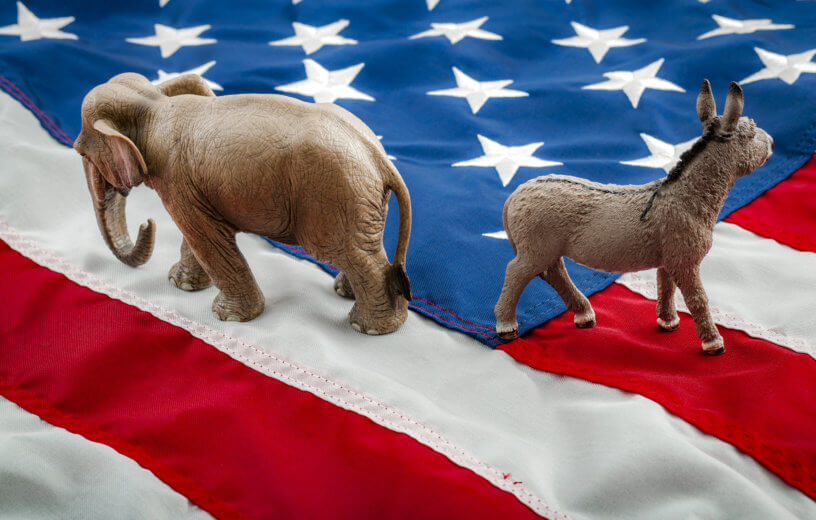
U.S. Politics - Democrats and Republicans, donkey and elephant on flag
(© Victor Moussa – stock.adobe.com)

(© Victor Moussa – stock.adobe.com)

Political polarization study finds liberal and conservative brains have one thing in common

PROVIDENCE, R.I. — There seems to be no end in sight to the political divide splitting America in two right now. While political polarization is not a new phenomenon, researchers say they still know very little about what causes people to see the world through an ideological bias. Now, a team from Brown University reveals liberals and conservatives actually do share some common ground — they all hate uncertainty.

Their study finds the brains of “political partisans” on both sides of the spectrum show an inability to tolerate uncertainty. These individuals also have a need to hold onto predictable beliefs about the world they live in.

Examining a group of liberals and conservatives, researchers discovered watching politically inflammatory debates or news coverage exacerbates each person’s intolerance of the unknown. Liberals began to display more liberal thinking and conservatives moved further to the conservative side. Despite their ideological differences, the team finds the same brain mechanics are driving this behavior.

“This is the first research we know of that has linked intolerance to uncertainty to political polarization on both sides of the aisle,” says study co-author Oriel FeldmanHall, an assistant professor of cognitive, linguistic and psychological sciences at Brown, in a university release. “So whether a person in 2016 was a strongly committed Trump supporter or a strongly committed Clinton supporter, it doesn’t matter. What matters is that an aversion to uncertainty only exacerbates how similarly two conservative brains or two liberal brains respond when consuming political content.”

Political views not to blame for polarized society?

Study authors used fMRI scans to measure brain activity while participants watched three different programs. The 22 conservatives and 22 liberals viewed a neutrally-worded news report on the very polarizing topic of abortion, a fiery political debate segment, and a completely non-political nature show.

After seeing the videos, participants answered questions gauging their understanding and opinions of the different segments. They also completed political and cognitive surveys measuring their intolerance of uncertainty. According to study co-author Jeroen van Baar, the results show political polarization is less about what people think and more about how their brains cope with the world around them.

“We found that polarized perception — ideologically warped perceptions of the same reality — was strongest in people with the lowest tolerance for uncertainty in general,” says van Baar, a former Brown researcher now at Trimbos, the Netherlands Institute of Mental Health and Addiction. “This shows that some of the animosity and misunderstanding we see in society is not due to irreconcilable differences in political beliefs, but instead depends on surprising — and potentially solvable — factors such as the uncertainty people experience in daily life.”

“We used relatively new methods to look at whether a trait like intolerance of uncertainty exacerbates polarization, and to examine if individual differences in patterns of brain activity synchronize to other individuals that hold like-minded beliefs,” FeldmanHall adds.

Birds of a (political) feather flock together

The study also reveals brain activity and neural responses in partisans diverge between liberals and conservatives. Researchers say these differences reflect each side’s subjective interpretation of the content they’re viewing. People who strongly identify as liberals processed political videos in a very similar way to other liberals in the study; a trait called neural synchrony. Study authors discovered the same thing when examining the brains of conservatives.

“If you are a politically polarized person, your brain syncs up with like-minded individuals in your party to perceive political information in the same way,” FeldmanHall explains.

The results also show people displaying a higher level of intolerance for uncertainty are more sensitive to politically polarizing content. Surprisingly, the news report on abortion with a completely neutral tone did not exacerbate the group’s polarized perceptions.

“This suggests that aversion to uncertainty governs how the brain processes political information to form black-and-white interpretations of inflammatory political content,” the researchers explain.

“This is key because it implies that ‘liberal and conservative brains’ are not just different in some stable way, like brain structure or basic functioning, as other researchers have claimed, but instead that ideological differences in brain processes arise from exposure to very particular polarizing material,” van Baar concludes. “This suggests that political partisans may be able to see eye to eye — provided we find the right way to communicate.”

The study appears in the journal PNAS

Breaking Up is Hard to Do (Political Edition)

What a week! I would normally shy away from discussing anything political on this blog, but it’s been such a wild time that I feel compelled to dive in and mix a few metaphors.

7 million more of us saw the writing on the (bathroom obscenities) wall and anticipated a certain amount of resistance to the election results. But I do have some sympathy for those blindsided Kool-Aid drinkers who couldn’t see that their beloved was in the throes of a Hitler-in-the-bunker last stand.

Think about it. Four years is a long time to be in an intense relationship with a crazy person. There’s been a collective Stockholm Syndrome amongst these supporters who only get information from their crush and don’t want the grownups to explain that all is not as it seems. Both the highs and lows are so intense that “normal” is seen as boring. And woe betide anyone who dares say that the emperor has no clothes (ok, that’s a horrifying visual). He HAS clothes. They’re GREAT clothes. They’re the BEST clothes anyone ever had.

Well, sadly, the wannabe coup-coo dictator can’t even break up with his fan club on Twitter, like other cowards do. And unless he’s planning to write a whole lot of personal “It’s not you, it’s me” Dear Don letters, they’ll have to learn about it on the real news, i.e. the non-conspiracy, actually-validated-with-facts sort of news.

Meanwhile, expect sales of tissues and Rocky Road ice cream to go through the roof.

Ain’t love a bitch?

Photo by Andrea Piacquadio on Pexels.com

Good News Monday (early edition): A Sigh of Relief

Despite the looming threats of new COVID devastation, many are feeling optimistic after Biden’s decisive presidential win. For any readers who are disappointed, I hope this will usher in a new era of civility and a return to classic American values of inclusion. Unless your ancestry is Indigenous, we all came to this melting pot from somewhere and we all deserve to live in a country that welcomes us.

Here’s a great piece — brought to my attention by the Enlightened Mind blog — that shows worldwide jubilation about the end of 45’s reign of terror. I have no doubt he’ll continue to tweet his nastygrams, but hopefully to a smaller audience and without daily media coverage of his sociopathy. Cheers!

Photo by cottonbro on Pexels.com

World now looks at how Biden will reshape U.S. policies after turbulent Trump era

Shibani Mahtani, Miriam Berger  1 day ago


Elections expert Q&A: No evidence of fraud and fail-safes everywhere in US.

The world looked ahead Saturday to new American leadership, with U.S. allies and rivals alike starting to predict what the change in the White House would mean for their relations with the United States and for American engagement more generally.a group of people standing in front of a crowd: Activists join a pro-migrant demonstration on the U.S.-Mexico border at the San Ysidro Crossing Port in Tijuana, Mexico, after Joe Biden was declared winner of the U.S. presidential election. (Guillermo Arias / AFP/Getty Images)Activists join a pro-migrant demonstration on the U.S.-Mexico border at the San Ysidro Crossing Port in Tijuana, Mexico, after Joe Biden was declared winner of the U.S. presidential election. (Guillermo Arias / AFP/Getty Images)

Here are the latest developments:

  • Congratulatory messages poured in from around the world to Biden and vice president-elect Kamala D. Harris.
  • Spontaneous celebrations broke out on streets in London, Berlin and other cities.
  • President Trump has continued to make unsubstantiated allegations of electoral fraud, retweeting misleading claims about the integrity of the vote count.
  • Trump’s far-right allies, notably Brexit party leader Nigel Farage, encouraged him to keep up the fight and railed against mail-in ballots.

It did not take long after Joe Biden’s victory was projected for world leaders to unleash the normal flood of congratulatory messages. But for those abroad who have felt uneasy with President Trump and his norm-breaking style, it was a much-awaited moment of optimism and even jubilation.PlayCurrent Time 0:14/Duration 1:15Loaded: 43.14%Unmute0FullscreenDeath toll from storm Eta soarsClick to expand

Death toll from storm Eta soars
The Washington Post Logo
Biden defeats Trump| The 2020 Fix
The Washington Post Logo
Crowds celebrate Biden-Harris win near White House

Shouts of “Biden!” and cheers broke out in Berlin, London, Toronto and other cities when the excruciating wait for an announcement came to an end. On Twitter, echoing Paris’ mayor, people tweeted out, “Welcome Back, America.”

Many hope that Trump’s unilateralism and America-first populism will give way to an era of renewed U.S. global leadership and an embrace of multilateralism to tackle common challenges.

“It’s good that there are finally clear numbers. We look forward to working with the next U.S. administration,” tweeted German Foreign Minister Heiko Maas. “We want to invest in cooperation for a transatlantic new beginning, a new deal.

Reinhard Bütikofer, a German member of European Parliament, quipped, “I heard a Pan-European sigh of relief, when Biden’s victory was called.”Marianne Hoenow from Connecticut celebrates the victory of president-elect Joe Biden and vice president-elect Kamala D. Harris in front of the Brandenbug Gate next to the United States Embassy in Berlin on Nov. 7, 2020. (Markus Schreiber/AP)Marianne Hoenow from Connecticut celebrates the victory of president-elect Joe Biden and vice president-elect Kamala D. Harris in front of the Brandenbug Gate next to the United States Embassy in Berlin on Nov. 7, 2020. (Markus Schreiber/AP)The U.S. election gripped the world, making way for plenty of memes

Though Trump had yet to acknowledge his defeat, some of the foreign leaders closest to him did not delay in sending their congratulations to Biden and Vice President-elect Kamala D. Harris.

British Prime Minister Boris Johnson tweeted his congratulations., saying, “The U.S. is our most important ally and I look forward to working closely together on our shared priorities, from climate change to trade and security.”

Poland’s right-wing President Andrzej Duda, who has been politically aligned with Trump, cautiously tweeted to congratulate Biden “for a successful presidential campaign.” Egyptian President Abdel Fatah al-Sissi, whom Trump once called his “favorite dictator,” sent his best wishes to Biden, and Indian Prime Minister Narendra Modi congratulated the president-elect. He also noted that Harris’s Indian heritage is “a source of immense pride.”Villagers in Painganadu, India, prepare placards featuring Sen. Kamala D. Harris on Nov. 6, 2020, a day before Joe Biden and Kamala D. Harris were declared winners as president-elect and vice president-elect. (Aijaz Rahi/AP)Villagers in Painganadu, India, prepare placards featuring Sen. Kamala D. Harris on Nov. 6, 2020, a day before Joe Biden and Kamala D. Harris were declared winners as president-elect and vice president-elect. (Aijaz Rahi/AP)

Harris’s family hometown in southern India — the birthplace of her maternal grandfather — had already been holding celebrations in her honor ahead of the traditional Diwali festival. Meanwhile, Jamaica’s prime minister, Andrew Holness, also saluted her family ties to Jamaica, the birthplace of her father, as well as her “monumental accomplishment for women.”

In Biden’s ancestral hometown in Ireland, a crowd gathered to pop champagne. “I want to congratulate the new President Elect of the USA @JoeBiden Joe Biden has been a true friend of this nation throughout his life and I look forward to working with him in the years ahead,” wrote Irish Prime Minister Micheál Martin in a nod to Biden’s Irish heritage.

Perhaps the first foreign leader to congratulate Biden was Frank Bainimarama, the prime minister of Fiji, who said in a tweet — even before the election was formally called — that they must work together to confront a warming planet and rebuild the global economy.

Hours later, congratulations from world leaders and others — who were watching the vote count unfold over days — were finally uncorked as soon as U.S. news organizations declared Biden the winner. Leaders with diverse views and priorities — from Canadian Prime Minister Justin Trudeau and French President Emmanuel Macron to Zimbabwe’s President Emmerson Dambudzo Mnangagwa and Ukrainian President Volodymyr Zelensky — were quick to share their enthusiasm about working with Biden.Residents in Ballina, Ireland, climb a scaffold as they hang out American flags and bunting for president-elect Joe Biden on Nov. 07, 2020 in the ancestral home of the Biden family. (Charles McQuillan/Getty Images)Residents in Ballina, Ireland, climb a scaffold as they hang out American flags and bunting for president-elect Joe Biden on Nov. 07, 2020 in the ancestral home of the Biden family. (Charles McQuillan/Getty Images)

Nigerian President Muhammadu Buhari urged Biden to “deploy his vast experience in tackling the negative consequences of nationalist politics on world affairs — which have created divisions and uncertainties — and to introduce greater engagement with Africa on the basis of reciprocal respect and shared interests.”

Nigerian President Muhammadu Buhari urged Biden to “deploy his vast experience in tackling the negative consequences of nationalist politics on world affairs — which have created divisions and uncertainties — and to introduce greater engagement with Africa on the basis of reciprocal respect and shared interests.”

Some U.S. rivals, however, reacted differently. The People’s Daily China, an official newspaper of the Central Committee of the Chinese Communist Party, chose instead to taunt Trump by retweeting his boast that he’d won the election and commenting “HaHa” with a laughing emoji.

Iranian Supreme Leader Sayyid Ali Khamenei did not directly mention Biden or Trump in a tweet denouncing the election as a sign of the “definite political, civil, & moral decline of the US regime.” But Iranian Vice President Eshaq was more optimistic, saying, “I hope we will see a change in the destructive policies of the United States, a return to the rule of law and international obligations and respect for nations.”a person riding on the back of a motorcycle: A man reads a copy of Iranian daily newspaper Sobhe Nou with a cartoon depicting U.S. president Donald J Trump and a headline reading 'Go to hell gambler', in front of a newsstand in Tehran, November 07, 2020. According to local media reports, many Iranians are rooting for Democratic candidate Joe Biden. (Abedin Taherkenareh/EPA-EFE/REX/Shutterstock)Man reads a copy of Iranian daily newspaper Sobhe Nou with a cartoon depicting U.S. president Donald J Trump and a headline reading ‘Go to hell gambler’, in front of a newsstand in Tehran, November 07, 2020. According to local media reports, many Iranians are rooting for Democratic candidate Joe Biden. (Abedin Taherkenareh/EPA-EFE/REX/Shutterstock) In Europe, few sad to see Trump go
Politics and pandemic

The pandemic has added urgency to Biden’s pledge to reverse Trump’s approach, which has left the United States estranged from the World Health Organization and facing the highest numbers of deaths and new cases at home.

After Trump withdrew from the WHO, Biden promised to rejoin it on his first day in office. Biden is a “globalist at heart,” wrote Natasha Kassam, a research fellow at Sydney’s Lowy Institute political think tank, in the Guardian.

Other Trump policies are also in doubt. The Times of India, which anticipated Biden’s win with the headline “Bye Don, It’s Biden Finally,” said that H1-B work visas — allowing nonimmigrants to work in the United States — are unlikely to return in their previous numbers, even if the Biden administration has a more favorable immigration policy. But it noted that the Democrats could be stronger about challenging human rights violations in India.

In China, relations with the United States have fallen to their lowest point in 40 years amid bitter disputes over trade, technology, human rights and the novel coronavirus. But hopes have been stirred that a Biden win might act as a circuit-breaker and offer possible cooperation in certain areas.

Still, an op-ed in the nationalistic Global Times tabloid noted deep partisan divisions in the United States that it said would not be easily eased.

With Trump determined to contest the election results in court, some foreign commentators expressed their fears.

“The squatter” was the title of the Saturday cover of Der Spiegel, a leading German news magazine. A defiant, fatigue-clad Trump is depicted holding a rifle, barricaded in the Oval Office with a bullet-holed picture of a smiling Biden in the backdrop.Trump’s claims of stolen election have some recent precedents — in Gambia and Guyana

In Britain, the Guardian declared Trump in a “fight against reality,” but noted in an editorial that Biden would have his work cut out to “rebuild the U.S. government’s credibility after Trumpism hollowed out its institutions.”

In Japan, a burger outlet near a U.S. naval base followed a long tradition of naming a burger after every sitting American president by adding the Biden Burger to its menu, according to public broadcaster NHK.

The Biden Burger pays homage to his Scranton, Pa., roots. It comes with Philadelphia-style cheese and potato chips to represent Pennsylvania, a major chip producer. The Trump Burger has a dash of jalapeño, “supposedly reflecting Trump’s sharp tongue,” NHK wrote.

Mahtani reported from Hong Kong and Berger from Washington. David Crawshaw in Hong Kong; Steve Hendrix in Jerusalem; Michael Birnbaum in Latvia, Riga; Kareem Fahim in Istanbul; Danielle Paquette in Dakar; William Booth and Karla Adam in London; Niha Masih in New Delhi; James McAuley in Paris; Susannah George in Kabul; Chico Harlan in Rome; Isabelle Khurshudyan in Moscow; Amanda Coletta in Toronto; Lesley Wroughton in Cape Town, South Africa, and Kate Chappell in Kingston, Jamaica, contributed to this report.

Why Lies Spread Faster Than the Truth

It’s not your imagination. Misinformation travels faster than a speeding bullet — or a potentially deadly virus — , making this video worth a look.

Thanks to the EnlightenedMind blog for the timely reminder.

white plane on the sky

Photo by Immortal shots on Pexels.com

Good News Monday: It’s Now Legal to Grow Hemp

Well, sort of.

Back in December, President Trump signed the bipartisan 2018 Congressional Farm Bill, which treats hemp as an agricultural commodity and removes it from the Drug Enforcement Agency’s list of schedule 1 drugs.

However, the Farm Bill also empowers states to regulate (or ban) the production and sale of hemp within their borders.

Anyone who follows US politics will not be surprised by the inconsistency.


Stayin’ Sane

Most days, the political news makes me want to pull the covers over my head and stay in bed for the next several years.

Take transgender military personnel. These brave folks are dodging bullets and land mines – are we seriously worried about whether they pee standing up or sitting down?

But, in the struggle to feel optimistic, I have a simple suggestion: buy wine. Not to drink, although drinking is to be encouraged in these fraught times, but to save.

This occurred to me yesterday, after stopping at one of our favorite wineries, Yamhill Valley Vineyards and buying a case of wine that won’t mature until 2020 or beyond. (Dare I suggest that we have a better chance with pinot than with our current president maturing by 2020?)

grapes-1952073_640

Think about it: You buy a bottle that is drinkable now but is going to be so much better if you have the patience to wait a few years. (This may be the only area in which I am patient. Just ask my Long Suffering Husband.)

Your wine can be a little time capsule. You could wrap it in a current newspaper and hope that 6-8 years from now the news will seem quaint and vaguely amusing. You can put it away somewhere cool and comfortable and just visit it occasionally to make sure it’s doing ok. You can start collecting recipes of yummy food that will be perfect to eat with your special bottle. Be creative! Have fun!

Our friend Linda, the tasting manager at Yamhill, is taking this whole optimism thing to a new level. She has found a new love, lost over 100 pounds, and looks gorgeously, radiantly happy as her wedding approaches. What’s more of a leap of faith than marriage, right?

cork-1574810_640

Let’s all check in with each other in 2020, open our bottles, and toast our collective survival. Good times ahead! xx, Alisa

[Unsponsored post. All photos from Pixabay.com.]

Requiem for Decency

Well, America — you got what you wished for.  And now the vulgarians are at the gate.

This blog is not about politics.  But the vitriol, racism and sexism unleashed during this election are unprecedented, and I can’t in good conscience refrain from comment.

Clearly, we have a lot of work to do. The Trump victory shines a spotlight on the dismal lack of education in our country — a discouraging number of voters who have never learned either civics or civility.  Voters who can’t tell when they’re being manipulated by lies and innuendo.  Voters who think a charlatan with no history of helping another human being is going to make their lives better. Voters who think “different” means “enemy”.

Black, brown, Muslim, Jewish, Latino, college-educated, LGBT, female… all our rights are at risk.  We’ll have to stand together over the next four years to make sure our voices are heard, our needs are met, and that this is a one-term setback for progress, not a wholesale abandonment of American values.  We’ll have to create a unified coalition to unseat the politics of hatred once and for all.

Our children and grandchildren deserve nothing less.

This should be a wake-up call for everyone.  And if you supported Trump, take a good look in the mirror.  The America your “victory” has created is about to become a dangerous and unpleasant place to live.  For you, too.