Tag Archives: holidays

Why Do We Wear Halloween Costumes?

[edited from historyfacts.com]

Samhain (pronounced “sow-in”), the ancient Celtic festival that inspired many of our modern-day Halloween traditions, represents the end of the harvest season and the onset of winter. An Irish Gaelic word also used in Scottish Gaelic and Manx, “Samhain” translates to “summer’s end”. Traditionally celebrated on November 1, it marked the time when the harvest had been gathered and stored, cattle were moved to closer pastures, livestock were secured for the winter, and communities were hunkering down for the long, cold months ahead.

Samhain was also believed to be a time when the spirits of those who had died during the year traveled to the otherworld. People believed that during Samhain, the boundary between the living and the dead was at its thinnest, allowing the spirit world to interact with the human world. To protect themselves from restless or malevolent spirits, people would light fires, leave offerings for deceased loved ones, and wear disguises.

Today, much of what we know about Samhain is rooted in Irish mythology, making it difficult to discern truth from lore. But here are five things we do know about this ancient and mysterious holiday.

Credit: Heritage Images/ Hulton Archive via Getty Images 

It Dates Back to the Iron Age

Observed by the ancient Celts across Ireland, Scotland, and the Isle of Man, Samhain dates back to the Iron Age, more than 2,000 years ago. The Celts divided the year into two halves, Samhain (the darkness) and Beltane (the light). Those two halves were further divided by Imbolc (a holiday marking the beginning of the spring season) and Lughnasadh (marking the beginning of the harvest season). These four cross-quarter days, as they were known, were celebrated with fire festivals and were among the eight sacred days in ancient Celtic tradition, along with the spring and fall equinoxes and summer and winter solstices, known as quarter days.

Some historians believe that Samhain, which fell on the day that corresponds to November 1 on the contemporary calendar, marked the beginning of the Celtic new year, while others argue there isn’t enough evidence to support that hypothesis. What we do know for certain is that elements of Samhain influenced the celebration of Halloween as we know it.

Samhain Came Before All Hallows’ Eve

Irish immigrants brought the traditions of Samhain to the United States in the 1800s, but the name “Halloween” traces back to influences of early Christianity as the church sought to incorporate pagan traditions into a Christian narrative in order to woo converts. In the eighth century, Pope Gregory III designated November 1 as All Saints’ Day to honor Christian martyrs and saints. By the 10th century, November 2 was recognized as All Souls’ Day, a time to remember the souls of the dead.

Over time, All Saints’ Day became known as All Hallows’ Day, and the evening before, called All Hallows’ Eve, eventually morphed into Halloween. Celebrated on the night of October 31, Halloween isn’t the same thing as Samhain, but the Celtic holiday inspired several traditions of our modern-day Halloween, including carving vegetables, dressing in costumes, and visiting homes to receive treats.

Fire Was Central to the Celebration

Marking the midpoint between the fall equinox and winter solstice, Samhain was the most important of the four fire festivals, coming as it did at the end of the harvest and the beginning of the colder, darker days ahead. The festival was observed over several days as a means of celebrating the harvest, appeasing the gods, honoring the dead, and warding off spirits.

Conflicting sources say that people’s hearth fires would either burn out from being left unattended during the gathering of the harvest or were deliberately extinguished at the start of the Samhain festival. In either case, after the harvest had been gathered, a large communal fire was lit by Celtic priests, known as druids. Sacrifices of crops and animals were made, and the animal bones were then tossed into the “bone-fire,” which is where we get the word “bonfire.” Celebrants would light torches from the bonfire to take back to their homes in order to relight their own hearth fires.
Credit: comprimido/ iStock 

People Believed They Could Commune With Spirits

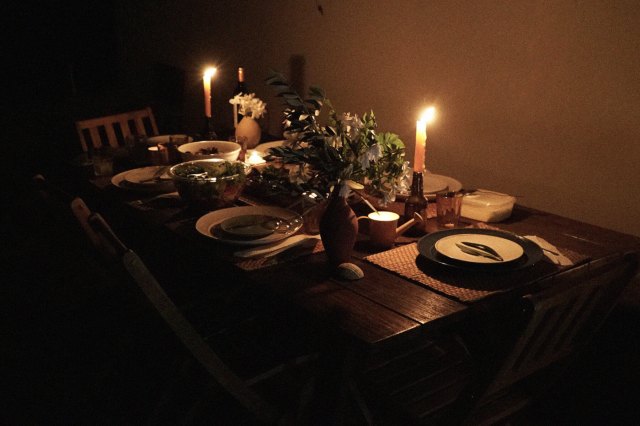
The Celts believed that Samhain was a time when the spirits of the dead could walk the world of the living, and that this temporary “thinning of the veil” between life and death meant it was possible to communicate with the deceased. A tradition known as a “dumb supper” involved setting a place at the head of the table to invite deceased ancestors to visit. The meal was served in absolute silence and celebrants avoided looking at the head of the table because they believed seeing the spirits would bring bad luck. After the supper, the untouched meal of the spirits was taken out and left in the woods.

Divination practices were also popular during Samhain because people believed the heightened spiritual energy of this liminal time was conducive to fortunetelling. Apples and nuts were used to predict the future and answer questions about the unknown. Some of these traditions later evolved into games, such as bobbing for apples.

Credit: Sally Anderson News/ Alamy Stock Photo 

Costumes and Carvings Were Meant To Deter Spirits

During the ancient festival of Samhain, people would wear masks, veils, and ghostly disguises to conceal their identity, confuse the spirits, and protect themselves from evil. Costumes were generally made from animal skins, and face coverings might have been an effort to impersonate dead ancestors. Children, meanwhile, would go from house to house showing off their disguises and singing or performing silly tricks in exchange for treats.

The Celts also created lanterns by carving faces into root vegetables that had been gathered during the harvest, including turnips, beets, and potatoes. These lanterns were illuminated with candles and placed in windows and outside of homes to ward off mischievous otherworldly visitors, including demons. This vegetable-carving tradition came to the U.S. with Irish and Scottish immigrants who discovered that pumpkins, which weren’t indigenous to Ireland, were well suited for carving.

Photo by Gantas Vaiu010diulu0117nas on Pexels.com

So there you have it. Happy Halloween, everyone!

Happy Boxing Day

You may not know that Boxing Day celebrates the age-old custom of returning unwanted gifts.

I believe it originated in Victorian England, after Queen Victoria received one too many antimacassars, taxidermy birds, and snuff boxes.

In modern times, it is mainly observed by Amazon.

Many happy returns!

Photo by Karolina Grabowska on Pexels.com

Valentines, and Other Commercial Holidays

I’m not a big fan of manufactured holidays that are all about overpriced flowers, chocolate, restaurant meals, and other so-called expressions of devotion.

Instead, may I propose a few alternatives:

Pizza Day: Celebrating one of the great food inventions of the century

Good Hair Day: Get out and about, knowing you look amazing

Junk Food Day: Pick your poison and indulge without judgement

Trashy Novel Day: Curl up with something absolutely superficial

I-Found-My-Keys Day: (Includes those reading glasses located atop one’s head). Celebrate by going somewhere you’d otherwise have to walk to

Favorite Movie Day: In our house, this is a multi-month tradition, with Dear Husband insisting we watch Four Weddings and a Funeral, Casablanca, or North by Northwest every time he spies them

New Socks Day: Does anyone know why socks always wear out at the heel, even expensive ones? Argh.

I’m-Really-Not-Sick-Sick Day: ‘Nuff said.

Manicurist Day: Doesn’t he or she deserve special recognition for keeping us presentable?

Purge Day: Clean your closets, toss or donate your crap, and then buy something new and fabulous

Happy Valentine’s Day to you, dear readers! xoxo

Photo by Muffin Creatives on Pexels.com

S.W.A.K.*

Happy Valentine’s Day! What do I love, besides my husband, children, friends, and you, my dear readers? This week’s find: Clinique’s Chubby Stick in my-lips-but-better Fuller Fig, a rosy brown. (If you have less pink you might like the Curviest Caramel shade.)

The product has been around for years but somehow I never tried it. The moisturizing lip balm gives a subtle wash of color and feels light, not gloppy.  Won’t feather like lipstick or run like a gloss.

IMG-1715

Basic, and yet rather elegant in its functionality.

Hope you have a wonderful day and celebrate the one who loves you best: yourself!

Regifting: Taboo or To Do?

“‘Tis the day after Christmas, and all through the land,

Folks are regifting the gifts they can’t stand…”

tabby cat lying under christmas tree with gifts

Photo by Jenna Hamra on Pexels.com

An article in the Wall Street Journal argues that regifting is a perfectly acceptable practice and preferable to throwing away something the giftee doesn’t want or need.

(Reprinted here because the link forces you to subscribe in order to read the whole piece. I hate that.)

From the Wall Street Journal

A recipient wants items A and B (say, a hat and gloves) yet receives items C and D (say, a scarf and mittens). Another recipient wants C and D, yet receives A and B. The solution seems simple: The two recipients can simply pass along the gifts they received to each other.

The psychology, however, is more complex. People in a study published in the Journal of Consumer Behaviour, for instance, used such words as guilty, lazy, thoughtless and disrespectful in describing their feelings about regifting. Popular culture casts it as taboo, as well. An entire episode of “Seinfeld” highlights the stigma attached to giving away presents meant for ourselves.

Getting stuck with gifts we do not want is no small problem. Consider that the National Retail Federation calculated that the average holiday-season shopper in the U.S. last year spent more than $1,000 on gifts. In a survey across 14 countries in Europe, meanwhile, 1 in 7 said they were unhappy with what they received for Christmas, yet more than half simply kept the gifts.

Why can’t more gifts be passed along to people who appreciate them?

Our research with Francis J. Flynn, a professor of organizational behavior at Stanford University’s Graduate School of Business, suggests the shame associated with regifting is largely unwarranted. Indeed, our research consistently tells us that people overestimate the negative consequences.

Next, we tried to shed light on just how serious the perceived offense is. We asked two groups—again, givers and regifters—to compare regifting a hypothetical wristwatch with throwing it in the trash. For the original givers, regifting the watch was a much less offensive act than trashing it. The regifters, however, wrongly assumed that the givers would find both equally offensive. The results were the same when regifting presents that the recipients didn’t like much.

Finally, given that the feared offense looks more imagined than real, we turned our attention to how people might be encouraged to break this taboo.

For this part of our research, we invited to our lab at Stanford people who had recently received presents, and divided the people into two groups. When we gave the first group an opportunity to regift that present, 9% did so.

When we gave the second group the same opportunity, we added that it was “National Regifting Day,” a real event that happens each year on the Thursday before Christmas. It wasn’t really National Regifting Day, but the group didn’t know that: 30% of them agreed to regift.

Everyone has received bad gifts in their lives, and we generally accept that we will receive more in the future. Yet for some (mathematically impossible) reason, we believe that we give only good gifts.

Our research offers a simple solution to the problem of unwanted gifts. This holiday season, consider regifting, and encourage recipients of your gifts to do the same if what you gave them isn’t quite what they hoped for.

Dr. Adams is an assistant professor at the University of Virginia. Dr. Norton is a professor at Harvard Business School. Email them at reports@wsj.com.


It’s Not Just You

According to a recent study, the average American can’t spend more than four hours with family during the holidays without getting stressed.

Lack of space and privacy, noise, too much togetherness, and family drama are some of the reasons. ‘Ya think?

However, knowing this, you might want to take a short walk around the block every few hours to clear your head and give you some alone time.  Happy holidays! xx

white and blue crew neck t shirt

Photo by Atul Choudhary on Pexels.com

Style: What to Avoid When Flying

window view of an airplane

Photo by Alex Powell on Pexels.com

‘Tis the season to be traveling. If your plans involve air travel — commercial, that is; you private plane people can wear whatever the hell you want — this timely advice (adapted from a post on WhoWhatWear) should come in handy. Click here for the full piece.

Tight Clothes

You want to avoid cramping and swelling caused by too-tight clothing and inactivity. Problems can range from the serious (DVTs) to uncomfortable bloating. An elastic waistband is your friend, and with a nice top layer no one needs to know you’re channeling Edith Bunker.

Anything Flammable

One more reason to choose natural fabrics! And cover your arms, legs and feet in case the unforeseen happens and you have to go down the emergency slide. A long-sleeved cotton t-shirt is breathable as well as protective.

High Heels, Backless Sandals, Flipflops

They make it difficult to quickly evacuate the aircraft, and could hurt others if they go flying off.  Heels could puncture the evacuation slide and they’ll sure make it a lot harder to run to another gate if necessary.

Meanwhile, that tiny airplane bathroom is even nastier if something on the floor gets on your toes. ‘Nuff said.  Opt for closed shoes such as sneakers, low heels or flats, or boots.

Studs, buckles, zippers, belts can set off metal detectors and slow you down. The same is true for bold jewely. And it’s better not to put your valuables on the conveyor belt; just store them securely in a small case in your purse or carry on until you’ve gone through security.
Not Enough Layers

Airplane cabins can be frigid, so wearing layers makes sense.  You can always remove a sweater or cashmere shawl if you get too warm.

Pack a change of outfit in your carryon if possible, too — fresh socks, a tee and underwear at a minimum. It makes life much more pleasant if you’re stuck on the tarmac in an emergency, or your checked luggage is delayed or lost.

Safe travels,

xoxo Alisa

Gift Ideas When Money Is No Object

While you’ve been agonizing over finding the perfect gifts, this post is sure to inspire a giggle or two.  It kinda gives new meaning to the phrase “insanely rich”.  Enjoy!

abundance bank banking banknotes

Photo by Pixabay on Pexels.com


…But Liquor is Quicker

Anyone else remember the saying, “Candy is dandy but liquor is quicker”? The expression is a quote from American poet Ogden Nash’s 1931 poem, “Reflections on Ice Breaking”.  It also appeared in the 1971 movie, “Willy Wonka & the Chocolate Factory”.

In honor of Halloween, I’m sharing the following.  My commentary below in red.

HOW TO QUIT CANDY AFTER HALLOWEEN

Weaning yourself off the good stuff once and for all.

By: Noah Lehava

There were tons of reasons Halloween was the best holiday as kids. One, you got to walk around all night in a ridiculous outfit, holding big bags that strangers would just throw full-sized candy bars into. Two, you’d have a cache of Starburst and Reese’s to last you weeks (or months, if you had a parent moderator). Three, your metabolism (and energy) and general lack of nutritional knowledge meant the guilt of stuffing your face with one last mini Snickers before bed didn’t exist. But alas, we’re adults now, which means we know that eating piles of candy isn’t actually all that good for us. That’s not to say we’re expecting you to avoid itty-bitty bags of sugary stuff all Halloween week long (that’s a thing, right?). But the struggle to quit sugar post-indulgence is real. Which is why we’ve come up with a few ways to wean yourself off the good stuff (in the palate sense).

GO FOR THE COMBO

This technique is what we like to call step one of the recovery process. When you really just want to pile M&Ms into your mouth until your stomach hurts, instead, eat or drink something healthy, like a green tea and vegetable-loaded salad for lunch, then finish it off with a bite of candy. You’ll be full from the nutrition-packed meal, but have just enough sugar-coated chocolate on your palate to satisfy a craving.

To go one step further, try drinking a combination of 1 part orange juice to 7 parts water.  There’s just enough sweetness to satisfy cravings, and the water fills you up. This is also great to have in the morning — often what we think is hunger is actually thirst, especially after fasting all night while we’re sleeping. You might not even crave those pancakes!

THE SWAP-OUT

We all know that the really bad stuff in candy is the added sugar (and, OK, there’s other stuff in there, but let’s not get too technical). But good sugar, fructose, by way of fruit, is an easy way to crush cravings, plus you’ll be filling up on the extra stuff in fruit like water, fiber, and, you know, actual nutrients.

Sugar is sugar. It’s generally better to avoid it, and satisfy the urge for sweetness with carrots, red or yellow peppers, etc. Experts suggest that it’s best to eat fruit with your meal rather than in-between.  And choose whole fruit, not juice.

SNACK

Not on candy! Waiting too long between meals and the impending hunger that comes with that will have you reaching into the plastic pumpkin every ten minutes. Eating regularly throughout the day keeps your blood sugar level stable—aka no crazy, irrational cravings.

Disagree! True hunger is actually a good thing — it tells you that your body needs sustenance. If you eat a satisfying meal (eg lunch) that includes lean protein, you should not be physically hungry for around 5 hours.  What we think of as mid-morning or mid-afternoon “hunger” is often anxiety, boredom, or another emotion.  Rather than eating, do something to distract yourself, such as taking a short walk. The brain can’t hold on to cravings for very long.

If it’s late afternoon, and you know you won’t be having dinner for a few hours and are starting to feel real hunger, try eating a handful of nuts (slowly) to help avoid temptation. But don’t beat yourself up if you can’t resist an occasional peanut butter cup.

HAPPY HALLOWEEN, dear readers!

light landscape sky sunset

Photo by Pixabay on Pexels.com