Tag Archives: Good News Monday

Good News Monday: Filling in the Gaps in African-American History

The Smithsonian Museum and the National Museum of African American History and Culture are tracking down important data about newly freed individuals who lived in the South after the Civil War.

The website reports that 90,000 pages of Freedmen’s Bureau images (including letters, marriage and birth records, and more) have already been transcribed by more than 9,000 volunteers, making it the largest crowdsourcing initiative ever sponsored by the Smithsonian.

With the help of people working from home — where most of us remain during these days of sheltering in place — they’ve unlocked a wealth of names and stories.  If there are gaps in your own family tree, this is a great way to get involved!

fashion photography of woman hands on chin with glitter makeup

Photo by 3Motional Studio on Pexels.com


Good News Monday: COVID Immunity

Reprinted from today’s New York Times

Is herd immunity ahead of schedule?

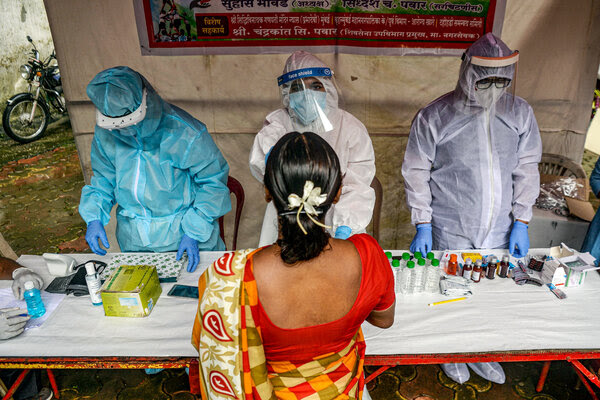
Mumbai may be among the cities that have already achieved herd immunity, scientists say.Indranil Mukherjee/Agence France-Presse — Getty Images

Today, we’re turning this section over to our colleague Apoorva Mandavilli, who has been covering the pandemic for The Times’s Science desk.

The pandemic will end only when enough people are protected against the coronavirus, whether by a vaccine or by already having been infected. Reaching this threshold, known as herd immunity, doesn’t mean the virus will disappear. But with fewer hosts to infect, it will make its way through a community much more slowly.

In the early days of the crisis, scientists estimated that perhaps 70 percent of the population would need to be immune in this way to be free from large outbreaks. But over the past few weeks, more than a dozen scientists told me they now felt comfortable saying that herd immunity probably lies from 45 percent to 50 percent.

If they’re right, then we may be a lot closer to turning back this virus than we initially thought.

It may also mean that pockets of New York City, London, Mumbai and other cities may already have reached the threshold, and may be spared a devastating second wave.

The initial calculations into herd immunity assumed that everyone in a community was equally susceptible to the virus and mixed randomly with everyone else.

The new estimates are the product of more sophisticated statistical modeling. When scientists factor in variations in density, demographics and socialization patterns, the estimated threshold for herd immunity falls.

In some clinics in hard-hit Brooklyn neighborhoods, up to 80 percent of people who were tested at the beginning of the summer had antibodies for the virus. Over the past eight weeks, fewer than 1 percent of people tested at those same neighborhood clinics have had the virus.

Likewise in Mumbai, a randomized household survey found that about 57 percent of people who live in the poorest areas and share toilets had antibodies, compared with just 11 percent elsewhere in the city.

It’s too early to say with certainty that those communities have reached herd immunity. We don’t know, for example, how long someone who was infected stays protected from the coronavirus. But the data suggests that the virus may move more slowly in those areas the next time around.

Good News Monday: Boredom Buster

Guess who else is bored with COVID-19? Penguins!

It seems they’d been extra fidgety over at the Newquay Zoo in Cornwall, England until a donor came up with an ingenious solution: a bubble maker.

No mere entertainment, the CPC (chief penguin caretaker) explained that the bubbles also keep the penguins’ predatory reflexes sharp.

One wonders… could there be a tie-in between champagne and aggression in humans? Is this why some wedding celebrations turn into drunken brawls?

Anyway, the article and video are seriously cute.

cold nature cute ice

Photo by Pixabay on Pexels.com

Good News Monday: Why Masks Work

Yes, it’s Tuesday. But, honestly, who can tell the difference between one day and the next?

This, from the Los Angeles Times, is interesting.  On the off chance that the link doesn’t work — because, mostly, they don’t since they want you to subscribe instead of reading for free — I’m pasting it here.

You’ll get the gist even if you don’t read the whole thing. (What’s a “gist”? Glad you asked. Extensive research indicates “early 18th century: from Old French, third person singular present tense of gesir ‘to lie’, from Latin jacere . The Anglo-French legal phrase c’est action gist [‘this action lies’ , e.g. occurs] denoted that there were sufficient grounds to proceed; gist was adopted into English denoting the grounds themselves.”  Now you know.

Masks offer much more protection against coronavirus than many think

RONG-GONG LIN II, MAURA DOLAN

There’s a common refrain that masks don’t protect you; they protect other people from your own germs, which is especially important to keep unknowingly infected people from spreading the coronavirus.

But now, there’s mounting evidence that masks also protect you.

If you’re unlucky enough to encounter an infectious person, wearing any kind of face covering will reduce the amount of virus that your body will take in.

As it turns out, that’s pretty important. Breathing in a small amount of virus may lead to no disease or far more mild infection. But inhaling a huge volume of virus particles can result in serious disease or death.

That’s the argument Dr. Monica Gandhi, UC San Francisco professor of medicine and medical director of the HIV Clinic at Zuckerberg San Francisco General Hospital, is making about why — if you are unlucky to get infected with the virus — masking can still protect you from more severe disease.

“There is this theory that facial masking reduces the [amount of virus you get exposed to] and disease severity,” said Gandhi, who is also director for the Center for AIDS Research at UC San Francisco.

The idea of requiring mask-wearing in public has become an increasingly pressing and politicized issue as California and the rest of the nation see a surge in new cases as the economy reopens.

California this week ordered a reclosure of many businesses, include a statewide halting of all indoor dining and a closure of bars. The state also ordered a closing down — in dozens of hard-hit counties, including L.A. County — of indoor gyms, houses of worship, hair salons, nail salons and offices for nonessential industries.

But experts say masks are essential for people to wear when they still go out in public, such as to shop or go to medical appointments, and to get exercise like heading to the beach or park.

California has mandated face coverings in public settings since June 18, and a growing number of communities said they will ticket people who disobey the rules. But there remains some resistance to the government mandating wearing masks in some corners of the state, including Orange County.

Some leaders in Orange County have pushed back against requiring students to wear masks should they return to classrooms in the fall.

In policy recommendations approved by the Orange County Board of Education on Monday, a document stated that “requiring children to wear masks during school is not only difficult — if not impossible to implement — but [is] not based on science. It may even be harmful.” Individual districts will have the final say on how schools open.

Some health experts were appalled by that language.

“This anti-mask rhetoric is mind-blowing, dangerous, deadly and polarizing,” said Dr. Peter Chin-Hong, professor of medicine and an infectious diseases specialist at UC San Francisco. “There is no evidence that it is dangerous.”

In fact, wearing masks can help prevent children from being infected and suffering serious consequences of infection, such as multisystem inflammatory syndrome, a rare condition that has been seen in children who have been infected with the coronavirus. “Kids not only transmit, but they can get sick as well,” Chin-Hong said.

While children are less likely to develop severe illness from the coronavirus than adults, they can still be infected, be contagious and transmit the virus to other people, Gandhi said.

Wearing a mask at school would not only reduce their ability to transmit the virus to other classmates, teachers and administrators, but also protect the students from getting infected with a large dose of virus from infected people.

Transmission rates for coronavirus have been rising across the state. Nearly 1,000 of San Francisco’s nearly 4,600 cases have been diagnosed in just the last two weeks, said Dr. Grant Colfax, the city’s director of public health.

In San Francisco, nearly half of all those who have tested positive in the city are Latinos, he said, even though Latino residents make up just 15% of the city’s population. Overall, the city has seen 7.8 new infections per 100,000 residents over the last seven days, far above its goal of no more than 1.8 new infections per 100,000 people.

“This, again, indicates that the virus is spreading throughout the city, particularly … in the southeast part of the city,” Colfax said.

For every one person who contracts the virus, another 1.25 people on average are now infected, he said. “We really need to drive that down to 1 or below as quickly and as soon as possible.”

The transmission rate also rose above 1 in L.A. County in June, but has fallen back to 1. “The virus currently rages on in our community,” Public Health Director Barbara Ferrer said.

The reason why masks are so important in controlling the spread of the coronavirus is that it can be widely spread by people who are not visibly sick — either because they haven’t yet shown signs of illness, or they will spend the entire course of their infections with little or no symptoms at all.

A key piece of evidence for this emerged earlier this year, on the Diamond Princess cruise ship that carried infected crew and passengers in Asia. A study published by the U.S. Centers for Disease Control and Prevention found that of 712 people testing positive for the virus, nearly half were asymptomatic at the time of testing.

“We also know that viral load is highest early during disease,” said Dr. Chaz Langelier, an assistant professor at UC San Francisco, during the panel discussion. In fact, 44% of transmissions are believed to occur when the infected person has no symptoms, according to a study published in Nature Medicine.

That’s different from the seasonal flu, where peak infectiousness occurs about one day after the onset of symptoms, Langelier said.

Masks don’t filter out all viral particles, Gandhi said. But even cloth face masks filter out a majority of viral particles.

And even if a person wearing a mask gets infected, the mask — by filtering out most of the viral particles exhaled by the infected person — probably leads to less severe disease, Gandhi said.

The idea that a lower dose of virus when being infected brings less illness is a well-worn idea in medicine.

Even going back to 1938, there was a study showing that by giving mice a higher dose of a deadly virus, the mice are more likely to get severe disease and die, Gandhi said.

The same principle applies to humans. A study published in 2015 gave healthy volunteers varying doses of a flu virus; those who got higher doses got sicker, with more coughing and shortness of breath, Gandhi said.

And another study suggested that the reason why the second wave of the 1918-19 flu pandemic was the deadliest in the U.S. was because of the overcrowded conditions faced in army camps as World War I wound down.

Finally, a study published in May found that surgical mask partitions significantly reduced the transmission of the coronavirus among hamsters. And even if the hamsters protected by the mask partitions acquired the coronavirus, “they were more likely to get very mild disease,” Gandhi said.

So what happens if a city dramatically masks up while in public?

If Gandhi is right, it may mean that even if there’s a rise in coronavirus infections in a city, the masks may limit the dose people are getting of the virus and result in them more likely to show less severe symptoms of illness.

That’s what Gandhi said she suspects is happening in San Francisco, where mask wearing is relatively robust. Further observations are needed, Gandhi said.

There’s more evidence that masks can be protective — even when wearers do become infected. She cited an outbreak at a seafood plant in Oregon where employees were given masks, and 95% of those who were infected were asymptomatic.

Gandhi also cited the experience of a cruise ship that was traveling from Argentina to Antartica in March when the coronavirus infected people on board, as documented in a recent study. Passengers got surgical masks; the crew got N95 masks.

But instead of about 40% of those infected being asymptomatic — which is what would normally be expected — 81% of those testing positive were asymptomatic, and the masking may have helped reduce the severity of disease in people on board, Gandhi said.

The protective effects are also seen in countries where masks are universally accepted for years, such as Taiwan, Thailand, South Korea and Singapore. “They have all seen cases as they opened … but not deaths,” Gandhi said.

The Czech Republic moved early to require masks, issuing an order in mid-March, Gandhi said; that’s about three months before Gov. Gavin Newsom did so statewide in California. But in the Czech Republic, “every time their cases would go up …their death rate was totally flat. So they didn’t get the severe illness with these cases going on.”

By May, the Czech Republic lifted its face mask rule. “And they’re doing great,” Gandhi said.

End of article, back to me.  If it’s good enough for hamsters, I’m definitely wearing a mask.
hamster

Photo by Juris Freidenfelds on Pexels.com

Good News Monday: Bad and Good Women Get What They Deserve

First up, breaking news: Amy Cooper, the white woman in Central Park who called the police on a Black bird watcher, will be charged with filing a false report, a misdemeanor punishable by up to a year in jail.

Ms. Cooper will be arraigned in October.  If convicted — which seems likely since the incident was captured on video and went viral — she could be given a conditional discharge or sentenced to community service or counseling rather than jail time. (Counseling seems like an excellent idea, regardless of any other punishment.)

On Memorial Day, Ms. Cooper who’d been walking with her dog, encountered Christian Cooper (no relation), a Harvard graduate and bird watching enthusiast, in the Ramble, a semi-wild part of the park where dogs must be leashed.

Mr. Cooper said that he asked Ms. Cooper to leash her dog, and when she refused, he attempted to lure the dog with treats, hoping to compel her to restrain her pet. (Pet owners don’t like strangers to offer treats and usually leash their dogs to avoid this.) The encounter then got ugly when Ms. Cooper decided to call 911 and tell them that an African-American man was threatening her life.

That’s the Bad Women part of this report. Now, let’s celebrate more illustrious women.

On a more positive note, this year marks the centennial of the 19th Amendment, which gave women the long-overdue right to vote. In honor, The National Trust for Historic Preservation is currently crowdsourcing locations where women made history.

Savingplaces.org directs visitors to a number of distinctive destinations, including the house where Susan B. Anthony was arrested for voting in 1872, the First Ladies’ Museum, Frederick Douglass’ D.C. home, which Helen Douglass and the National League of Colored Women worked to save, the first secondary school for women, the home where the initial Girl Scouts meeting was held, and many others. They’re hoping to receive hundreds of suggestions.

[pixabay.com]

Good News Monday: Plastic Fantastic

These amazing artworks, created from the tons of plastic that wash up on local beaches, are exhibited at the Oregon Zoo, The Smithsonian, and other locations to call attention to pollution and its effect on marine life. I imagine the schedule is changing due to coronavirus, but this is something I can’t wait to see!

Washed Ashore: Art to Save the Sea

What Is Washed Ashore?

Roughly 300 million pounds of plastic is produced globally every year—but less than 10 percent is recycled. As a result, millions of pounds of plastic end up in our oceans.

Washed Ashore takes on the global marine debris crisis by turning plastic waste into beautiful, thought-provoking works of art. With the aim to educate viewers on the state of plastic pollution in our oceans, Washed Ashore features larger-than-life sea creatures made entirely of discarded, washed-up plastic waste.

Washed Ashore founder and director Angela Haseltine Pozzi began the project in 2010, collecting accumulated plastic along the Oregon coast. With the help of a small staff and thousands of volunteers, Pozzi has since processed around 18 tons of plastic and transformed it into powerful art with an important message.

Washed Ashore will be on display at the Oregon Zoo beginning in late January. Come view these spectacular sea creatures for yourself, and discover the reality of the “deadliest ocean predator”—plastic pollution.

Reducing plastic pollution

The rise of plastic pollution has created a global plastic waste crisis, and our oceans are feeling the effects. Plastic pollution is a threat that continues to grow, and impacts the health of both marine and land-based wildlife, as well as our ecosystems and humans. The Oregon Zoo believes that reducing sources of plastic pollution is an essential aspect of protecting the health of both wildlife and people, and the ecosystems we all depend on.

Reducing plastic pollution is only achievable through a combined effort on the part of consumers, business and governments. To learn more about what the Oregon Zoo and the city of Portland have done to reduce plastic waste and consumption, and see actions that you can take to help, click here.


Good News Monday: A Step Towards Equality

Truly happy to report an important step towards recognizing that being able to live one’s life is a human right.

Today, the US Supreme Court ruled that a landmark civil rights law from 1964 protects gay and transgender workers from workplace discrimination.

It’s about freakin’ time!

no labels written on a piece of paper

Photo by Sharon McCutcheon on Pexels.com

Good News Monday: Natural Stress Relief

I admit it’s hard to find any good news today.  But I did find a wonderful way to relax, courtesy of the Monterey Bay Aquarium Jelly Cam.  The livestream, available from 10 am to 9 pm PDT on their website, features hypnotic images of floating jellyfish, accompanied by spa sounds.

You can also ooh and ahh over live footage of their sea otters and penguins.

I’ll take whatever distractions I can get.

Good News Monday: COVID-19 is Killing the Drug Trade

The coronavirus pandemic has crippled cities and crushed businesses from coast to coast.  It’s also costing drug traffickers millions, multiple law enforcement officials told NBC News, because their methods of moving money have been compromised.

Since the start of the crisis, federal drug agents in major U.S. hubs have seized substantially more illicit cash than usual amid statewide lockdowns that have disrupted the way cartels do business, the officials said.

“Their activities are a lot more apparent than they were three months ago,” said Bill Bodner, special agent in charge of the Drug Enforcement Administration’s Los Angeles field office.

Bodner said California’s stay-at-home order has made it more difficult for traffickers to launder money and move around the city unseen.

“When there’s less hay in the haystack, it’s easier to find the needle,” he added. “It’s caused the drug cartels and money launderers to take more risks, and that’s where we can capitalize.”

Part of a $1 million seizure in the Los Angeles area.
Part of a $1 million seizure in the Los Angeles area.DEA

From March 1 to May 8, seizures of cash in the greater Los Angeles area have more than doubled from $4.5 million last year to $10 million during the same period this year. Bodner said that includes four separate seizures of more than $1 million in Long Beach, Cerritos, Anaheim, and Wildomar.

DEA agents operating on the East Coast have seen similar success.

The New York City field division’s cash seizures are up 180 percent since last year, said special agent in charge Ray Donovan, with the bulk of them coming in the last couple of months.

“It’s really around April, where we started saying, ‘Hey, we’re having a lot more success in this area,’” Donovan said.

When moving product along the West Coast, Mexican cartels use manufacturing businesses as de facto banks that help to launder the drug proceeds and funnel the money back across the southern border

But in New York, the cartels typically rely on “international Asian criminal organizations” to clean their cash, Donovan said. These cartel associates will buy American goods with drug money and ship them back to China. In return, the criminal gangs that receive the products will then send money back to the cartels in Mexico — often through bank wires, which are more difficult to track from China.

But the city’s lockdown has deprived the traffickers of using the first link in their sophisticated operation.

“With all the stores and shops closed down here, they don’t have that as one of the means to quickly launder money,” Donovan said.

As a result, the cartel’s cash has been piling up, Donovan said, resulting in larger seizures.

Pre-pandemic busts would often net cash hauls in the neighborhood of $100,000. Now, with the cartel’s laundering methods disrupted, New York DEA agents have been recovering piles of cash exceeding $1 million, Donovan said.

“More money is being stockpiled here,” he added. “So when we come across them, instead of seizing $100,000, we seize $1 million or several million dollars.”

The recent busts haven’t been confined to stacks of cash. Along the northern border, federal officers have confiscated large quantities of drugs over the past few months.

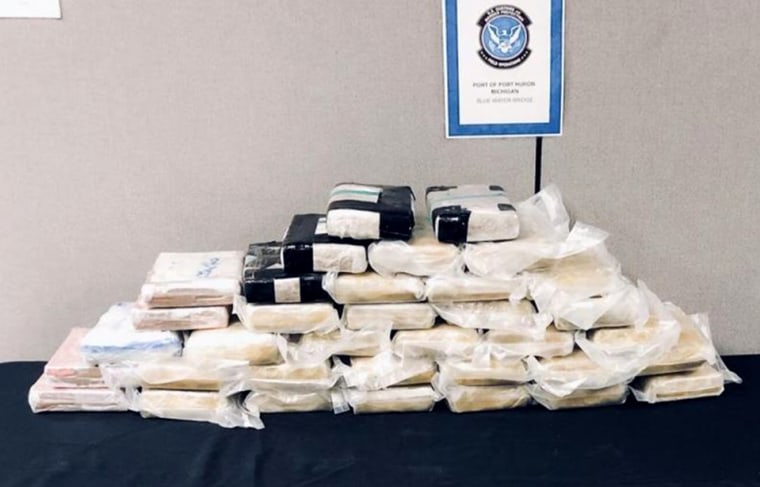
From March 21 to May 16, border patrol officers working out of the Detroit field office have seized 2,856 pounds of marijuana, 87 pounds of cocaine, 12 pounds of fentanyl and 12 guns.

“We are definitely seeing an uptick,” said Kris Grogan, spokesman for U.S. Customs and Border Protection in Detroit.

Image: Drugs seized at Blue Water Bridge in Port Huron, Mich., on April 17, 2020.
Drugs seized at Blue Water Bridge in Port Huron, Mich., on April 17, 2020.U.S. Customs and Border Protection

DEA agents in Michigan and Ohio have hauled in $6 million in drug money since March 16, officials said. That amount is not unusually high, but there’s been a marked increase in the amount of cash seized at airports.

“Hundreds of thousands of dollars,” said Keith Martin, special agent in charge of the DEA’s Detroit field office. “Which is not normal.”

Unlike New York and Los Angeles, the drug money made in Michigan and Ohio is moved the old-fashioned way — by driving it across the southern border.

Martin said it’s too early to draw a firm conclusion on what’s fueling the spike in cash seizures at airports, but a drop in car traffic because of statewide lockdowns is likely a contributing factor.

“They don’t want to be that one vehicle out in the road that gets pulled over,” Martin said. “When there’s not a lot of border traffic, you’re singled out easier than if there were a thousand cars.”

Part of a $1 million seizure in the Los Angeles area.
Part of a $1 million seizure in the Los Angeles area.DEA

While COVID-19 is already reshaping parts of the global economy, the impact on the drug cartels’ overall business remains yet to be determined, the officials said.

The coronavirus is also affecting drug prices. The price of methamphetamine has skyrocketed in California, according to Bodner, rising from about $1,000 a pound in November to upward of $2,000 a pound. He said that’s due in part to the economic disruptions and difficulties in importing chemicals from China and India, as well as the closure of the southern border to nonessential travel.

In New York, the price of marijuana is up 55 percent, according to Donovan, in part because of the increased risk of getting it into the country. Cocaine is up 12 percent, and heroin 7 percent, he said.

The virus has also changed the way law enforcement operates. One example: fewer DEA agents in the office, and more out in the streets.

“We’re practicing social distancing,” said Martin, the Detroit agent. “But the pandemic has not kept us from doing our job.”

Federal agents are also out in the streets en masse in Los Angeles and New York.

“I asked all my agents to stay in the street and just work in the street,” Donovan said. “We are there for our community, and ultimately, we’re doing a pretty damn good job.”

By Andrew Blankstein, Tom Winter, and Rich Schapiro, NBC News 5.24.2020

Really Good News Monday: Hope on the Horizon?

The first coronavirus vaccine to be tested in people appears to be safe and able to stimulate an immune response against the virus, its manufacturer, Moderna, announced on Monday.

The findings are based on results from the first eight people who each received two doses of the vaccine, starting in March.

Those people, healthy volunteers, made antibodies that were then tested in human cells in the lab, and were able to stop the virus from replicating — the key requirement for an effective vaccine. The levels of those so-called neutralizing antibodies matched the levels found in patients who had recovered after contracting the virus in the community.

The company has said that it is proceeding on an accelerated timetable, with the next phase involving 600 people to begin soon. But U.S. government officials have warned that producing a vaccine that would be widely available could take a year to 18 months. There is no proven treatment or vaccine against the coronavirus at this time.