This is a fascinating analysis of COVID’s two-month cycle, with the Delta variant following a similar pattern to the first outbreaks. (Apologies for formatting wonkiness — cutting and pasting NYT articles doesn’t always work well.)
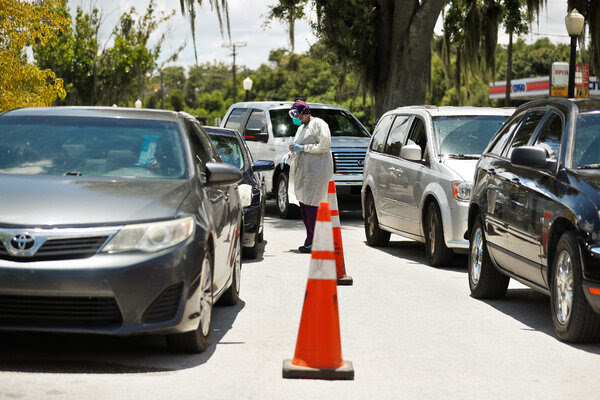
A testing site in Auburndale, Fla., last month.Octavio Jones for The New York Times
Has the Delta-fueled Covid-19 surge in the U.S. finally peaked?
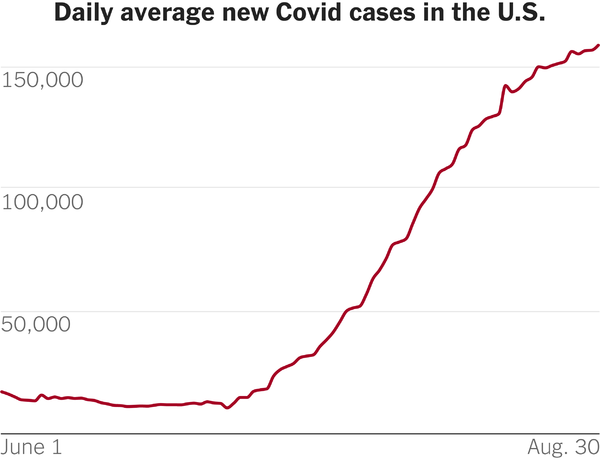
The number of new daily U.S. cases has risen less over the past week than at any point since June, as you can see in this chart:
The New York Times
There is obviously no guarantee that the trend will continue. But there is one big reason to think that it may and that caseloads may even soon decline.
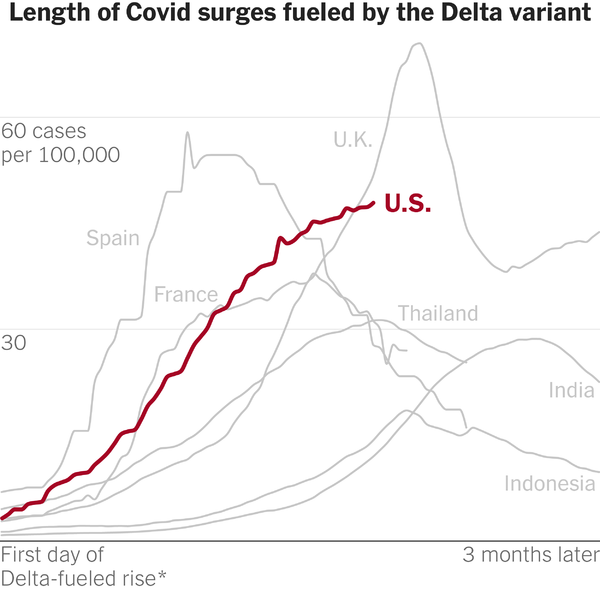
Since the pandemic began, Covid has often followed a regular — if mysterious — cycle. In one country after another, the number of new cases has often surged for roughly two months before starting to fall. The Delta variant, despite its intense contagiousness, has followed this pattern.
After Delta took hold last winter in India, caseloads there rose sharply for slightly more than two months before plummeting at a nearly identical rate. In Britain, caseloads rose for almost exactly two months before peaking in July. In Indonesia, Thailand, France, Spain and several other countries, the Delta surge also lasted somewhere between 1.5 and 2.5 months.
* Between February and July 2021, depending on the country.The New York Times
And in the U.S. states where Delta first caused caseloads to rise, the cycle already appears to be on its downside. Case numbers in Arkansas, Florida, Louisiana, Mississippi and Missouri peaked in early or mid-August and have since been falling:
The New York Times
Two possible stories
We have asked experts about these two-month cycles, and they acknowledged that they could not explain it. “We still are really in the cave ages in terms of understanding how viruses emerge, how they spread, how they start and stop, why they do what they do,” Michael Osterholm, an epidemiologist at the University of Minnesota, said.
But two broad categories of explanation seem plausible, the experts say.
One involves the virus itself. Rather than spreading until it has reached every last person, perhaps it spreads in waves that happen to follow a similar timeline. How so? Some people may be especially susceptible to a variant like Delta, and once many of them have been exposed to it, the virus starts to recede — until a new variant causes the cycle to begin again (or until a population approaches herd immunity).
The second plausible explanation involves human behavior. People don’t circulate randomly through the world. They live in social clusters, Jennifer Nuzzo, a Johns Hopkins epidemiologist, points out. Perhaps the virus needs about two months to circulate through a typically sized cluster, infecting the most susceptible — and a new wave starts when people break out of their clusters, such as during a holiday. Alternately, people may follow cycles of taking more and then fewer Covid precautions, depending on their level of concern.
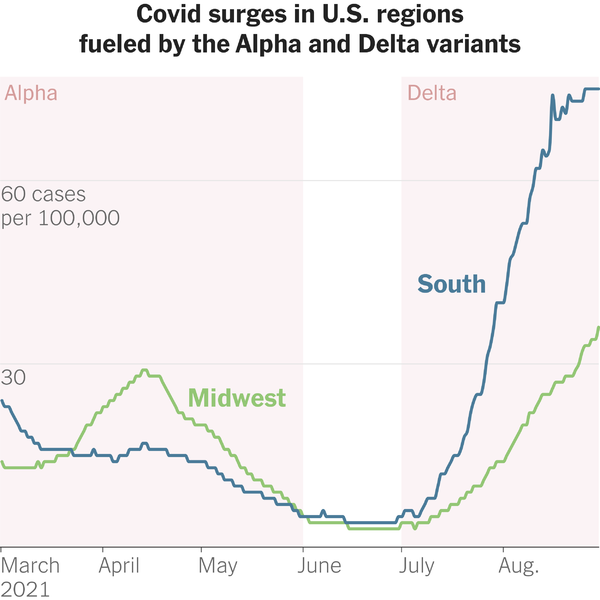
Whatever the reasons, the two-month cycle predated Delta. It has repeated itself several times in the U.S., including both last year and early this year, with the Alpha variant, which was centered in the upper Midwest:
What now?
The New York Times
In a few countries, vaccination rates have apparently risen high enough to break Covid’s usual two-month cycle: The virus evidently cannot find enough new people to infect. In both Malta and Singapore, this summer’s surge lasted only about two weeks before receding.
We want to emphasize that cases are not guaranteed to decline in coming weeks. There have been plenty of exceptions to the two-month cycle around the world. In Brazil, caseloads have followed no evident pattern. In Britain, cases did decline about two months after the Delta peak — but only for a couple of weeks. Since early August, cases there have been rising again, with the end of behavior restrictions likely playing a role. (If you haven’t yet read this Times dispatch about Britain’s willingness to accept rising caseloads, we recommend it.)
In the U.S., the start of the school year could similarly spark outbreaks this month. The country will need to wait a few more weeks to know. In the meantime, one strategy continues to be more effective than any other in beating back the pandemic: “Vaccine, vaccine, vaccine,” as Osterholm says. Or as Nuzzo puts it, “Our top goal has to be first shots in arms.”
The vaccine is so powerful because it keeps deaths and hospitalizations rare even during surges in caseloads. In Britain, the recent death count has been less than one-tenth what it was in January.
I don’t know about you, but I could use a little extra good news these days. This story comes from Georgia, so it may be a little biased. (Georgia produces one-third of the pecan harvest in the US: nearly 88 million pounds of pecans from over six thousand pecan trees.) Still food for thought.
ATHENS, Ga. — Adding more pecans to your diet can dramatically improve cholesterol and fat levels, leading to better heart health, a new study finds.
Researchers from the University of Georgia find people at risk for heart disease who ate pecans during an eight-week trial displayed “significant” improvements in total cholesterol, low-density lipoprotein (LDL) or “bad” cholesterol, and triglycerides — which are fats the body stores in cells.
The team saw an average drop of five percent in total cholesterol and between six and nine percent in LDL among participants who ate the nuts as part of their daily diet.
“This dietary intervention, when put in the context of different intervention studies, was extremely successful,” says study co-author Professor Jamie Cooper in a university release. “We had some people who actually went from having high cholesterol at the start of the study to no longer being in that category after the intervention.”
The research team finds these nuts beat out 51 exercise plans designed to lower cholesterol, which reported an average drop of one percent in total cholesterol and five percent in LDL cholesterol.
“The addition of pecans to the diet not only produced a greater and more consistent reduction in total cholesterol and LDL compared to many other lifestyle interventions, but may also be a more sustainable approach for long-term health,” Dr. Cooper adds. “Some research shows that even a 1% reduction in LDL is associated with a small reduction of coronary artery disease risk, so these reductions are definitely clinically meaningful.”
Adding pecans (any way you can) improves health
For the study, researchers assigned 52 adults between the ages of 30 and 75 who were at higher risk for cardiovascular disease to one of three groups. One group consumed 68 grams (about 470 calories) of pecans a day as part of their regular diet. The second group did not add the nuts on top of their normal diet, but replaced other things they ate with the same number of calories in pecans. The third control group did not eat any pecans at all.
At the eight-week mark, participants ate a high-fat meal which allowed researchers to detect changes in the fats and sugars in their blood. Results revealed improvements in the levels of fat in blood among the two pecan groups, while post-meal triglycerides dropped in the group that added pecans. Blood sugar levels were also lower in the group that replaced parts of their usual diet with pecans.
“Whether people added them or substituted other foods in the diet for them, we still saw improvements and pretty similar responses in total cholesterol and LDL cholesterol in particular,” Dr. Cooper explains.
The team says their findings back up previous research which revealed bioactive properties of pecans for possible mechanisms driving the improvements. They added that pecans are high in healthy fatty acids and fiber, both of which contribute to lower cholesterol.
BOULDER, Colo. — Fossils of a creature which researchers compare to the character Beorn from “The Hobbit” may change how scientists look at the evolution of mammals following the extinction of the dinosaurs. The prehistoric mammal is one of three new species a team from the University of Colorado-Boulder have discovered that they say roamed North America shortly after the age of dinosaurs.
Paleontologists generally accept that the end of the dinosaurs is also the dawn of modern mammals on Earth. However, scientists have assumed that there was very little diversity in mammal species during the earliest Paleocene Epoch — a geological period roughly 56 to 66 million years ago. This new discovery suggests that mammals actually diversified much quicker after dinosaurs left the planet.
The three new species — Miniconus jeanninae, Conacodon hettingeri, and Beornus honeyi — range in size from rat-sized mammals to modern house cats. At the largest end of the spectrum, these creatures would be much larger than their fellow mammals living alongside the dinosaurs at the time.
A smile made for the movies
Researchers say each of these animals have unique dental features which reveal them to be separate species. In the case of Beornus honeyi, its inflated molars (or puffy cheek teeth) give it the appearance of being like Beorn from “The Hobbit” — hence its colorful name.
All three mammals belong to a group called archaic ungulates (or condylarths), which are the primitive ancestors to today’s hoofed mammals such as horses, elephants, cows, and hippos. The findings come from an analysis of unearthed lower jaw bones and teeth. These fossils provide insight into an animal’s lifestyle and body size.
The team’s examination points to the animals being omnivores who could grind up both plants and meat. Despite this, scientists can’t rule out that these early mammals only ate plants during this period. One thing is certain though, mammal life took off roughly 66 millions ago following the mass extinction event that wiped out the final era of their reptilian neighbors.
“When the dinosaurs went extinct, access to different foods and environments enabled mammals to flourish and diversify rapidly in their tooth anatomy and evolve larger body size. They clearly took advantage of this opportunity, as we can see from the radiation of new mammal species that took place in a relatively short amount of time following the mass extinction,” explains lead author Madelaine Atteberry from the University of Colorado Geological Sciences Department, in a media release.
North America had a diverse rodent population?
Atteberry and co-author Jaelyn Eberle analyzed the jaw bone fossils of 29 condylarth species to determine the anatomical differences between each animal. Using phylogenetic techniques, they assessed how each species compared to other early Paleocene condylarths living in the present day western United States.
From those studies, the team believes they have unearthed three completely new species from those first years following the demise of dinosaur life. Results also show that Beornus honeyi appears to be the largest of the three, measuring about the size of a modern feline.
While Conacodon hettingeri and Miniconus jeanninae are similar in size to other rodent-like early mammals, they differ in the shape and form of their last molars.
“Previous studies suggest that in the first few hundred thousand years after the dinosaur extinction (what is known in North America as the early Puercan) there was relatively low mammal species diversity across the Western Interior of North America, but the discovery of three new species in the Great Divide Basin suggests rapid diversification following the extinction,” says Atteberry. “These new periptychid ‘condylarths’ make up just a small percentage of the more than 420 mammalian fossils uncovered at this site. We haven’t yet fully captured the extent of mammalian diversity in the earliest Paleocene, and predict that several more new species will be described.”
Back in June, when it was becoming impossibly hot and boring living in our rental apartment (with molasses-slow progress on our home renovation), Dear Husband and I decided to brave the outside world and travel out of the country.
Armed with passports, vaccination cards, entry documents, and recent COVID tests, DH and I embarked on a short Viking river cruise to Lyon and Provence. The tipping point was their excellent health and safety program, in which every crew member and passenger takes a short, non-invasive COVID test daily. At least we’d be protected within our bubble.
A few highlights, as this is by no means a comprehensive travelogue:
Watching the world flow by from our little balcony
Cocktail hour with witty and cultured new friends K and S
Breathtaking mountain views of the countryside
Strolling through Arles
Morning croissants and coffee
A day on our own in Avignon visiting two museums (classic and contemporary) and finding a terrific place for lunch
The uniformly excellent food, wine, service and crew on board
And a couple of lowlights:
The airports in Marseilles and Frankfurt (our connection), which were overcrowded and understaffed, with insuffient time to check all passengers’ COVID documents
Not enough time in Lyon; we will have to return!
Tournon-sur-Rhône
Les Baux-de-Provence (from the bus)TournonJust drifting alongSaint-Barthelemy-le-PlainSoon to be sunflower oilArles
Yours Truly
My alter ego
Our HOA would never allow this!
Tarascon through a window
imageArles ArenaOne family’s multi-generational olive oil mill in Fontvielle
We’ve been back from France for nearly two weeks — another post for another time — and have been craving Provençale dishes. This had led to some delicious experiments with tapenade.
Tapenade — like pesto — is one of those basic ingredients worth keeping on hand because you can whip up dinner in no time. The complex flavor adds richness to pasta, fish or chicken (spread a layer on top before baking), or dab it on sliced rounds of crusty toasted bread. Here’s my favorite recipe:
In a food processor, blend: 1 cup pitted brined kalamata olives; 2 anchovy fillets; 1 large garlic clove, roughly chopped; 1 tablespoon capers; 2 tablespoons lemon juice (genius time saver: Minute Maid frozen lemon juice); 3 tablespoons extra virgin olive oil; 1/4 tsp herbes de Provence; 1/4 teaspoon cayenne; freshly ground black pepper to taste.
Last night I tried it on pizza. Whenever I make this dough (a half-recipe is enough for two large pies) I keep one portion in the freezer for the next time we need a quick meal. The result was somewhere between a traditional pizza and a more labor-intensive pissaladière. Note: You can use nearly any type of crust or even puff pastry if you’re feeling decadent and go more traditional with a rectangular baking sheet.
Directions:
Preheat oven to 500 degrees F, or your hottest setting.
Slice 1 1/2 large yellow onion into thin slices.
Prepare pizza pan by oiling it and sprinkling with corn meal. I used a 14″ round.
After many years together, I’ve recently discovered that my dear husband (DH) and I have very different ways of recalling events that have happened to us. This isn’t about what we remember (or block out, as the case may be!) but how we recreate those situations in our minds.
DH, who is an artist, remembers as if he were watching a movie. It is completely visual.
I, on the other hand, remember as if I were reading a novel; that is, while I might visualize certain aspects of the story, the narrative is generally descriptive and verbal.
I found this quite fascinating, and it makes me wonder how you, my dear readers and bloggers, remember things. SInce most of you are writers, do you also imagine a story being told to you? Or do you conjure up vivid pictures?
Dreams are quite different, I think, as they seem to always be visual, whether we are involved as characters or as onlookers. Is this true for you? Do share!
With some of my favorite people about to move out of the neighborhood, I’ve been realizing that friendship is largely situational.
In childhood, we make friends through chance commonalities. We may live on the same street. Go to the same school — where we often become friends with the person who sits next to us because their name starts with the same letter — or play the same sport. Or fidget through the same religious services.
As adults, we might meet because our children know each other. Become friends with our co-workers. Live near each other. Volunteer for the same causes; attend the same church, mosque or synagogue; chat on a trip; or detest a common enemy.
Many connections fade without the proximity that is friendship’s oxygen. And that’s ok: they enriched our lives while we shared common experiences.
But if we’re lucky, a special few survive geographical separation because our deeper interests and affection forge a long-term bond.
So, in honor of all our besties, some wise quotes:
“An old friend will help you move. A good friend will help you move a dead body.” Jim Hayes
“It is one of the blessings of old friends that you can afford to be stupid with them.” Ralph Waldo Emerson
“The holy passion of Friendship is of so sweet and steady and loyal and enduring a nature that it will last through a whole lifetime, if not asked to lend money.” Mark Twain
“There is nothing like puking with somebody to make you into old friends.” Sylvia Plath
“Friends give you a shoulder to cry on. But best friends are ready with a shovel to hurt the person who made you cry.” Unknown
“It is more fun to talk with someone who doesn’t use long, difficult words but rather short, easy words like ‘What about lunch?’” A. A. Milne
For my stepdaughter’s upcoming bachelorette weekend, attendees have been asked to offer a piece of marriage advice. Below are some observations to ponder, serious and otherwise.
“A wedding may require a team of professionals; a marriage only requires two amateurs.”
“It’s so great to find that one special person you want to annoy for the rest of your life.” ~Rita Rudner
“In olden times, sacrifices were made at the altar. They still are.”
“Marriage is the triumph of hope over experience.”
“Keep your eyes wide open before marriage, half shut afterwards.” ~Benjamin Franklin”
“Marriage is the bond between a person who never remembers anniversaries and another who never forgets them.” ~Ogden Nash
“The best way to get most husbands to do something is to suggest that perhaps they’re too old to do it.” ~Anne Bancroft
“If at first you don’t succeed, try, try, again.”
On a less-snarky note, the following is a good checklist for how to get along in any long-term partnership. Condensed here, so click for the full article.
Remember Your Commitment Life is busy and unpredictable. You both signed up to ride together during whatever comes your way. A foundation of love and caring helps you get through the tough times.
Assume the Best of One Another Unless you’re married to a total rotter, your partner probably means the best. Even if they piss you off — and they will — their intentions were likely pure. So, as a general rule, assume you both have each other’s best interests in mind. (Unless proven otherwise.)
Don’t Ever Stop Trying Make the commitment to keep being generous, showing appreciation, and saying thank you more than you probably are. Being taken for granted is never sexy.
Stop Stonewalling This is the act of shutting down during an argument. The person stonewalling stops responding and maintains a calm exterior, which tells their partner that they don’t care at all about what they’re saying. What to do instead? Ask for a break. Then return to the discussion — sooner rather than later — when you’re ready.
Communicate Respectfully Argue and attack the issues at hand without getting defensive, digging up the past and throwing it in the other’s face, dismissing a partner’s experience, or any other caustic habit.
Always Be Flexible Life’s full of surprises, not always pleasant ones. A couple’s ability to ‘go with the flow’ – especially when it’s dramatically different from what they expected – gives them the opportunity to learn new skills and get to know each other in ways they might never have known before.
Curiosity Saves Couples Your partner will likely change over time, so being open to the ways in which he or she changes can allow you to identify the ways you’ve changed as well. Shared curiosity — learning a new skill, hobby, traveling, etc. — creates new opportunities to bond.
Be Willing to Grow and Learn Everyone screws up, says dumb things, gets stuff wrong. It’s all about how people react that defines a relationship. Being willing to admit mistakes, and apologize sincerely, is an important key in creating a deeper bond with your partner.
Stop Invalidating This type of belittling can be incredibly destructive to a relationship, implying that what they’re doing or saying means they must be either crazy, stupid, or some combination of the two. It can happen in a quick, almost casual manner (“That’s ridiculous”), or it can be passive-aggressive, telling a partner how they should react before you even speak (“Don’t freak out, but I have to tell you something…”). Marriages thrive on mutual trust, respect, and security. Without this, the relationship will eventually corrode.
Prioritize Sex and Date Nights When you’re busy, this means putting it on a schedule and sticking to it. Like other self-care activities (e.g., going to the gym) if you don’t block time out in your schedule, it’s not going to happen. Especially if you have young kids.
Get on the Same Page Whether it’s how and what involvement the in-laws will have, how many activities the kids should participate in, or even when/if to have children, having the same priorities builds trust and reduces stress.
Learn How to Move On From Arguments Disagreement is unavoidable in any marriage — as are spats, snipes, and all-out fights. “It’s important to talk about what happened afterward and own your part,” says one marriage and family therapist.
Laugh it Up If you can laugh together, you can survive anything.
Always Be Validating Having your partner listen, appreciate, and understand you speaks to a basic need for connection. It’s okay to disagree, as long as you respect each other.
Stop Obsessing Over Who Wins When couples respect each other, they can accept not being right in favor of maintaining a healthy balance. Successful couples choose their battles, knowing that closeness can sometimes be more satisfying than being right.
Make Time for Self-Care Don’t just take care of your spouse; look after yourself. That means exercising regularly, eating well, getting enough sleep, and making regular doctor and dentist appointments. Investing in yourself and your own well-being shows your partner that you want to be at your best for them.
Pay Attention to the Little Things For couples who have mutual respect, small gestures are second-nature. A simple love note, a slightly longer hug or kiss goodbye can make your partner feel validated and appreciated.
Give One Another Space It’s important to be supportive and engaged with your spouse. But you also can’t hover over them and try and solve all their problems for them. Have enough faith in each other to know when to step back and let them handle something on their own.
Lately I’ve been seeing a lot of posts and articles about “new season dressing”, summer fashion, etc. But no one seems be addressing the critical need for a leisurewear wardrobe for those of us still in need of shedding the dreaded COVID-19. (That’s lbs not kilos, as COVID-8.618 doesn’t scan as well.)
Clearly, this dearth of fashion advice needs to be addressed forthwith.
Elastic waists: They’re not just for seniors anymore!
CASUAL: This is the category for dashing to the grocery store, UPS drop-off, and other errands. Heathered grey pairs well with most t-shirts and face masks. Most casual are those with ribbed ankles, which work with either sneakers/trainers or flip flops. Highly versatile!
BUSINESS CASUAL: Black, of course, ups the elegance factor of these garments. A bootcut hem balances the body, distracting from the mid-section. (We would not be in sweatpants to begin with if our mid-section was svelte, no?) Pair with a bright top for seasonal glamour.
DRESSY: Black leggings – freshly cleaned and not too formfitting – covered with a very long cardigan or duster, also in black, that floats away from the body. Bright lipstick focuses attention on the lips, not the hips. Pair with heels if you must, though do not imagine you will fool anyone into thinking this outfit is haute couture.
SLOB: When no one will see you — cleaning the house or garage, painting, cooking, etc. The more stains, the merrier. A matching tee or sweatshirt adds to the “Je ne care pas” insouciance. Just do NOT answer the doorbell.
Meanwhile, this writer strives to lose the extra poundage and fit back into real clothes, especially with a family wedding on the fall horizon. However, nothing is quite so boring as someone’s weight loss “journey”, am I right?

 The New York Times
 * Between February and July 2021, depending on the country.The New York Times
 The New York Times
 The New York Times







 olderfatterhappierdotcom