This article brightened my freakin’ morning; enjoy!
Why swearing is a sign of intelligence, helps manage pain and more
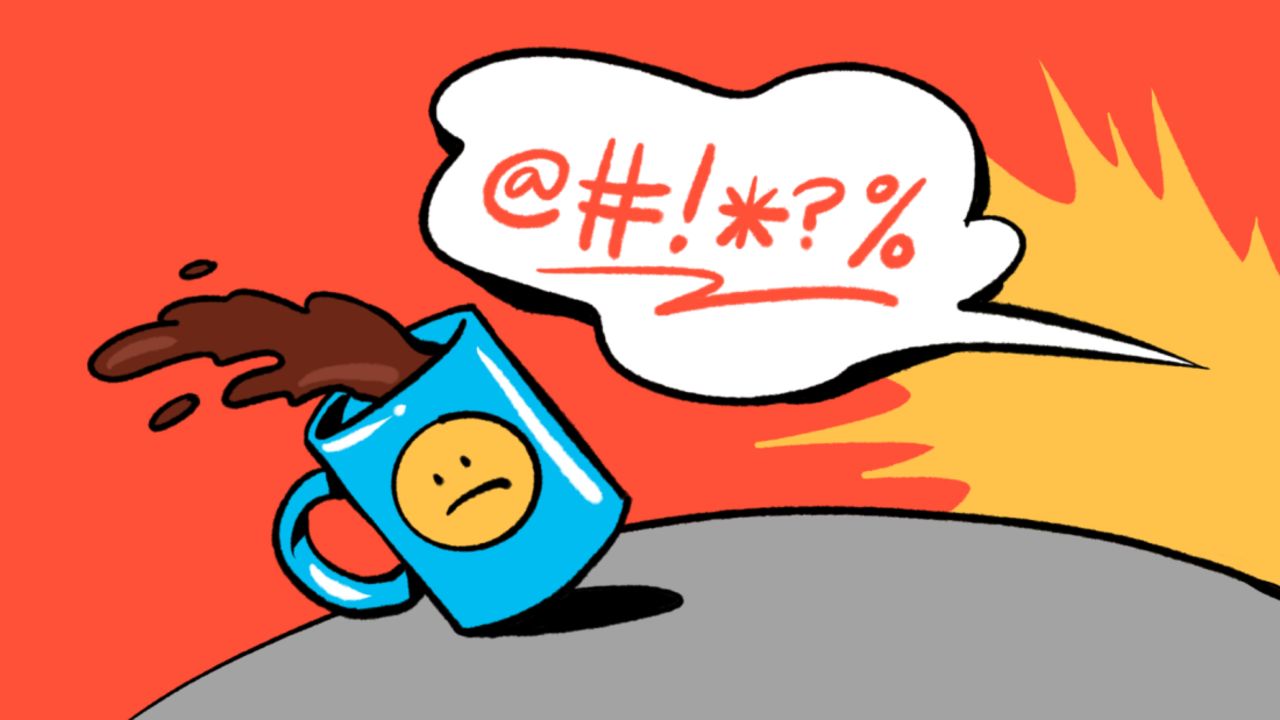
Max Pepper/CNN
Polite society considers swearing to be a vulgar sign of low intelligence and education, for why would one rely on rude language when blessed with a rich vocabulary?
That perception, as it turns out, is full of, uh … baloney. In fact, swearing may be a sign of verbal superiority, studies have shown, and may provide other possible rewards as well.
“The advantages of swearing are many,” said Timothy Jay, professor emeritus of psychology at the Massachusetts College of Liberal Arts, who has studied swearing for more than 40 years.
“The benefits of swearing have just emerged in the last two decades as a result of a lot of research on brain and emotion, along with much better technology to study brain anatomy.”
1. Cursing may be a sign of intelligence
Well-educated people with plenty of words at their disposal, a 2015 study found, were better at coming up with curse words than those who were less verbally fluent.
Participants were asked to list as many words that start with F, A or S in one minute. Another minute was devoted to coming up with curse words that start with those three letters. The study found those who came up with the most F, A and S words also produced the most swear words.
That’s a sign of intelligence “to the degree that language is correlated with intelligence,” said Jay, who authored the study. “People that are good at language are good at generating a swearing vocabulary.”
Swearing can also be associated with social intelligence, Jay added.
“Having the strategies to know where and when it’s appropriate to swear, and when it’s not,” Jay said, “is a social cognitive skill like picking the right clothes for the right occasion. That’s a pretty sophisticated social tool.”
2. Swearing may be a sign of honesty
Science has also found a positive link between profanity and honesty. People who cursed lied less on an interpersonal level, and had higher levels of integrity overall, a series of three studies published in 2017 found.
“When you’re honestly expressing your emotions with powerful words, then you’re going to come across as more honest,” said Jay, who was not involved in the studies.
While a higher rate of profanity use was associated with more honesty, the study authors cautioned that “the findings should not be interpreted to mean that the more a person uses profanity, the less likely he or she would engage in more serious unethical or immoral behaviors.”
3. Profanity improves pain tolerance
And swearing doesn’t just help your endurance: If you pinch your finger in the car door, you may well feel less pain if you say ‘s**t” instead of “shoot.”
People on bikes who swore while pedaling against resistance had more power and strength than people who used “neutral” words, studies have shown.
Research also found that people who cursed while squeezing a hand vice were able to squeeze harder and longer.
Spouting obscenities doesn’t just help your endurance: If you pinch your finger in the car door, you may well feel less pain if you say “sh*t” instead of “shoot.”
Another study found people who cursed as they plunged their hand into icy water felt less pain and were able to keep their hands in the water longer than those who said a neutral word.
“The headline message is that swearing helps you cope with pain,” said psychologist Richard Stephens, the lead author of the three studies. Stephens researches swearing at the Psychobiology Research Laboratory at Keele University in Staffordshire, England.
Stephens says it works like this: swearing produces a stress response that initiates the body’s ancient defensive reflex. A flush of adrenaline increases heart rate and breathing, prepping muscles for fight or flight.
Simultaneously, there is another physiological reaction called an analgesic response, which makes the body more impervious to pain.
“That would make evolutionary sense because you’re going to be a better fighter and better runner if you’re not being slowed down by concerns about pain,” Stephens said.
“So it seems like by swearing you’re triggering an emotional response in yourself, which triggers a mild stress response, which carries with it a stress-induced reduction in pain,” he added.
Careful, however, the next time you decide to extend your workout by swearing. Curse words lose their power over pain when they are used too much, research has also discovered.
Some of us get more out of swearing than others. Take people who are more afraid of pain, called “catastrophizers.”
“The research found men who were lower catastrophizers seemed to get a benefit from swearing, whereas men who are higher catastrophizers didn’t,” Stephens said. “Whereas with women there wasn’t any difference.”
4. Cussing is a sign of creativity
Swearing appears to be centered in the right side of the brain, the part people often call the “creative brain.”
“We do know patients who have strokes on the right side tend to become less emotional, less able to understand and tell jokes, and they tend to just stop swearing even if they swore quite a lot before,” said Emma Byrne, author of “Swearing Is Good for You.”
Research on swearing dates back to Victorian times, when physicians discovered that patients who lost their ability to speak could still curse.
“They swore incredibly fluently,” Byrne said. “Childhood reprimands, swear words and terms of endearment — words with strong emotional content learned early on tend to be preserved in the brain even when all the rest of our language is lost.”
5. Throwing expletives instead of punches
Why do we choose to swear? Perhaps because profanity provides an evolutionary advantage that can protect us from physical harm, Jay said.
“A dog or a cat will scratch you, bite you when they’re scared or angry,” he said. “Swearing allows us to express our emotions symbolically without doing it tooth and nail.
“In other words, I can give somebody the finger or say f**k you across the street. I don’t have to get up into their face.”
Cursing then becomes a remote form of aggression, Jay said, offering the chance to express feelings quickly while hopefully avoiding repercussions.
“The purpose of swearing is to vent my emotion, and there’s an advantage in that it allows me to cope,” he said. “And then it communicates very readily to bystanders what my emotional state is. It has that advantage of emotional efficiency — it’s very quick and clear.”
A universal language
What makes the use of naughty words so powerful? The power of the taboo, of course. That reality is universally recognized: Just about every language in the world contains curse words.
“It seems that as soon as you have a taboo word, and the emotional insight that the word is going to cause discomfort for other people, the rest seems to follow naturally,” Byrne said.
It’s not just people who swear. Even primates curse when given the chance.
“Chimpanzees in the wild tend to use their excrement as a social signal, one that’s designed to keep people away,” Byrne said.
Hand-raised chimps who were potty-trained learned sign language for “poo” so they could tell their handlers when they needed the toilet.
“Chimpanzees in the wild tend to use their excrement as a social signal, one that’s designed to keep people away,” Byrne said. “And as soon as they learned the poo sign they began using it like we do the word s**t.”
Does that mean that we should curse whenever we feel like it, regardless of our environment or the feelings of others? Of course not. But at least you can cut yourself some slack the next time you inadvertently let an f-bomb slip.
After all, you’re just being human.



 olderfatterhappierdotcom