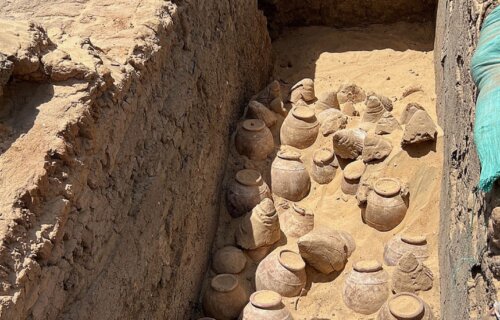
5,000-year-old wine jars in the tomb of Queen Meret-Neith in Abydos during the excavation. The jars are in their original context and some of them are still sealed. (Credit: EC Köhler
Cheers! 5,000-year-old wine collection discovered in tomb of ancient Egypt’s first female pharaoh
ABYDOS, Egypt — This gives a whole new meaning to “aging like fine wine.” Archaeologists from Germany and Austria have discovered a treasure trove of wine in the tomb of Egypt’s first female pharaoh.
The team, led by Christiana Köhler from the University of Vienna, was conducting an excavation of Queen Meret-Neith’s tomb when they found hundreds of large wine jars. Remarkably, some of these jars were in pristine condition, even preserving remnants of 5,000-year-old wine within them. Inscriptions discovered within the tomb further indicate Queen Meret-Neith’s significant influence, revealing her control over pivotal government sectors, including the treasury.
The tomb complex of Queen Meret-Neith in Abydos during excavation. The Queen’s burial chamber lies in the centre of the complex and is surrounded by the secondary tombs of the courtiers and servants. (Credit: EC Köhler)
Meret-Neith, a key figure around 3,000 BC, stands out not only as the most influential woman of her time but also as the sole woman to have her own monumental tomb in Egypt’s first royal cemetery at Abydos. The team’s new findings have reignited discussions about her unique place in history, as her true identity remains shrouded in mystery. It also hints at the possibility of Meret-Neith being the first female pharaoh of ancient Egypt.
Excavations in the tomb complex of Queen Meret-Neith in Abydos. (Credit: EC Köhler)
The expansive tomb complex of Meret-Neith in the Abydos desert is not limited to her burial chamber. It also encompasses the tombs of 41 courtiers and servants. Made primarily from unbaked mud bricks, clay, and wood, the intricate structure showcases multiple construction phases spanning a relatively extended period. Such evidence challenges earlier beliefs of human sacrifices accompanying royal burials during the 1st Dynasty – a concept frequently assumed but never definitively proven.
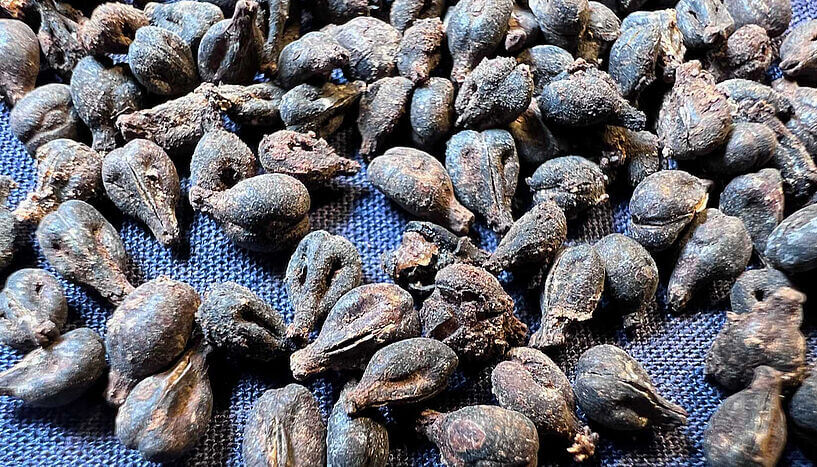
These excellently preserved grape seeds were found in the sealed wine jars in the tomb of Queen Meret-Neith in Abydos. (Credit: EC Köhler)
Köhler’s team is the result of a collaboration among multiple institutions, including the Egyptian Ministry of Tourism and Antiquities, the German Archaeological Institute in Cairo, the University of Vienna, the Vienna University of Technology in Austria, and Lund University in Sweden. Their work has been made possible through the support of the Austrian Science Fund (FWF) and the German Research Foundation (DFG).
Admittedly, it’s pretty difficult these days to think of any good news. My brain is consumed with thoughts of Ukraine, as I’m sure yours is as well.
But if drinking a little wine is helping the world seem a little less terrifying, apparently there’s a health benefit as well. Read on, and sip with impunity.
NEW ORLEANS — Enjoy a glass of vino with your meal every now and again? Turns out you might be doing your body good. Researchers from Tulane University report that drinking wine with dinner could help stave off diabetes.
Compounds in grape skin combat the metabolic disease by reducing blood sugar levels, say scientists. But drinking beer or liquor with food increases the risk.
The finding is based on data from 312,000 British residents who describe themselves as regular drinkers. Those who had a glass of wine or two — particularly red — at mealtimes were 14 percent less likely to develop the metabolic disease over the next decade.
“Drinking moderate amounts of wine with meals may prevent Type 2 diabetes if you do not have another health condition that may be negatively affected by moderate alcohol consumption and in consultation with your doctor,” says lead author Dr. Hao Ma, a biostatistical analyst at the Tulane University Obesity Research Center, in a statement.
Good news for wine drinkers
Wine is rich in healthy plant chemicals including resveratrol, which acts like an antioxidant. Red varieties are particularly abundant in the compound.
“The effects of alcohol consumption on health have been described as a double-edged sword because of its apparent abilities to cut deeply in either direction – harmful or helpful, depending on how it is consumed,” says Ma. “Previous studies have focused on how much people drink and have had mixed results. Very few studies have focused on other drinking details, such as the timing of alcohol intake.”
Moderate drinking is defined as a small glass of wine (150ml) or other alcoholic beverage daily for women, and up to two for men.
“Clinical trials have also found that moderate drinking may have some health benefits, including on glucose metabolism,” adds Ma. “However, it remains unclear whether glucose metabolism benefits translate into a reduction of type 2 diabetes. In our study, we sought to determine if the association between alcohol intake and risk of type 2 diabetes might differ by the timing of alcohol intake with respect to meals.”
The participants were tracked for about eleven years on average. They did not have diabetes, cardiovascular diseases or cancer at the outset. Their average age 56, slightly more than half were women and 95 percent were white. Those who reduced alcohol consumption due to illness, doctor’s advice or pregnancy were excluded.
During the follow-up period about 8,600 developed Type 2 diabetes. Those who drank with their meal — rather than without eating food — cut their risk by 14 percent. The potential benefit was evident only among the former group. Specific times were not collected. It was also mainly among those who drank wine rather than other types of alcohol.
Alcohol still raises risks of many other conditions
While the finding is good news for wine lovers, researchers still say consuming alcohol is best in moderation. That’s because it’s also linked to high blood pressure, obesity, stroke, breast cancer, liver disease, depression, suicide, accidents, alcohol abuse and alcoholism. The risks increase as the amount of alcohol an individual drinks rises. For some cancers and other health conditions, the risk increases even at very low levels of alcohol consumption – less than one drink daily.
The American Heart Association and the US Centers for Disease Control and Prevention (CDC) recommend that adults who do not drink alcohol should not start. Among those who drink alcohol regularly, they should talk with their doctors about the benefits and risks of consuming alcohol in moderation.
Some people should not drink at all, including women who are pregnant or trying to get pregnant, people under the age of 21 and people with certain health conditions.
Professor Robert Eckel, of the University of Colorado, who was not involved in the study, says the relationship between alcohol and Type 2 diabetes remains controversial. Eckel is a former president of the American Heart Association. “These data suggest that it is not the alcohol with meals but other ingredients in wine, perhaps antioxidants, that may be the factor in potentially reducing new-onset type 2 diabetes,” he notes. “While the type of wine, red versus white, needs to be defined, and validation of these findings and mechanisms of benefit are needed, the results suggest that if you are consuming alcohol with meals, wine may be a better choice.”
The study was presented at the American Heart Association Epidemiology, Prevention, Lifestyle & Cardiometabolic Health Conference in Chicago.
South West News Service writer Mark Waghorn contributed to this report.
Speaking of wine, the industry’s latest annual report cited some millennial trends that will impact not just this age group (currently 23-38) but the rest of us, too, as winemakers take notice. Cheers to healthy wines at a reasonable price!
Millennials:
Tend to prefer craft beers, spirits (e.g., whiskey) and/or cannabis to wine
Less interested in accumulating “stuff”; experiences mean more
Health oriented (wine’s competing with kombucha, for heaven’s sake!), which means a preference for wine that’s organic, sustainable and local
Don’t have a lot of money. They’re still dealing with fallout from the 2008 recession, student loans, and establishing themselves in their careers
Want their drinking experience to be fun (hence the appeal of inventive cocktails and entertaining mixologists), not precious or snobby
Turned off by pretentious tasting rooms (and high prices) they associate with their parents
Inclined to reject “safe” choices like pinot and chardonnay in favor of something unexpected. (Barrel-aged sauvignon blanc, anyone? Oenologists describe this rare specialty as having a creamier texture and more rounded lemony/crème brûlée flavors than flinty Sancerre or herbaceous New Zealand offerings.)
Are you a millennial? Do you agree with these general observations?
Incidentally, did you know that rosé is the fastest growing wine segment in the US? If you’re of the generation that grew up on Mateus and have shunned them ever since, one of Oregon’s lovely, fresh, pinot noir rosés will be a revelation.
Most days, the political news makes me want to pull the covers over my head and stay in bed for the next several years.
Take transgender military personnel. These brave folks are dodging bullets and land mines – are we seriously worried about whether they pee standing up or sitting down?
But, in the struggle to feel optimistic, I have a simple suggestion: buy wine. Not to drink, although drinking is to be encouraged in these fraught times, but to save.
This occurred to me yesterday, after stopping at one of our favorite wineries, Yamhill Valley Vineyards and buying a case of wine that won’t mature until 2020 or beyond. (Dare I suggest that we have a better chance with pinot than with our current president maturing by 2020?)
Think about it: You buy a bottle that is drinkable now but is going to be so much better if you have the patience to wait a few years. (This may be the only area in which I am patient. Just ask my Long Suffering Husband.)
Your wine can be a little time capsule. You could wrap it in a current newspaper and hope that 6-8 years from now the news will seem quaint and vaguely amusing. You can put it away somewhere cool and comfortable and just visit it occasionally to make sure it’s doing ok. You can start collecting recipes of yummy food that will be perfect to eat with your special bottle. Be creative! Have fun!
Our friend Linda, the tasting manager at Yamhill, is taking this whole optimism thing to a new level. She has found a new love, lost over 100 pounds, and looks gorgeously, radiantly happy as her wedding approaches. What’s more of a leap of faith than marriage, right?
Let’s all check in with each other in 2020, open our bottles, and toast our collective survival. Good times ahead! xx, Alisa
Having just returned from a long weekend in L.A. (both literally and in the “endurance” sense), this week’s post is a total cop-out. Hope you enjoy it!









 olderfatterhappierdotcom