Sharing a fun and random factoid from blogger Mliae. Enjoy!

Fun and Random Factoids 28.03.2017
Leave a reply

Sharing a fun and random factoid from blogger Mliae. Enjoy!


Whew! I’ve finally unpacked, done the laundry, and gotten a decent night’s sleep, having just returned from a quick 10-day visit to two of my favorite cities.
Rather than a full travelogue – most of you are quite familiar with these locations – here are some random impressions/moments from this trip.
LONDON
Arrival Day (Hooray for British Airways Austin-London direct flight!)
High points:







PARIS
We spent most of our time here, and my overall sense was that people are feeling edgy and a bit under siege, although everyone we encountered was perfectly lovely.
Sadly, the city is looking a bit tired and dingy. More litter and dogs*** in the streets/on the sidewalk than I recall from the last trip two years ago. The métro is smellier. There’s almost a palpable collective Gallic shrug of “why bother?” going on.
However, we had a wonderful visit. How bad can things be when you eat croissants every day? (I recommend finding your local Eric Kayser bakery.) 
Notes:


xo, Alisa 

They say, “You’re only as young as you feel”. Is the opposite, “You’re only as old as you look”? While aging is inevitable, some little things we do every day can make us look older than we have to. Luckily, they’re easily avoided; no medical intervention necessary!
Commuting. If you spend a lot of time in the car, the left side of your face gets extra sun exposure – the #1 cause of old-looking skin. Slather on the sunscreen, and don’t neglect the backs of your hands.

Stress. Whether from road rage or other causes, chronic stress accelerates premature aging by shortening telomeres, the specialized DNA sequences and associated proteins that maintain the integrity of our chromosomes. Whole books have now been written about harnessing the power of telomerase, the enzyme that protects telomeres. If you don’t feel like reading all that, meditation, deep breathing, exercise, vodka and Xanax are also highly effective.

Tech neck. Did you know that constantly looking down at our devices and computers encourages slackening of our jaw and neck muscles? Obviously we’re not about to give them up but people who care about these things suggest we keep them at eye level whenever possible.

Sleep. Sleeping is good. Smooshing our face into the pillow is not so good, leading to additional wrinkling. If you can’t sleep on your back – and many can’t – try a silk or satin pillowcase, or use a sleep mask.

Dry Climate. Dryness saps moisture from your skin. Use a humidifier, especially during the night. If you live in Texas, buy two.

Straws. I was all about drinking my coffee through a straw to minimize staining my teeth until I realized that pursed lips accelerate wrinkles around the mouth. (Look at any chronic smoker.) And if you drink a lot of bottled water, you might want to pour it into a glass with a wider opening.

Inactivity. According to a 2010 Australian study, every hour spent watching TV after age 25 cuts almost 22 minutes off the viewer’s lifespan. Yikes. Does my pounding heartbeat when I watch a show like The Americans or Man in The High Castle count as exercise, though?

City Living. Here’s something interesting from a Harvard School of Public Health study: Women living in the greenest areas, as measured by satellite, were 34 percent less likely to die from a respiratory illness than women living in the most paved-over areas. And women living amidst greenery were 13 percent less likely to die of cancer. If you live in a city, get some houseplants!

Sugar. Really want to wreck your skin? Eat sugar! It causes inflammation, which breaks down collagen and elastin, the building blocks of healthy, plump skin.

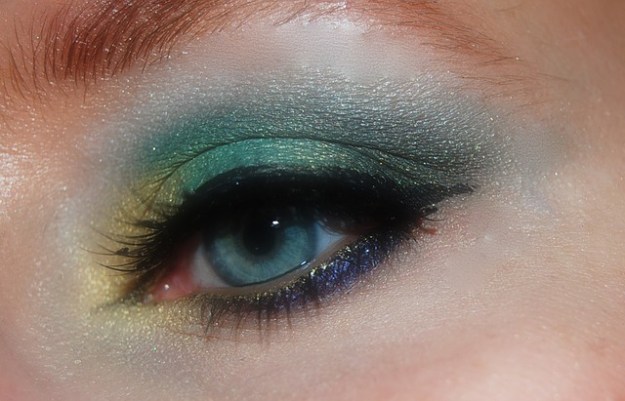
Heavy makeup. Kind of a no-brainer, but wearing more makeup as we age is actually, well, aging. Go easy on foundation, substituting a tinted moisturizer with a broad-spectrum sunblock, dab a little concealer only where you need it, and skip under-eye liner and mascara, which cast a shadow and make older eyes look tired.
How about a quick way to look younger? Every year our skin and hair tones change subtly, so what used to be flattering may not look as good now. Color experts recommend wearing one of these four universally flattering shades.
NEW BLACK Black is my go-to. But I admit it’s often too severe for mature skin, making fine lines, under-eye circles and wrinkles more obvious. Much more flattering are softer shades like charcoal grey and navy. And when you do wear black, consider adding a scarf to bring color near your face.
PERIWINKLE Even the name is charming! Hair and skin tones become “cooler” as we age, so one color that looks pretty on most women is this medium blue with a touch of violet or purple.
TURQUOISE Turquoise looks great against every skin tone. To figure out whether to go bluer or greener, one color expert suggests looking at the veins in your wrist and choosing a shade that leans in that direction. On medium to darker skin, either will be beautiful.
RED VIOLET This vibrant color is more flattering than pastel pink, especially on lighter skin. Fuchsia, raspberry and magenta can brighten your face and still look sophisticated.

I’ve always longed for straight hair. As a pre-teen in the Swinging Sixties I envied iconic model Jean Shrimpton, whose flowing mane seemed impervious to the rain, humidity and heat which turned my own careful flip into a flop faster than you could say “Carnaby Street”.
If you’re a woman of a certain age, you’ll remember ironing your hair — yes, bending over an actual ironing board and flattening it with an iron! — or setting it by wrapping your hair sideways around your head or rolling it over empty beer or soup cans.
In fact, the first time my husband saw me, in the summer of ’68, I was walking around the theatre where we both worked with my hair in those giant improvised rollers.
And yet he married me (admittedly, 40+ years later)!
Over the decades, I’ve sort of made peace with my wavy hair, but as I’ve gotten older it’s become harder to manage, with an uneven curl pattern exacerbated by wiry greys that insist on poking through.
I’d been tempted by keratin, Japanese and Brazilian treatments but the potential damage from harsh chemicals (including formaldehyde) scared me off. Then my colorist at Aveda told me about their Smooth Infusion Retexturizing salon treatment.
Aveda’s mission is to use as many organic and natural ingredients as possible, so their gentler formula protects hair during processing with organic jojoba oil and coconut-derived conditioners. Unlike a chemical relaxer, this is a thermal straightener designed to minimize potential breakage, while organic ylang ylang oil contributes a pleasant scent instead of a strong chemical odor.
The Smooth Infusion Retexturizing Treatment is not for the impatient or the faint of wallet. It takes about 3 hours and is not cheap. But after doing this a few weeks ago I’m convinced it’s worth it—and I should only need touch-ups every 6-12 months depending on how fast my curly roots grow.
One great thing about the Aveda system is that it can be customized from stick straight to loose curls. I opted to leave a slight wave so my fine hair wouldn’t be completely flat and would have some texture if I just let it air dry.
This is a multi-step process. After a consult about the desired results, and a caution that it may lighten hair a shade or two (which, for me, was a benefit), here’s what happens:
Check out this You Tube video to see all the steps.


(Wet hair before treatment) (Wet hair after treatment)
The result: My hair was smooth and shiny and the process did indeed lighten the color slightly. It’s now much easier to style, barely needs a flat iron to lie smooth, and hasn’t puffed up on the days we’ve had high humidity or rain. If I save 20 minutes whenever I wash my hair, the 3 hours spent at the salon will more than pay off.
Next time, I might even go straighter. All in all, highly recommended!
.

Lately, my husband and I have been wondering, “Was he/she raised in a barn?” This week, I was particularly reminded that manners in general are going to hell in a hand basket. (And what the hell IS a hand basket?)
Too bad more people haven’t read Miss Manners’ (aka Judith Martin’s) Guide to Excruciatingly Correct Behavior, a beacon of civility in an increasingly uncivil world.
As she might tell you, manners aren’t arbitrary rules dictated by some humorless expert; they exist to make people more comfortable. By knowing how to behave you put others at ease and everyone gets along with at least the appearance of grace and mutual respect.
When I was a kid, my parents bought my sister and me copies of a book called Tiffany’s Table Manners for Teenagers. Written by Walter Hoving, former chairman of Tiffany’s of New York, it’s a delightful step-by-step introduction to all the basics, from the moment the meal begins. Sample: “Remember that a dinner party is not a funeral, nor has your hostess invited you because she thinks you are in dire need of food. You’re there to be entertaining.”
Miss M would also insist upon a proper dress code to honor the host’s wishes and the occasion.
Recently, I attended a lovely afternoon interfaith tea, where each of the 10-seat tables had been dressed to the nines (an Old English or Scots expression dating back to the 1700’s, possibly a corruption of “thine eyes”, though no one seems certain). The women were also dressed nicely, in appreciation of the event itself and the time people spent planning it.
Later that evening, my husband and I attended a memorial service at that same synagogue. I’d have thought this would be a more formal occasion than a tea. Nope. Some attendees wore jeans and sneakers and most of the men — including the rabbi– didn’t even bother to put on a yarmulke. Call me a fuddy-duddy but I think death is one of those instances where people should make an effort, especially in a house of worship.
While I’m on my manners hobbyhorse, here are a few personal experiences that get my goat:
– Guests who bring uninvited extra people to a sit-down dinner and don’t even apologize; guests who show up hours late to a dinner party (not an open house); guests who don’t send a “bread and butter” thank-you note or e-mail. Is it just me?
– In December, one guest showed up at his colleague’s black tie holiday party – knowing full well that formality was important to the host – in faded jeans. The implication: “My comfort is more important than your wishes”. My grandmother would have said, “Just because you can, doesn’t mean you should.”
– And have you ever sent a gift to someone and not received a thank you card or acknowledgment, making you forever wonder whether it arrived, or if they hated it?
– Also on the subject of gifts: There’s a wealthy woman we know who attended the wedding of a young woman who’d worked for her — and whose parents were close friends — who gifted the happy couple with a $20 picture frame she’d probably picked up at the drugstore on the way to the wedding.
Strictly speaking, this might not fall under the heading of “manners” but… isn’t a gift supposed to match the occasion?
I’m not advocating a return to white gloves, bustles, or waiting to the point of silliness for someone to open a door for you. But wouldn’t the world be a little bit nicer if everyone made a bit more effort?

Hope you are doing something sweet for yourselves today! With love, Alisa

Having just returned from a long weekend in L.A. (both literally and in the “endurance” sense), this week’s post is a total cop-out. Hope you enjoy it!
|
|
|||||
|
When I first got contact lenses in 7th grade and announced ecstatically that I could finally see properly, my mother burst into tears. I remember this primarily because it’s the only sentimental thing she ever did.
Since then, glasses, contacts and post-age-40 reading glasses have been a fact of life and an ever-expanding part of my wardrobe. If I wear my contacts I can’t see anything smaller than type THIS BIG so I stash reading glasses all over the house, in the car and in at least one pocket. This also requires the expensive addition of reader sunglasses — also stashed in multiple locations. And yet, I often can’t find a pair.
Although I see best with my regular (progressive bifocal) glasses, they’re a real pain. They get dirty. They stretch and eventually slip off my nose. And they’re heavy enough to break tiny blood vessels in my cheeks if I wear them all the time. Memo: stock up on cover up.
Eventually I’ll probably need cataract surgery and maybe by then science will have a perfect solution. Meanwhile, at my latest annual eye exam, my doctor suggested I try monovision to eliminate the need for readers, which she thought would work better for me than bifocal contacts.

How It Works
With monovision, you wear a contact lens on one eye to correct your distance vision (aka nearsightedness) and a lens on the other eye to correct your near vision (farsightedness). The distance vision lens is worn on your dominant eye, i.e., the one that sees far away objects better.
The term “monovision” is a bit misleading. After about a week or two, brain learns to merge the two images to (theoretically) let you see clearly at all distances. But each eye will still see best at its own designated correction.
Plan on Multiple Visits
My eye doctor warned me that it might take multiple visits before landing on the right combination. Meanwhile, as my friend S (who won’t try this) says, I could be walking into walls. I leave with a 10-day supply of trial lenses. Note: you may be charged a higher fitting fee than usual because most people need “tweaking” before the lenses are perfect.
Rx 1: Right eye (distance) same as my normal prescription. Left eye (close up): under-corrected for distance and too blurry for close-up reading. Result: dizziness and lousy vision. Lose-lose.
Rx 2: A different doctor (young and impossibly chic) gives me a thorough exam trying a lot of subtle modifications to get me closer to the best prescription. Results: No change to right eye. Left eye made weaker so close-ups are better, but not great. Still dizzy and not seeing well enough. Feh.
Rx 3 (3 weeks after my initial checkup): Dr. Chic has me try a toric (weighted) lens for the mild astigmatism in my right eye. Upside: distance vision is a little sharper. Downsides: toric lenses are more expensive, thicker, and have to be perfectly positioned. She explains that there is a vertical line on the lens that should be at the bottom when you place it in your eye. After struggling to figure out why the line keeps moving, I realize the next day that there are actually TWO vertical lines – one will be at the top of the lens when the other is at the bottom. This seems unnecessarily complicated.
For the left eye, she gives me an even weaker lens. Now my close-up vision is excellent. Off I go with more test lenses, opting to wait a few days to see if this whole experiment is worth it or if I should just renew my old contacts prescription and stick with reading glasses. After all, I have made a substantial investment in readers at this point!
 The Research
What I’ve learned so far: Not everyone is a monovision candidate. Some people find that it compromises the clarity of their distance vision, making far away objects appear slightly blurry. I suspect this is going to be my problem, especially when I’m driving.
For others, monovision doesn’t provide good enough near vision to eliminate the need for readers. That would be pointless, no?
Finally, although the two eyes work together as a team, there can be a slight loss in depth perception. And I’d always need to carry glasses with me in case of an emergency (e.g., getting something in my distance eye and truly not being able to see anything.) If I have to carry glasses, wouldn’t it be a whole lot easier to just wear them?? Plus, they’re never going to fit in a small purse.
All in all, I’m giving this another week. Fingers (and eyes) crossed!

A friend sent me this helpful guide the other day. Author unknown.
| You can retire to Phoenix, Arizona where…
1. You are willing to park three blocks away from your house because you found shade. OR You can retire to California where… 1. You make over $450,000 and you still can’t afford to buy a house. OR You can retire to New York City where… 1 You say “the city” and expect everyone to know you mean Manhattan. OR You can retire to Minnesota where… 1. You only have three spices: salt, pepper and ketchup. OR You can retire to The Deep South where… 6. You can say anything about anyone, as long as you say “Bless his heart” at the end. OR You can move to Colorado where… OR You can retire to Nebraska or Kansas where… OR FINALLY You can retire to Florida where…
|
London living with lady Sarah
Tales of Mystery and the Supernatural
aka operasandcycling.com
Mit Wohnmobil und Kamera auf den Spuren der Natur
Tale of Net Cancer
Exploring the History and Beauty of the Iconic Carré: Interesting Facts, History, Photos and Shop.
Whatever That May Be
by Cherie White, Author and Anti-Bullying Advocate
Travel and Lifestyle Blog
Traveling to experience places not just visit them!
Rachel McAlpine writes, blogs, draws and podcasts here
Ramblings of a retiree in France
A personal blog that shares writing & positivity
For when France seems too far away. Shop for inspiring images of France and discover travel tips, packing advice, recipes, book reviews and more.
Art from the Earth
Random musings on style and substance
Life in islamic point of view


 olderfatterhappierdotcom