Tag Archives: dinosaurs

Science News: the “Pre-Dinosaur”

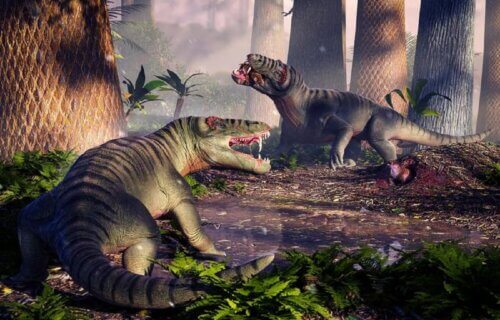
Artistic reconstruction of two Pampaphoneus biccai dinosaurs in the middle of the forest eating prey.
Artistic reconstruction of Pampaphoneus biccai. (credit: Original artwork by Márcio Castro)

This ‘bloodthirsty’ predator ruled South America 40 million years before dinosaurs

by StudyFinds

RIO GRANDE DO SUL, Brazil — A 265-million-year-old skull belonging to a terrifying and “bloodthirsty” creature has been discovered in the rural area of São Gabriel, Brazil. According to scientists, this ancient predator, named Pampaphoneus biccai, was the largest meat-eating animal of its time.

An international team of researchers found the “astoundingly well-preserved” skull, along with some ribs and arm bones, during a month-long excavation. Study delays due to the pandemic meant it took an additional three years for the fossil to be cleaned and thoroughly analyzed.

Pampaphoneus lived just before Earth’s largest mass extinction event, which wiped out 86 percent of all animal species worldwide. It belonged to a group of animals known as dinocephalians — large, land-dwelling creatures that included both meat-eaters and plant-eaters. The term “dinocephalian” translates to “terrible head” in Greek, a nod to the group’s notably thick skull bones.

The researchers explain that while well-known in South Africa and Russia, the animals are rare in other parts of the world. Pampaphoneus biccai is the only known species in Brazil.
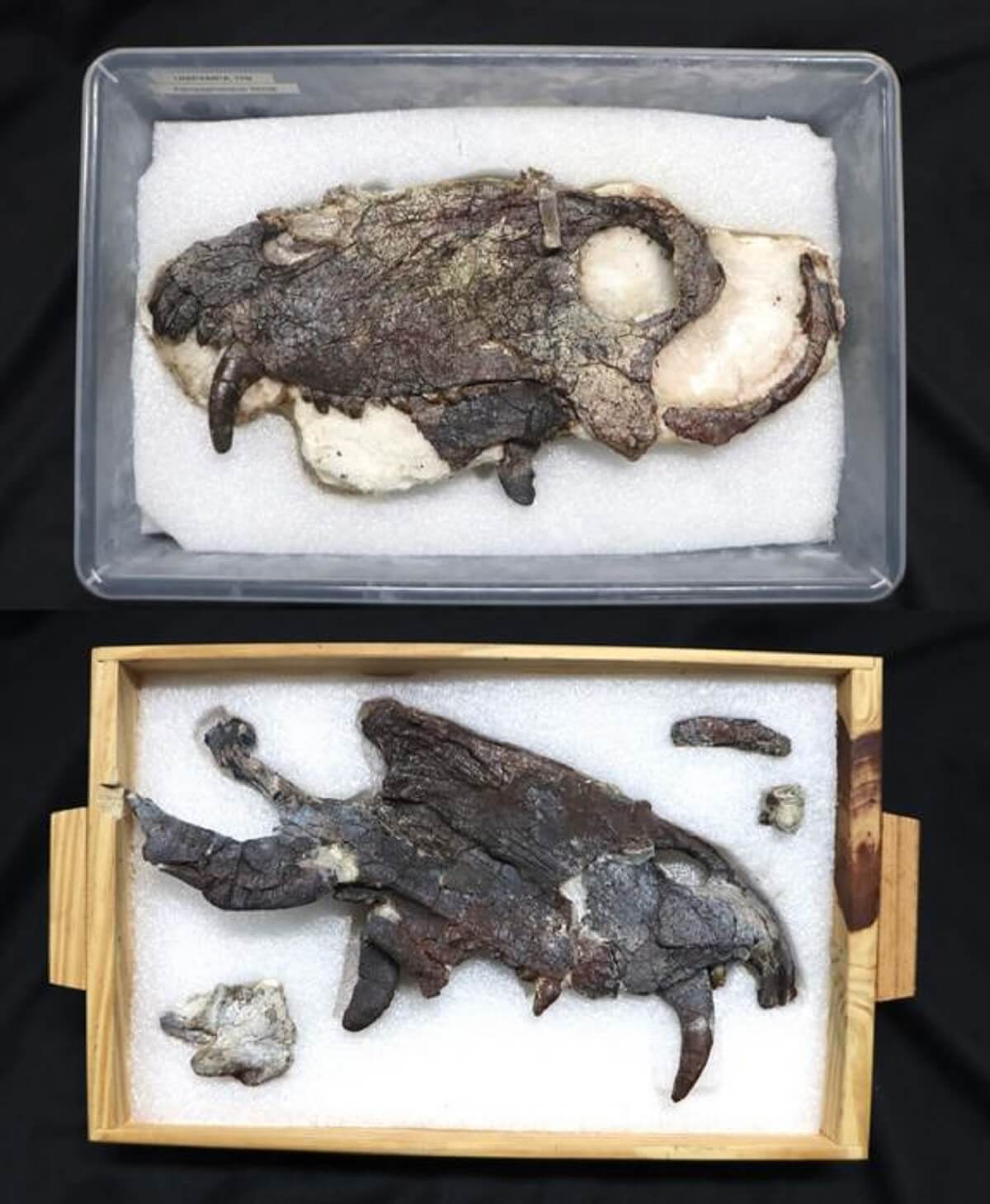
Skull of the new Pampaphoneus biccai specimen... a newly discovered terrestrial predator

Skull of the new Pampaphoneus biccai specimen. (credit: Photo by Felipe Pinheiro)

The skull provides crucial insights into the creature’s morphology, or physical structure, due to the excellent preservation of its bones. It is the second Pampaphoneus skull ever found in South America and is larger than the first.

“Finding a new Pampaphoneus skull after so long was extremely important for increasing our knowledge about the animal, which was previously difficult to differentiate from its Russian relatives,” says Mateus Costa Santos, the study’s lead author from the Federal University of Pampa (UNIPAMPA), in a media release.

Researchers estimate that the largest individuals of this species could have reached nearly 10 feet in length and weighed around 882 pounds. Potential prey for this fearsome creature have also been discovered in the same area, including the small dicynodont Rastodon and the giant amphibian Konzhukovia.

“It was the largest terrestrial predator we know of from the Permian in South America. The animal had large, sharp canine teeth adapted for capturing prey,” says senior author Professor Felipe Pinheiro, also of UNIPAMPA. “Its dentition and cranial architecture suggest that its bite was strong enough to chew bones, much like modern-day hyenas.”

The study also reveals Pampaphoneus fed on small to medium-sized animals.

“This animal was a gnarly-looking beast, and it must have evoked sheer dread in anything that crossed its path. Its discovery is key to providing a glimpse into the community structure of terrestrial ecosystems just prior to the biggest mass extinction of all time,” says co-author Professor Stephanie Pierce of Harvard University.

The research is published in the Zoological Journal of the Linnean Society.

Good News Monday: Hobbits Were Real

Well, sort of, according to this article on StudyFinds.com:


‘Hobbit’ creature discovered in North America, rewriting history of mammals after dinosaur era

by Chris Melore

BOULDER, Colo. — Fossils of a creature which researchers compare to the character Beorn from “The Hobbit” may change how scientists look at the evolution of mammals following the extinction of the dinosaurs. The prehistoric mammal is one of three new species a team from the University of Colorado-Boulder have discovered that they say roamed North America shortly after the age of dinosaurs.

Paleontologists generally accept that the end of the dinosaurs is also the dawn of modern mammals on Earth. However, scientists have assumed that there was very little diversity in mammal species during the earliest Paleocene Epoch — a geological period roughly 56 to 66 million years ago. This new discovery suggests that mammals actually diversified much quicker after dinosaurs left the planet.

The three new species — Miniconus jeanninaeConacodon hettingeri, and Beornus honeyi — range in size from rat-sized mammals to modern house cats. At the largest end of the spectrum, these creatures would be much larger than their fellow mammals living alongside the dinosaurs at the time.

A smile made for the movies

Researchers say each of these animals have unique dental features which reveal them to be separate species. In the case of Beornus honeyi, its inflated molars (or puffy cheek teeth) give it the appearance of being like Beorn from “The Hobbit” — hence its colorful name.

All three mammals belong to a group called archaic ungulates (or condylarths), which are the primitive ancestors to today’s hoofed mammals such as horses, elephants, cows, and hippos. The findings come from an analysis of unearthed lower jaw bones and teeth. These fossils provide insight into an animal’s lifestyle and body size.

The team’s examination points to the animals being omnivores who could grind up both plants and meat. Despite this, scientists can’t rule out that these early mammals only ate plants during this period. One thing is certain though, mammal life took off roughly 66 millions ago following the mass extinction event that wiped out the final era of their reptilian neighbors.

“When the dinosaurs went extinct, access to different foods and environments enabled mammals to flourish and diversify rapidly in their tooth anatomy and evolve larger body size. They clearly took advantage of this opportunity, as we can see from the radiation of new mammal species that took place in a relatively short amount of time following the mass extinction,” explains lead author Madelaine Atteberry from the University of Colorado Geological Sciences Department, in a media release.

North America had a diverse rodent population?

Atteberry and co-author Jaelyn Eberle analyzed the jaw bone fossils of 29 condylarth species to determine the anatomical differences between each animal. Using phylogenetic techniques, they assessed how each species compared to other early Paleocene condylarths living in the present day western United States.

From those studies, the team believes they have unearthed three completely new species from those first years following the demise of dinosaur life. Results also show that Beornus honeyi appears to be the largest of the three, measuring about the size of a modern feline.

While Conacodon hettingeri and Miniconus jeanninae are similar in size to other rodent-like early mammals, they differ in the shape and form of their last molars.

“Previous studies suggest that in the first few hundred thousand years after the dinosaur extinction (what is known in North America as the early Puercan) there was relatively low mammal species diversity across the Western Interior of North America, but the discovery of three new species in the Great Divide Basin suggests rapid diversification following the extinction,” says Atteberry. “These new periptychid ‘condylarths’ make up just a small percentage of the more than 420 mammalian fossils uncovered at this site. We haven’t yet fully captured the extent of mammalian diversity in the earliest Paleocene, and predict that several more new species will be described.”

The findings appear in the Journal of Systematic Palaeontology.