Monthly Archives: April 2024

A Palestinian’s POV

Violating my self-imposed “rule” not to discuss politics but thought this was an important article to share. I’ve bolded some of his remarks.

The author, Bassem Eid, is a Palestinian human rights activist who lives in Judea and Samaria.  He published this article in Newsweek Magazine on March 5th and updated it on March 7th.

My Fellow Palestinians: Stop Blaming the Jews—Hamas Is Starving Our Brothers and Sisters in Gaza | Opinion

By Bassem Eid

How can we understand the terrible, self-imposed deprivation now gripping the people of Gaza? The heart-wrenching stampede that unfolded in Gaza last Thursday casts a stark light on the brutal reality of life under Hamas‘s rule. It is a somber reminder of the urgent need to address the suffering of Gaza’s people, but it also serves as a crucial moment to clarify the accountability for Gaza’s plight.

The chaos and desperation that led to this tragedy are direct outcomes of Hamas’s governance, which prioritizes violence and killing Jews over the welfare of its population. The stampede, occurring during an aid distribution, tragically underscores the severe humanitarian crisis in Gaza. Driven by sheer desperation, people found themselves in a deadly crush, a situation that should never occur.

To pave the way for peace and stability for my brothers and sisters in Gaza, it is essential to acknowledge the root causes of their suffering. Hamas’s diversion of resources, suppression of dissent, and neglect of civilian needs must end. The international community, along with the Palestinian people, must demand accountability and seek a future where governance prioritizes human dignity, economic opportunity, and peaceful coexistence. Only through addressing these fundamental issues can we hope to prevent such tragedies and build a brighter future for all Palestinians.

As a Palestinian human rights activist deeply sympathetic to the plight of the Palestinian people and the complexities of the Israeli-Palestinian conflict, I can tell you beyond the shadow of a doubt that the terrorist group Hamas is responsible for the suffering of Gazans.

Outside obfuscators often try to misplace blame for the suffering onto Israel’s “blockade” on the Strip, but a brief consideration of the timeline shows the absurdity of this conceit. Israel unilaterally withdrew all of its soldiers and settlers from Gaza in 2005. Within hours, Hamas-aligned looters had stripped bare and destroyed the greenhouses and farms Israel had left behind for local sustenance. In 2007, Hamas seized military control of the strip in a brutal local coup against the internationally recognized Palestinian Authority (PA), throwing its supporters off the roofs of buildings.  

Rape, torture, and bodily mutilation were reported on a systemic scale, and over 240 innocents were dragged back to Hamas’s terror emirate in Gaza as hostages. Hamas is still holding over 130 of these innocents hostage.  As a human rights activist and a human being, I recognize that it defies all rules of geopolitics, morality, and human nature to suggest that Israel not respond militarily to dismantle Hamas and rescue its people, who we now know are being raped and psychologically tortured in captivity.

And yet, amidst the intensity of the ongoing war, Israel has facilitated the transfer of international aid to Hamas-controlled territory—while Hamas has been seizing these essential supplies and transferring them for military purposes. Hamas has built a massive network of tunnels under the Strip that exceeds the New York subway system in length, where hostages have been kept underground without light and used as human shields to protect terrorist commanders. Hamas’s cannibalization of the civilian economy has gone so far as to dig up water pipes and convert them into makeshift rockets to fire into Israeli territory.

Beyond economic manipulation, Hamas’s rule in Gaza is marked by a severe crackdown on political dissent. Opposition and press voices are silenced, often violently, with human rights organizations reporting arbitrary arrests, torture, and extrajudicial killings. LGBTQ+ individuals, and anyone else who defies the harsh religious extremism governing all life in the Strip face torture and execution.

The real victims of Hamas’s governance are the ordinary people of Gaza, who endure the consequences of their rulers’ bloodthirsty actions. The youth, facing unemployment rates that are among the highest in the world, see their futures evaporate in an economy stifled by mismanagement and artificially exacerbated conflict. The sick suffer from a health care system in disarray, with hospitals overwhelmed and under-resourced, in part due to the diversion of medical supplies to serve Hamas’s fighters and the repurposing of these healing spaces into military command centers.

As a Palestinian human rights activist, my loyalty lies with the Palestinian people, whose rights and future have been compromised by a cruel leadership that prioritizes military and terrorist objectives over human welfare. For those of us caught in the middle, the path forward requires an honest confrontation with the reality of our situation.

The plight of Gaza is a wound at the heart of the Middle East, a testament to the failures of an international policy that has foolishly coddled a brutal tyrant and implacable foe. Only by dismantling the governing rule of the irredeemable Hamas can we begin to heal this wound and move toward a future where the rights and dignity of all Palestinians are upheld, and peace and economic development alongside our Israeli neighbors can at last bear fruit for both sides.

Photo by Jonathan Meyer on Pexels.com

Grin and Bear It

Sharing a fascinating article from historyfacts.com.

Photo by Vadim Bocharov on Pexels.com

Why Are People Never Smiling in Old Photographs?

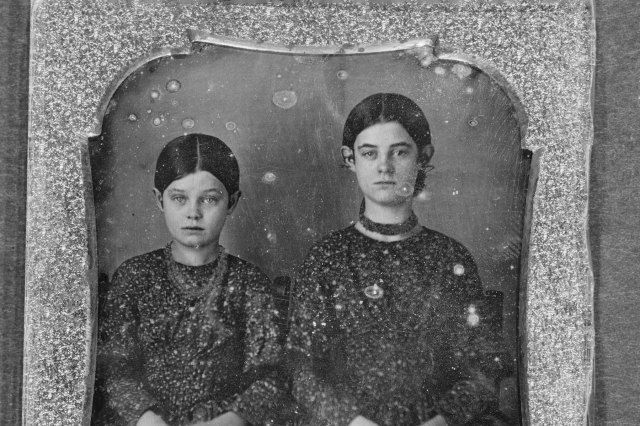
First developed in the late 1820s, photography combined art and science into one medium capable of capturing an image in the moment. The innovation transformed recorded history into something that could be documented in pictures as well as text. As the technology advanced, the medium exploded in popularity, making it possible for families to create snapshots of memories for future generations to appreciate. These early photographic portraits transport us back in time, painting a picture of a different way of life: Families were larger, clothes were bulkier, and postures were noticeably stiff and formal. But perhaps the most conspicuous difference of all is that no one ever seemed to smile.

The somber expressions preserved in early photographs might lead us to assume that past generations led austere and joyless lives. However, the lack of joviality in these snapshots can be attributed to several other factors. Here’s the truth behind those stern expressions in old photos.

Photo credit: Science & Society Picture Library via Getty Images

Long Exposure Times

In the earliest days of photography, the lengthy exposure periods made it impractical to photograph people. For instance, French inventor Nicéphore Niépce’s 1826 “View from the Window at Le Gras,” credited as the oldest surviving photograph, required an exposure time of eight hours. It was more than a decade before Louis Daguerre’s 1839 invention of the daguerreotype made portrait photography practical. But even then, it was a relatively slow and meticulous process that required the subject to remain still for as long as 20 minutes

By the early 1840s, photographic technology had advanced further, and the daguerreotype images that once required a 20-minute exposure needed only 20 seconds to process. Still, even modern photo subjects understand the difficulty of maintaining an open-mouthed smile for any amount of time. It only takes a few moments for a candid smile to turn into something more like an awkward grimace. And anyone who has dealt with a restless child can attest that more than a few seconds of remaining motionless is a formidable challenge. To minimize movement and guarantee a sharp image, children were sometimes put into restraints for the length of a photo shoot. 

Additionally, until the 20th century, the expense of photographic equipment and the toxic and dangerous chemicals needed to process film meant that most photographs were taken by professional photographers working out of studios or traveling with their equipment. A photography session was a time-consuming and pricey undertaking; it cost the average person as much as three or more months’ salary, and a person might only be photographed a few times in their life. The requirement for stillness, combined with the novelty and cost of posing for a professional photographer, created an atmosphere where it was simply easier to maintain a neutral or serious expression. But even once the technology existed to capture more relaxed expressions, it was a long time before smiling in photos became the norm.

Photo credit: UniversalImagesGroup via Getty Images

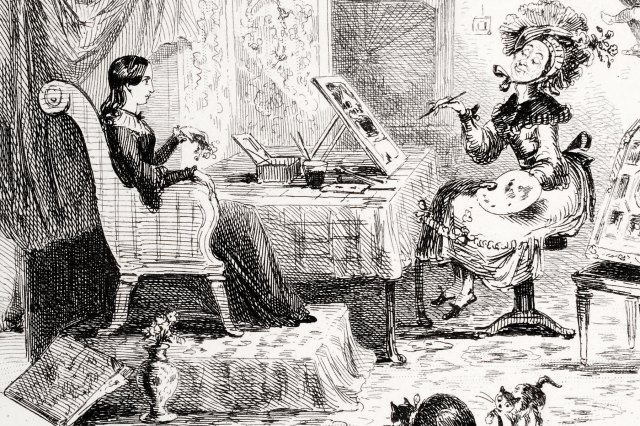
Early Photographers Imitated Portrait Artists 

Though technological limitations are frequently cited as the reason for the solemn expressions in old photographs, it wasn’t the only reason our ancestors so often appeared solemn in front of the camera. One notable feature shared by artist portraits from the 17th and 18th centuries and photographs from the early 19th century is the presence of stoic, enigmatic expressions on the subjects’ faces. As portrait artist Miss La Creevy observes in Charles Dickens’ novel Nicholas Nickleby, only two types of expressions existed in portraiture: “the serious and the smirk.”

Before photography, a painted portrait was the only way to preserve someone’s image for posterity. Having your portrait painted was an activity associated with wealth and social status, and accordingly, the art form had its own rules and expectations. This formal portraiture proved to be a big influence on early photographers, who featured their subjects in ways that represented their social status, occupation, or other interests. The social mores associated with painted portraits carried over into photographic portraiture, and smiling was discouraged.

Photo credit: Heritage Images/ Hulton Archive via Getty Images

Social Etiquette Frowned Upon Smiling

Some historians believe that advancements and accessibility in dental care may have contributed to more smiles eventually being captured on film. Other experts disagree, noting that for centuries, a lack of dental care was the norm and thus wasn’t considered to detract from a person’s physical appeal. Still, smiling for a photograph wasn’t commonplace in the early days of photography. In fact, instead of the modern directive to “say cheese!” to produce a wide, toothy grin, some photographers in Victorian-era England asked people to say “prunes,” forcing them to tighten their lips for a more socially acceptable expression based on the beauty standards and etiquette of the time. 

In an era where open-mouthed grins were considered unacceptable and a smile was believed to signify someone was poor, drunk, lewd, or otherwise corrupt, it was rare for someone to choose to smile in a portrait — and even less likely that a photographer would encourage it. That all changed, however, with Kodak’s democratization of photography in the early 20th century.

Photo credit: Bettmann via Getty Images

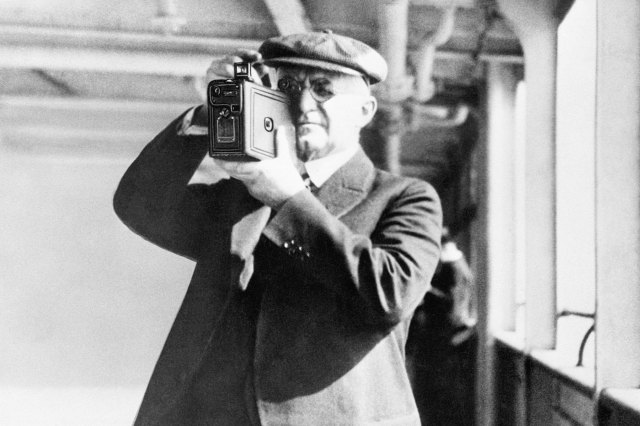
The Kodak Revolution

As photography became more accessible in the late 19th century, a wider variety of people took and sat for photographs, and what was acceptable in portrait photography became less rigid. In 1888, Kodak founder George Eastman started a photographic revolution that put cameras in the hands of amateur photographers and gave them an instruction manual on how to take good photos. In 1900, the Kodak Brownie camera was marketed for children and sold for just $1, creating a photography craze that appealed to adults as well.  

By the 1920s, a century after the first landscape photographs were captured on film, more relaxed postures and a greater variety of expressions, including closed- and open-mouthed smiles, were common in both amateur and professional photography. With the advent of color photography, the popularity of candid photos, and the rise of affordable personal cameras, capturing an array of expressions — including moments of genuine joy — became the gold standard.