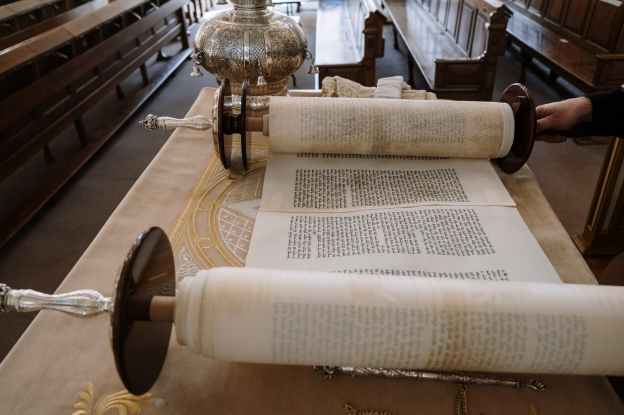
The Jewish New Year begins tomorrow, and I’m guessing some of you don’t know exactly what’s involved. Below is a lovely explanation I read recently.

Interfaith Voices: The Jewish New Year and the possibilities for transformation
by Sari Sapon-White
At sundown on Sept. 15, the Jewish New Year begins.
The first 10 days of the Jewish year, known as the “Yamim Norayim” (Days of Awe), begin with Rosh Hashanah and end with Yom Kippur, the Day of Atonement.
Rosh Hashanah (literally “the head of the year”) is a day to look back on the accomplishments as well as the disappointments of the previous year, and to look forward with hope to the new possibilities that lie ahead.
Unlike the secular New Year, it is not marked with late-night parties or resolutions. Jews typically welcome Rosh Hashanah with a festive family dinner, an evening service that introduces the special melodies that are sung at this season, and a blessing over sliced apples and honey in hopes that sweetness lies ahead.
This evening is followed by a full day (or two) of services that include singing, readings from the Hebrew Bible, and blowing the shofar (ram’s horn), dramatically awakening our spirit and readying us for a heightened level of self-awareness.
But that isn’t the endpoint — in one week it will be Yom Kippur, often considered the holiest day of the Jewish year. The intervening days are spent not in communal prayer but in private reflection.
We are to review our behavior over the past year and identify the ways in which we missed the mark or fell short of the morals and values we aspire to uphold.
While the ultimate purpose of this process is to make things right with God and be granted a new year of life, we are told that we cannot ask God to forgive our failings unless we first ask forgiveness of any fellow human beings whom we have mistreated. This process is known in Hebrew as “heshbon ha-nefesh,” an accounting of the soul.
Yom Kippur has an entirely different tone from Rosh Hashanah; it is marked by a complete fast, simple dress (often white) and a full day of services that include many penitential prayers.
It is an intense experience of prayer that urges us to take responsibility for the ways in which we have failed to be our best selves in our relationships with loved ones, friends, community members, strangers and God.
If it sounds hard, it is. It can feel grueling and emotionally painful. What carries me through is doing this in community with other Jews. When we recite long lists of the ways in which we have strayed, we say the words aloud in unison.
Certainly, no one of us has fallen short in all those ways, but by speaking them together we acknowledge our own failings and express support for those standing next to us who have different but equally challenging habits they also yearn to change.
As the sun begins to set, we hear the final blast of the shofar. Standing together, humbled and vulnerable, we hope to move closer to the version of ourselves we most wish to be in the world.
I recently heard a Jewish spiritual leader propose that we also use this time of year to ask ourselves if there is anything around us that is broken that we did not break, and then consider what we might do toward healing this brokenness.
Taking responsibility for social justice is a core tenet of Judaism, but I see tremendous value in adding this question.
The times we are living through are fraught with inequity, injustice and increasingly frightening manifestations of climate chaos; it feels right and timely to bring the focused intentionality of these days to a broader vision of transformation.
Sari Sapon-White of Corvallis is a writer who also tutors children preparing for their Bar and Bat Mitzvah. She is an active member of the local Jewish community.
 olderfatterhappierdotcom
Thank you Alisa!
Beautifully said.
Btw, do. You forgive me?
😘
LikeLiked by 1 person
I would if you ever did something requiring forgiveness, LOL. But yes of course and vice versa.
LikeLike
Shana tova! – Marty
LikeLiked by 1 person
Shana tova to you and your family, Marty! Alisa
LikeLike
The Jewish High Holidays are a meaningful and spiritually significant time in the Jewish calendar, encompassing Rosh Hashanah and Yom Kippur. These holidays are about reflection, repentance, and renewal. They provide an opportunity for Jewish individuals to come together, seek forgiveness, and strive for personal growth and a stronger connection with God.
LikeLiked by 1 person
Thank you for reading and commenting, Lola. It all seems so long ago in the face of the current attacks. I wish more people understood that Hamas is a terrorist organization like Isis and Al-Qaeda and does not represent the feelings of many Palestinians, who are also victimized by Hamas.
LikeLike