
Monthly Archives: September 2023

Science News: the “Pre-Dinosaur”

Artistic reconstruction of two Pampaphoneus biccai dinosaurs in the middle of the forest eating prey.
Artistic reconstruction of Pampaphoneus biccai. (credit: Original artwork by Márcio Castro)

This ‘bloodthirsty’ predator ruled South America 40 million years before dinosaurs

by StudyFinds

RIO GRANDE DO SUL, Brazil — A 265-million-year-old skull belonging to a terrifying and “bloodthirsty” creature has been discovered in the rural area of São Gabriel, Brazil. According to scientists, this ancient predator, named Pampaphoneus biccai, was the largest meat-eating animal of its time.

An international team of researchers found the “astoundingly well-preserved” skull, along with some ribs and arm bones, during a month-long excavation. Study delays due to the pandemic meant it took an additional three years for the fossil to be cleaned and thoroughly analyzed.

Pampaphoneus lived just before Earth’s largest mass extinction event, which wiped out 86 percent of all animal species worldwide. It belonged to a group of animals known as dinocephalians — large, land-dwelling creatures that included both meat-eaters and plant-eaters. The term “dinocephalian” translates to “terrible head” in Greek, a nod to the group’s notably thick skull bones.

The researchers explain that while well-known in South Africa and Russia, the animals are rare in other parts of the world. Pampaphoneus biccai is the only known species in Brazil.
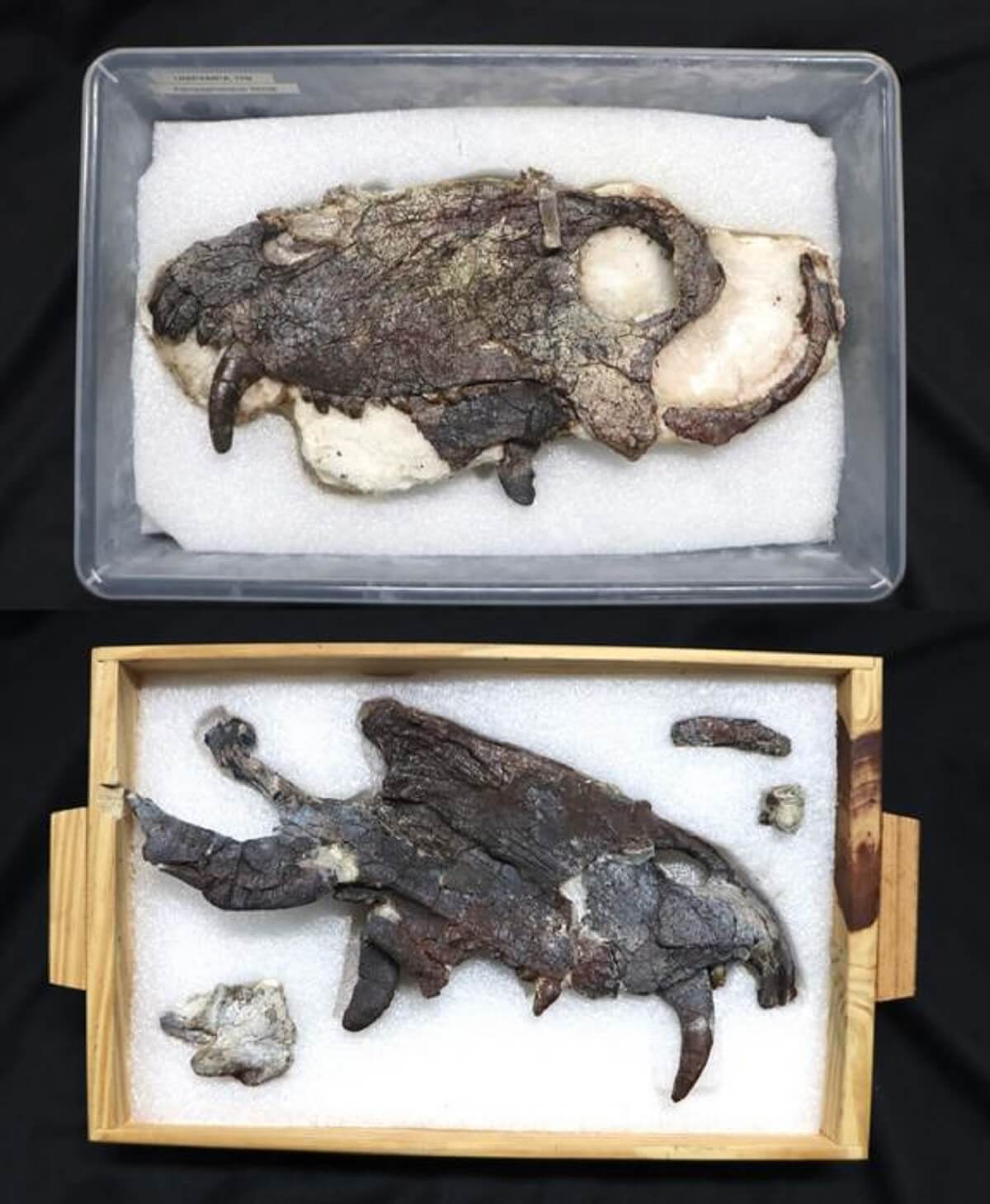
Skull of the new Pampaphoneus biccai specimen... a newly discovered terrestrial predator

Skull of the new Pampaphoneus biccai specimen. (credit: Photo by Felipe Pinheiro)

The skull provides crucial insights into the creature’s morphology, or physical structure, due to the excellent preservation of its bones. It is the second Pampaphoneus skull ever found in South America and is larger than the first.

“Finding a new Pampaphoneus skull after so long was extremely important for increasing our knowledge about the animal, which was previously difficult to differentiate from its Russian relatives,” says Mateus Costa Santos, the study’s lead author from the Federal University of Pampa (UNIPAMPA), in a media release.

Researchers estimate that the largest individuals of this species could have reached nearly 10 feet in length and weighed around 882 pounds. Potential prey for this fearsome creature have also been discovered in the same area, including the small dicynodont Rastodon and the giant amphibian Konzhukovia.

“It was the largest terrestrial predator we know of from the Permian in South America. The animal had large, sharp canine teeth adapted for capturing prey,” says senior author Professor Felipe Pinheiro, also of UNIPAMPA. “Its dentition and cranial architecture suggest that its bite was strong enough to chew bones, much like modern-day hyenas.”

The study also reveals Pampaphoneus fed on small to medium-sized animals.

“This animal was a gnarly-looking beast, and it must have evoked sheer dread in anything that crossed its path. Its discovery is key to providing a glimpse into the community structure of terrestrial ecosystems just prior to the biggest mass extinction of all time,” says co-author Professor Stephanie Pierce of Harvard University.

The research is published in the Zoological Journal of the Linnean Society.

What the Jewish High Holidays are All About

The Jewish New Year begins tomorrow, and I’m guessing some of you don’t know exactly what’s involved. Below is a lovely explanation I read recently.

Photo by Skylar Kang on Pexels.com

Interfaith Voices: The Jewish New Year and the possibilities for transformation

by Sari Sapon-White

At sundown on Sept. 15, the Jewish New Year begins.

The first 10 days of the Jewish year, known as the “Yamim Norayim” (Days of Awe), begin with Rosh Hashanah and end with Yom Kippur, the Day of Atonement.

Rosh Hashanah (literally “the head of the year”) is a day to look back on the accomplishments as well as the disappointments of the previous year, and to look forward with hope to the new possibilities that lie ahead.

Unlike the secular New Year, it is not marked with late-night parties or resolutions. Jews typically welcome Rosh Hashanah with a festive family dinner, an evening service that introduces the special melodies that are sung at this season, and a blessing over sliced apples and honey in hopes that sweetness lies ahead.

This evening is followed by a full day (or two) of services that include singing, readings from the Hebrew Bible, and blowing the shofar (ram’s horn), dramatically awakening our spirit and readying us for a heightened level of self-awareness.

But that isn’t the endpoint — in one week it will be Yom Kippur, often considered the holiest day of the Jewish year. The intervening days are spent not in communal prayer but in private reflection.

We are to review our behavior over the past year and identify the ways in which we missed the mark or fell short of the morals and values we aspire to uphold.

While the ultimate purpose of this process is to make things right with God and be granted a new year of life, we are told that we cannot ask God to forgive our failings unless we first ask forgiveness of any fellow human beings whom we have mistreated. This process is known in Hebrew as “heshbon ha-nefesh,” an accounting of the soul.

Yom Kippur has an entirely different tone from Rosh Hashanah; it is marked by a complete fast, simple dress (often white) and a full day of services that include many penitential prayers.

It is an intense experience of prayer that urges us to take responsibility for the ways in which we have failed to be our best selves in our relationships with loved ones, friends, community members, strangers and God.

If it sounds hard, it is. It can feel grueling and emotionally painful. What carries me through is doing this in community with other Jews. When we recite long lists of the ways in which we have strayed, we say the words aloud in unison.

Certainly, no one of us has fallen short in all those ways, but by speaking them together we acknowledge our own failings and express support for those standing next to us who have different but equally challenging habits they also yearn to change.

As the sun begins to set, we hear the final blast of the shofar. Standing together, humbled and vulnerable, we hope to move closer to the version of ourselves we most wish to be in the world.

I recently heard a Jewish spiritual leader propose that we also use this time of year to ask ourselves if there is anything around us that is broken that we did not break, and then consider what we might do toward healing this brokenness.

Taking responsibility for social justice is a core tenet of Judaism, but I see tremendous value in adding this question.

The times we are living through are fraught with inequity, injustice and increasingly frightening manifestations of climate chaos; it feels right and timely to bring the focused intentionality of these days to a broader vision of transformation.

Sari Sapon-White of Corvallis is a writer who also tutors children preparing for their Bar and Bat Mitzvah. She is an active member of the local Jewish community.

Photo by cottonbro studio on Pexels.com

Chutzpah*

This morning I received an email that leaves me speechless.

Nearly twenty years ago, my son’s friend suddenly and tragically developed lower-body paralysis that left him unable to walk. Of course, friends and family rallied around, donating time and money to help.

Since then, “C” has held down a steady job and gotten married. His wife works. His single mother continues to work and has an excellent income. This woman, someone I considered a friend in those years, pointedly dropped contact after I remarried, moved out of state, and ceased being “useful”. I haven’t heard from her in thirteen years. We are both on FaceBook and my birthday is two days before hers, so I know her lack of contact — even annual birthday wishes — is deliberate. Even when I’ve sent birthday wishes to her.

Back to this morning, when I received a group letter FundMe-type request to contribute to the cost of a new, $80,000 wheelchair-accessible van for the son, who is now nearly 40. WTF?!?

I am biting my lip and fingers to avoid sending her a blistering email in return, but am inclined to simply ignore it.

What would you do?

*”chutzpah” — roughly pronounced “hoots-pah”,ˈho͝otspə,ˈKHo͝otspə”, is a Yiddish word meaning nerve, gall, audacity, supreme self-confidence, and conspicuous boldness.

Photo by Frank Cone on Pexels.com