Tag Archives: bloggers50+

A Fashionable Life: Iris Apfel


Fashion Icon Iris Apfel Dead at 102

Apfel was known for her love of colors and prints and created collections for HSN, H&M and more

By Hedy Phillips

H&M AND IRIS APFEL CELEBRATE THE IRIS APFEL X H&M COLLECTION WITH AN INTIMATE LUNCHEON IN PALM BEACH
PHOTO: COURTESY H&M

Fashion icon Iris Apfel has died at age 102 on Friday, a statement published on her Instagram page confirmed.

Stu Loeser, a spokesman for Apfel’s estate, also confirmed her death to the New York Times. She died at her home in Palm Beach, Fla.

Iris Apfel x Ciate London
COURTESY CIATE LONDON

 Iris Apfel Celebrates Turning 100 by Sharing Her Best Lessons on Love, Life and Plastic Surgery

Apfel celebrated her iconic 100th birthday in 2021, telling PEOPLE that she considers herself to be an Energizer Bunny who simply loves to work — which she did for her entire life.

“At 100, what else is there to do except sit around? I don’t play bridge. I don’t play golf. I love to work, and I really enjoy what I do,” she shared.

Among those projects were a clothing collection with H&M and a beauty collection with Ciáte London, both in 2022. Both gave the creative an outlet to channel her love of colors and patterns.

“The world can be a gray place, so colors, patterns and textures are a way to bring some fun to life. Same with makeup — I want my lipsticks to be as bright and bold as possible,” she told PEOPLE in August 2022.

Iris Apfel with her birthday cake at her 100th Birthday Party at Central Park Tower on September 09, 2021 in New York City.
PATRICK MCMULLAN/GETTY

Apfel has become known over the years for her love of colors — and her oversize black-framed glasses. The style icon never set out to be known for her glasses, though. It was purely happenstance. “I always thought eyeglass frames were very stylish accessories,” she told PEOPLE in 2015, adding that she liked to pick up unique frames at flea markets.

“People would say to me, ‘why are they so large?’ and I would say because they are good to see you,” she said, adding, “And that would shut them up.”

Iris Apfel
Carl and Iris Apfel in 2008. PATRICK MCMULLAN/GETTY

Though Apfel became a fashion giant in her twilight years, she spent her early years as an interior designer and textile expert. After marrying husband Carl Apfel in 1947, the two started Old World Weavers, a textile company that called the likes of Greta Garbo, Estée Lauder and Marjorie Merriweather Post their clients in the 1950s, according to The New York Times.

Together the Apfels did White House restorations for nine sitting presidents, though the couple took a backseat at the company in 1992 when Stark Carpet took over Old World Weavers.

It wasn’t until the 2000s when Apfel — who told the Guardian in 2018 that she’d like to be remembered as the “world’s oldest living teenager” — started to truly be recognized for her penchant for fashion. After decades of collecting pieces from flea markets and beyond, an exhibit of her fashion finds was opened at New York’s Metropolitan Museum of Art.

Titled “Rara Avis,” the exhibit opened in 2005 featuring Apfel’s accessories along with fully styled looks she’d worn. She jokingly told The New York Times when the exhibit opened, “This is no collection. It’s a raid on my closet,” adding, “I always thought to show at the Met you had to be dead.”

Iris Apfel
Carl and Iris Apfel, cira 1970s. COURTESY IRIS APFEL

 Fashion Icon Iris Apfel Partners with Ciaté London on Vibrant New Collection

From there, she was the subject of a documentary called Iris in 2014, directed by Albert Maysles, and worked as a visiting professor at the University of Texas. She told Vogue in 2015 that the university asked her to help “beef up” their fashion program, which she did with gusto, showing the students that fashion isn’t always glamorous.

“I expose them to important jobs in licensing, styling, back-of-museum work, and on and on,” she said, adding that through her program, she would bring students to New York to show them an “intensive” week in the fashion capital. “It has just been mind-boggling for them. They just go bananas. And I’ve learned so much.”

Apfel was born on Aug. 29, 1921, in Queens, New York, and was preceded in death by her husband, who died in 2015 at age 100. She told PEOPLE in 2020 of his death, “We had done everything together and I was devastated.” However, she continued to work, going as far as calling herself a “workaholic.”

celeb-hsn-lines-1

 Iris Apfel Partners with H&M on a New Collection: ‘They Let Me Do What I Wanted’

In the last decade of her life, Apfel got real about aging and why she continues to work past the point when many people choose to slow down. She told Today in 2022, “Oh, I love to work. It’s fun because I enjoy it. … I think retiring at any age is a fate worse than death. Just because a number comes up doesn’t mean you have to stop.”

She lived a busy, fulfilling life with no regrets, which she described to Harper’s Bazaar UK in early 2022. She reiterated that there’s nothing in life that she regrets or wishes she’d known earlier, adding, “I don’t live backwards or forwards; I live in the now.”

Hamas are terrorists not ‘militants’ – Why won’t the media get it right?

I don’t normally address politics in this blog but this is too important to ignore. The writer addresses some uncomfortable truths we all need to understand. I’ve highlighted some key points.

Hamas are terrorists not ‘militants’ – Why won’t the media get it right?

Hamas’ charter needs to be taken seriously, it calls for the obliteration of Israel and its replacement with an Islamic state and the obliteration of Jews.

By DAVID BREAKSTONE
The destruction caused by Hamas Militants in Kibbutz Be'eri, near the Israeli-Gaza border, in southern Israel, October 11, 2023. (photo credit: OREN BEN HAKOON/FLASH90)The destruction caused by Hamas Militants in Kibbutz Be’eri, near the Israeli-Gaza border, in southern Israel, October 11, 2023. (photo credit: OREN BEN HAKOON/FLASH90)

I just checked. For anyone harboring any doubts, the horror of 9/11 was perpetrated by terrorists. Every American newspaper and news station reported it that way. Curious, then, that so many of the world’s most respectable news outlets, including CNN and The New York Times, are now reporting that the barbarism recently visited upon Israel was perpetrated by militants.

Militants: those intensely devoted to a cause, promoting their beliefs with the full power of their convictions, but not generally violent. I may not be totally objective, but that doesn’t sound to me a particularly fitting description of those who indiscriminately butcher babies, rape women, slaughter young festival goers, murder children in front of their parents and parents in front of their children, pile handcuffed civilians upon one another and burn them alive, and ruthlessly abduct infants and the infirm along with everyone in-between.

The savagery and the numbers are staggering. The more than 1300 dead, 3600 wounded, and 199 hostages are proportionally far greater than the casualties of the heinous attack on the Twin Towers. Ten deaths for every million Americans back then; 140 for every million Israelis today. Why, then, the refusal to call out Hamas for being the heinous terrorist organization it is? Antisemitism is too easy an answer. There may be an element of that in the equation, but it is far from a sufficient explanation.

The reason may be better attributed to the inconceivably lingering perception of Hamas as a humanitarian organization, concerned with the welfare of the Palestinian people, which is how it presented itself to the world when it came to power in Gaza in 2007. That, along with the persistent perception that it is Israel and its policies that are the root cause of the sadistic violence that has now erupted with unprecedented depravity. As casualties in Gaza continue to mount and as the humanitarian crisis there continues to deepen, demands that Israel explain itself are going to become increasingly strident. That might not be fair, but it’s already happening.The destruction caused by Hamas Militants in Kibbutz Be'eri, near the Israeli-Gaza border, in southern Israel, October 14, 2023.  (credit: Omer Fichman/Flash90)The destruction caused by Hamas Militants in Kibbutz Be’eri, near the Israeli-Gaza border, in southern Israel, October 14, 2023. (credit: Omer Fichman/Flash90)

SOME QUESTIONS and answers, then, for those prepared to take on our detractors:

1. Isn’t Israel’s occupation of the West Bank the real reason for the Hamas invasion of Israel – and doesn’t the cycle of violence that Israel and Hamas have been caught up in for years suggest that one side is as much to blame as the other?

While Hamas indeed declares its aim is to end the “occupation,” the occupation it seeks to end is that of the entire State of Israel. Israel’s 1998 offer to withdraw from 96% of the West Bank as part of a comprehensive peace plan was summarily rejected by the Palestinians. Its 2005 unilateral withdrawal from Gaza, rather than being welcomed as a harbinger of peace, has been met with a 17-year barrage of tens of thousands of rockets targeting civilians.

Hamas’ charter needs to be taken seriously. It asserts that “Palestine is an Islamic Waqf, land consecrated for Muslim generations until Judgement Day” and calls for the obliteration of Israel and its replacement with an Islamic state extending from the Jordan River to the Mediterranean Sea (Article 11), an objective fueled by vitriolic hatred of the Jew. “The Day of Judgment will not come about until Muslims fight the Jews, when the Jew will hide behind stones and trees. The stones and trees will say, ‘O Muslim, O servant of Allah, there is a Jew behind me, come and kill him’” (Article 7), precisely the harrowing script played out on October 7.

Israel’s genuine desire for peace was signaled by its unilateral withdrawal from Gaza in 2005 and its ongoing efforts at rapprochement, which have been steadfastly rebuffed by Hamas who has remained true to its unequivocal declaration: “There is no solution for the Palestinian question except through armed struggle [and that] so-called peaceful solutions… are in contradiction to the principles of Hamas” (Article 13), decrying any attempt by Arab countries to enter into a peace agreement with Israel as a betrayal of Islam (Article 32).

In contrast, Israel has consistently advocated for a two-state solution to end the conflict. There is no case to be made for moral equivalency in judging the two sides joined in battle. Regardless, there is no justification for the war crimes committed by Hamas, deliberately targeting Israel’s civilian population while using its own as a human shield to deter Israeli retaliation.

2. Doesn’t Israel’s stranglehold on Gaza leave Hamas with no choice but to resort to violence?

After its 2005 withdrawal, Israel signed an Agreement on Movement and Access with the Palestinian Authority. It would have granted the Palestinians control over their own borders, allowed for imports and exports, and the construction of a seaport. Then came the 2006 elections in Gaza which brought Hamas to power after a bloody struggle that decimated the Palestinian Authority and rendered the accord obsolete. Nevertheless, Israel has continually facilitated the import of humanitarian aid and the supply of electricity and water. This continued even as Hamas channeled the massive amounts of building supplies and billions of dollars it received for construction of hospitals and schools into the construction of tunnels and the procurement of weapons for attacks against Israel’s civilian population rather than serving the needs of its own.

Still, right up until Hamas launched its brutal attack, Israel was allowing 18,000 Gazans daily to cross its border for work.

3. Even if Israel has a legitimate right to retaliate against the massacre of its citizens, doesn’t the death toll of Palestinians relative to the number of Israeli casualties indicate a disproportionate response on its part?

The death of every innocent Palestinian is a tragedy, and Israel, abiding by the rules of war, has been doing its utmost to avoid that. The problem is, that while Israel uses its weapons to defend its people, Hamas is using its people to defend its weapons. It not only launches rockets from schools, hospitals, and mosques, but endeavors to prevent civilians from evacuating areas Israel has expressly warned them to leave.

What does proportionality mean?

As to proportionality, what would that mean? Killing the same number of civilians in Gaza as Hamas slaughtered in Israel? That would be tit-for-tat, revenge, retribution. Israel has no interest in that. It wants only to render Hamas incapable of inflicting any further casualties on its citizenry. Ever. Its resolve in this regard is ironclad. Hamas will have to decide how many of its own civilians it is prepared to sacrifice in its attempt to save itself. In the meantime, Israel is doing what it can to mitigate the suffering of Gaza’s civilian population, having established a corridor for the safe passage between Gaza and Egypt of civilians and the humanitarian aid they require. These are all things the world needs to know. Words matter.

The Hamas Charter matters. Hamas’s actions matter even more. Its members are terrorists, not militants, and the victims of the October 7 massacre, and the entire enlightened world Hamas threatens, deserves to hear the story told as it is.

The writer is currently engaged in establishing the Navon Center for a Shared Society. He previously served as deputy chair of the Jewish Agency and World Zionist Organization and was the founding director of the Herzl Museum and Educational Center.  breakstonedavid@gmail.com

Science News: the “Pre-Dinosaur”

Artistic reconstruction of two Pampaphoneus biccai dinosaurs in the middle of the forest eating prey.
Artistic reconstruction of Pampaphoneus biccai. (credit: Original artwork by Márcio Castro)

This ‘bloodthirsty’ predator ruled South America 40 million years before dinosaurs

by StudyFinds

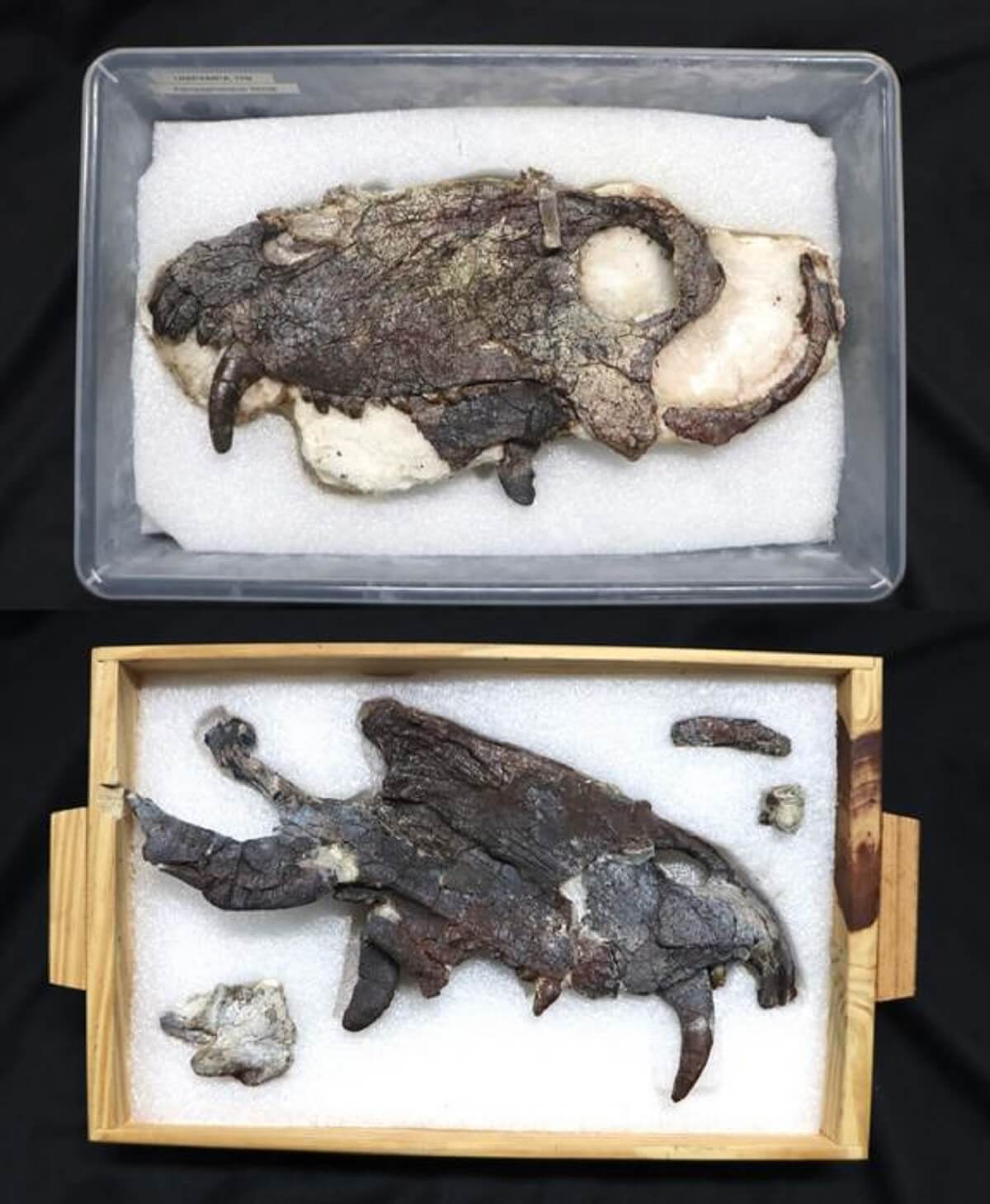
RIO GRANDE DO SUL, Brazil — A 265-million-year-old skull belonging to a terrifying and “bloodthirsty” creature has been discovered in the rural area of São Gabriel, Brazil. According to scientists, this ancient predator, named Pampaphoneus biccai, was the largest meat-eating animal of its time.

An international team of researchers found the “astoundingly well-preserved” skull, along with some ribs and arm bones, during a month-long excavation. Study delays due to the pandemic meant it took an additional three years for the fossil to be cleaned and thoroughly analyzed.

Pampaphoneus lived just before Earth’s largest mass extinction event, which wiped out 86 percent of all animal species worldwide. It belonged to a group of animals known as dinocephalians — large, land-dwelling creatures that included both meat-eaters and plant-eaters. The term “dinocephalian” translates to “terrible head” in Greek, a nod to the group’s notably thick skull bones.

The researchers explain that while well-known in South Africa and Russia, the animals are rare in other parts of the world. Pampaphoneus biccai is the only known species in Brazil.

Skull of the new Pampaphoneus biccai specimen... a newly discovered terrestrial predator

Skull of the new Pampaphoneus biccai specimen. (credit: Photo by Felipe Pinheiro)

The skull provides crucial insights into the creature’s morphology, or physical structure, due to the excellent preservation of its bones. It is the second Pampaphoneus skull ever found in South America and is larger than the first.

“Finding a new Pampaphoneus skull after so long was extremely important for increasing our knowledge about the animal, which was previously difficult to differentiate from its Russian relatives,” says Mateus Costa Santos, the study’s lead author from the Federal University of Pampa (UNIPAMPA), in a media release.

Researchers estimate that the largest individuals of this species could have reached nearly 10 feet in length and weighed around 882 pounds. Potential prey for this fearsome creature have also been discovered in the same area, including the small dicynodont Rastodon and the giant amphibian Konzhukovia.

“It was the largest terrestrial predator we know of from the Permian in South America. The animal had large, sharp canine teeth adapted for capturing prey,” says senior author Professor Felipe Pinheiro, also of UNIPAMPA. “Its dentition and cranial architecture suggest that its bite was strong enough to chew bones, much like modern-day hyenas.”

The study also reveals Pampaphoneus fed on small to medium-sized animals.

“This animal was a gnarly-looking beast, and it must have evoked sheer dread in anything that crossed its path. Its discovery is key to providing a glimpse into the community structure of terrestrial ecosystems just prior to the biggest mass extinction of all time,” says co-author Professor Stephanie Pierce of Harvard University.

The research is published in the Zoological Journal of the Linnean Society.

Tulip Time

“Oh to be in Holland now the tulips are in bloom” (with apologies to Robert Browning)! We’ve just returned from a relaxing two weeks in The Netherlands and Belgium and I was eager to post photos except that my computer died over the weekend😩!!! Ah technology— can’t live with it/can’t live without it. Fingers crossed the iPad keeps functioning.

The shots below are from the glorious Keukenhof Gardens in Amsterdam.

Annual indoor tulip extravaganza
Keukenhof in bloom


I also learned a great trick for keeping tulips from getting all droopy. For years I’ve used the old method of adding copper pennies to the vase, but this works better:

When you bring your flowers home, do not unwrap them. Simply place the wrapped tulips in a container of cool room temperature water and leave them to ”acclimate” for 2 hours. After they’ve rested, you can unwrap the flowers, trim the stems about 1/2” on the diagonal, and transfer to a vase.

On day 5, mine are still upright. Happy Spring, everyone!

Money Isn’t the Root of All Evil

Jealousy is.

Money can fund philanthropy, the arts, technical innovation, beauty, medical breakthroughs, and many public services we take for granted.

Jealousy has a lot less to recommend it (though it might provoke healthy competition).

In our tiny neighborhood, jealousy has recently run amok. Sometimes expressed in the loathsome designations “up the hill” or “down the hill”, we’ve got an awful lot of neighbors (in both senses) obsessively focused on who has a better view, a nicer house, a prettier yard, or an apparently easier life.

Oh, this is seldom verbalized in any direct way. The jealousy is cloaked in righteous indignation: “Those damn so-and-so’s are breaking the rules again!” by allowing their dog to escape the yard and do its business “wherever it chooses”. The finger-pointers didn’t bothered to learn that said dog was dying of cancer and unable to control its bodily functions. (Dog died=problem solved=do move on, please.)

Then, there are false and oft-repeated claims that the committee responsible for managing the landscaper’s schedule spends the budget keeping the areas near the ocean looking good “for the benefit of the people who live down the hill”. Yet, these same folks are the first to grumble if their view becomes overgrown.

And finally, complaints about matters long since resolved, such as whether someone’s outdoor lighting is too bright. (Consider: #1 There are no street lamps in the community, #2 Ever thought about getting window shades?, #3 Maybe if you asked nicely?)

Sheesh. Have a nice glass of vitriol and (don’t) call me in the morning. I’ll be working on my next rant.

Photo by Pixabay on Pexels.com

How Do You Remember?

After many years together, I’ve recently discovered that my dear husband (DH) and I have very different ways of recalling events that have happened to us. This isn’t about what we remember (or block out, as the case may be!) but how we recreate those situations in our minds.

DH, who is an artist, remembers as if he were watching a movie. It is completely visual.

I, on the other hand, remember as if I were reading a novel; that is, while I might visualize certain aspects of the story, the narrative is generally descriptive and verbal.

I found this quite fascinating, and it makes me wonder how you, my dear readers and bloggers, remember things. SInce most of you are writers, do you also imagine a story being told to you? Or do you conjure up vivid pictures?

Dreams are quite different, I think, as they seem to always be visual, whether we are involved as characters or as onlookers. Is this true for you? Do share!

Photo by Luis Quintero on Pexels.com